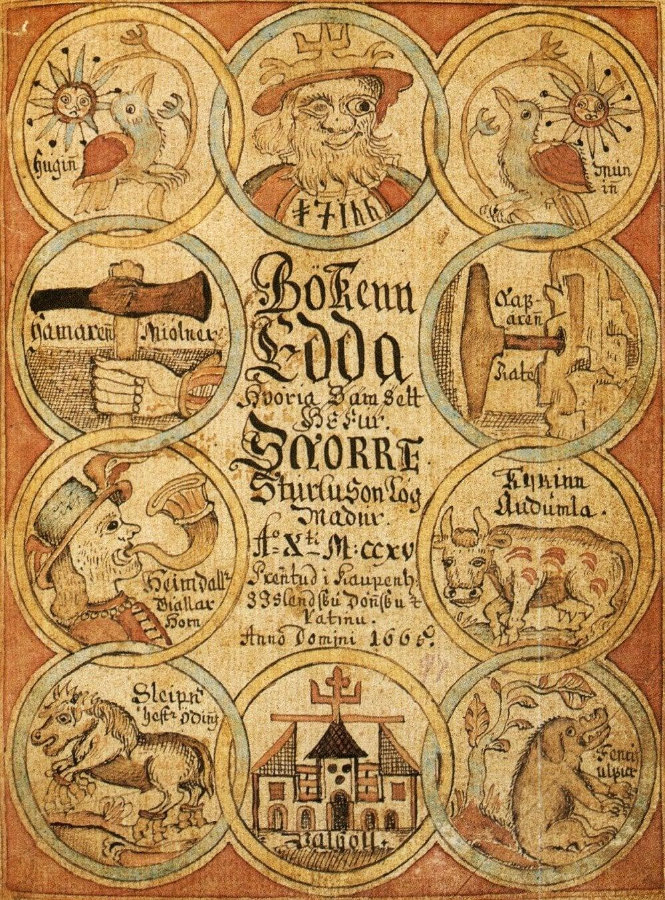
In Norse mythology, Gróa is a völva (seeress) and practitioner of seiðr, a type of magic. She is the wife of Aurvandil the Bold. Groa was also the goddess of knowledge. Gróa appears in the Prose Edda book Skáldskaparmál, in the context of Thor’s battle with the jötunn Hrungnir. After Thor has dispatched Hrungnir with the hammer Mjollnir, Gróa is asked to help magically remove shards of Hrungnir’s whetstone which became embedded in Thor’s head. Unfortunately while Gróa was about her work, Thor distracted her by telling her of how he had earlier helped Aurvandil cross the river Élivágar, and had saved her husband’s life by snapping off his frost-bitten toe. Gróa’s spell miscarried and the pieces of whetstone remained permanently embedded in Thor’s head. Gróa is also a völva (or seeress), summoned from beyond the grave, in the Old Norse poem Grógaldr, (a section of Svipdagsmál), by her son Svipdagr. In death she has lost none of her prophetic powers, and is able to assist him in a successful conclusion of the task which he has been set by his cruel stepmother. It is possible that this second Gróa is the same as the first one, but the poem is a late 17th-century imitation of the Edda.
Appearance List Literary: Prose Edda (c. 1220 CE) by Snorri Sturluson; Poetic Edda (c. 1270 CE); Northern Mythology (1851–1852) by Benjamin Thorpe [Internet Archive]; Asgard Stories: Tales from Norse Mythology (1901) by Mary H. Foster and Mabel H. Cummings [Internet Archive]; In the Days of Giants: A Book of Norse Tales by Abbie Farwell Brown (1902) [Internet Archive]; The Elder or Poetic Edda (1908) [Internet Archive]; The Heroes of Asgard: Tales from Scandinavian Mythology by Keary and Keary (1909) [Internet Archive]; Teutonic Myths and Legends (1912) by Donald A. Mackenzie [Internet Archive]; The Children of Odin (1920) by Padraic Colum [Internet Archive].
Description In Norse mythology, Gróa is a völva (seeress) and practitioner of seiðr, a type of magic. She is the wife of Aurvandil the Bold. Groa was also the goddess of knowledge. Gróa appears in the Prose Edda book Skáldskaparmál, in the context of Thor’s battle with the jötunn Hrungnir. After Thor has dispatched Hrungnir with the hammer Mjollnir, Gróa is asked to help magically remove shards of Hrungnir’s whetstone which became embedded in Thor’s head. Unfortunately while Gróa was about her work, Thor distracted her by telling her of how he had earlier helped Aurvandil cross the river Élivágar, and had saved her husband’s life by snapping off his frost-bitten toe. Gróa’s spell miscarried and the pieces of whetstone remained permanently embedded in Thor’s head. Gróa is also a völva (or seeress), summoned from beyond the grave, in the Old Norse poem Grógaldr, (a section of Svipdagsmál), by her son Svipdagr. In death she has lost none of her prophetic powers, and is able to assist him in a successful conclusion of the task which he has been set by his cruel stepmother. It is possible that this second Gróa is the same as the first one, but the poem is a late 17th-century imitation of the Edda.