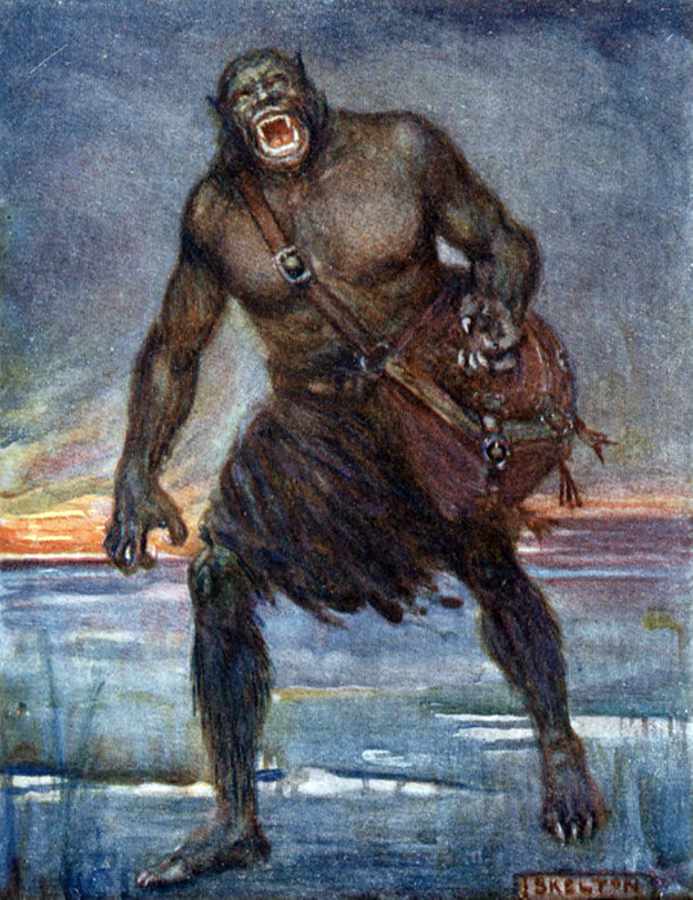
Grendel is a character in the poem Beowulf, preserved in the Nowell Codex. Grendel, being cursed as the descendant of the Biblical Cain, is “harrowed” by the sounds of singing that come every night from the mead-hall of Heorot built by King Hrothgar. He is unable to bear it any more and attacks Heorot. Grendel continues to attack the Hall every night for twelve years, killing its inhabitants and making this magnificent mead-hall unusable. To add to his monstrous description the poet details how Grendel consumes the men he kills; “now that he could hope to eat his fill.” Beowulf hears of these attacks and leaves his native land of the Geats to destroy Grendel. He is warmly welcomed by King Hrothgar, who gives a banquet in celebration. Afterwards Beowulf and his warriors bed down in the mead hall to await the inevitable attack of the creature. Grendel stalks outside the building for a time, spying the warriors inside. He then makes a sudden attack, bursting the door with his fists and continuing through the entry. The first warrior Grendel finds is still asleep, so he seizes the man and devours him. Grendel grabs a second warrior, but is shocked when the warrior grabs back with fearsome strength. As Grendel attempts to disengage, the reader discovers that Beowulf is that second warrior. Beowulf uses neither weapon nor armour in this fight. He also places no reliance on his companions and had no need of them. He trusts that God has given him strength to defeat Grendel, whom he believes is God’s adversary. Finally Beowulf tears off Grendel’s arm, mortally wounding the creature. Grendel flees but dies in his marsh den. There, Beowulf later engages in a fierce battle with Grendel’s mother, over whom he triumphs. Following her death, Beowulf finds Grendel’s corpse and removes his head, which he keeps as a trophy. Beowulf then returns to the surface and to his men at the “ninth hour” (l. 1600, “nōn”, about 3 pm). He returns to Heorot, where a grateful Hrothgar showers him with gifts.
Appearance List Literature: Beowulf (Old English epic poem, written ~975–1025 CE), Beowulf by Francis Barton Gummere (1910) [Internet Archive], Beowulf: An Anglo-Saxon Epic Poem (Project Gutenberg), Bulfinch’s Mythology by Thomas Bulfinch, et. al. Comics: Conquest #1 (Famous Funnies): The tale of Beowulf, Hercules (Charlton).
Sample Read The story of Beowulf: translated from Anglo-Saxon into modern English prose [Internet Archive]
Description Grendel is a character in the poem Beowulf, preserved in the Nowell Codex. Grendel, being cursed as the descendant of the Biblical Cain, is “harrowed” by the sounds of singing that come every night from the mead-hall of Heorot built by King Hrothgar. He is unable to bear it any more and attacks Heorot. Grendel continues to attack the Hall every night for twelve years, killing its inhabitants and making this magnificent mead-hall unusable. To add to his monstrous description the poet details how Grendel consumes the men he kills; “now that he could hope to eat his fill.” Beowulf hears of these attacks and leaves his native land of the Geats to destroy Grendel. He is warmly welcomed by King Hrothgar, who gives a banquet in celebration. Afterwards Beowulf and his warriors bed down in the mead hall to await the inevitable attack of the creature. Grendel stalks outside the building for a time, spying the warriors inside. He then makes a sudden attack, bursting the door with his fists and continuing through the entry. The first warrior Grendel finds is still asleep, so he seizes the man and devours him. Grendel grabs a second warrior, but is shocked when the warrior grabs back with fearsome strength. As Grendel attempts to disengage, the reader discovers that Beowulf is that second warrior. Beowulf uses neither weapon nor armour in this fight. He also places no reliance on his companions and had no need of them. He trusts that God has given him strength to defeat Grendel, whom he believes is God’s adversary. Finally Beowulf tears off Grendel’s arm, mortally wounding the creature. Grendel flees but dies in his marsh den. There, Beowulf later engages in a fierce battle with Grendel’s mother, over whom he triumphs. Following her death, Beowulf finds Grendel’s corpse and removes his head, which he keeps as a trophy. Beowulf then returns to the surface and to his men at the “ninth hour” (l. 1600, “nōn”, about 3 pm). He returns to Heorot, where a grateful Hrothgar showers him with gifts.