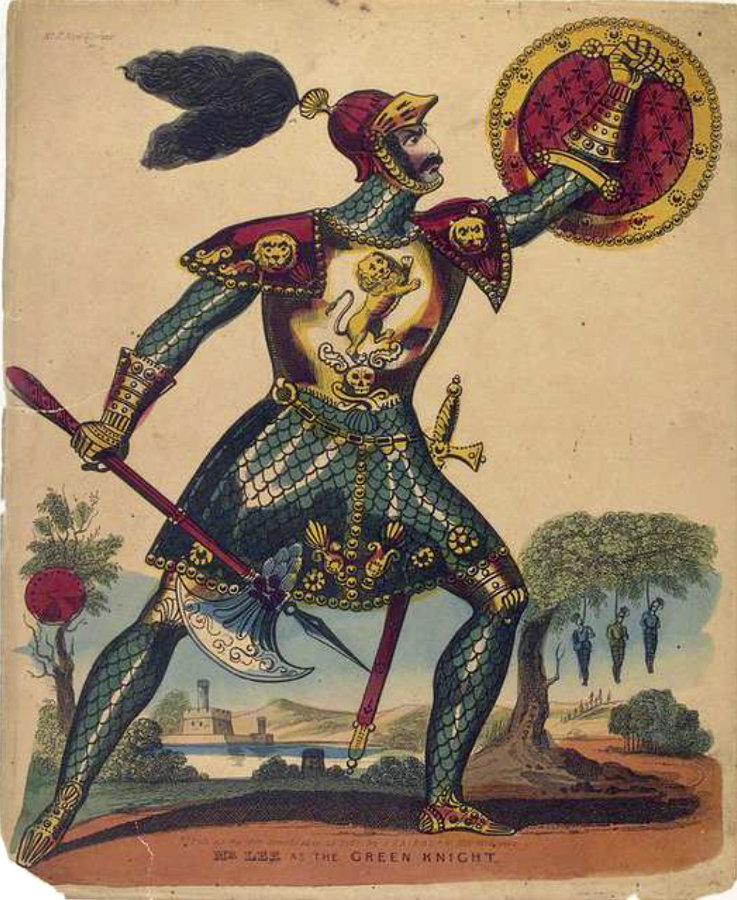
The Green Knight is a heroic character of the Matter of Britain, originating in the 14th-century poem Sir Gawain and the Green Knight and the related medieval work The Greene Knight. His true name is revealed to be Bertilak de Hautdesert (spelled in some translations as “Bercilak” or “Bernlak”) in Sir Gawain, while The Greene Knight names him “Bredbeddle”. The Green Knight later features as one of Arthur’s greatest champions in the fragmentary ballad King Arthur and King Cornwall, again with the name “Bredbeddle”. In Sir Gawain and the Green Knight, Bertilak is transformed into the Green Knight by Morgan le Fay, a traditional adversary of King Arthur of around half-giant size, to test his court. However, in The Greene Knight, he is transformed by a different woman for the same purpose. In both stories, he sends his wife to seduce Gawain as a further test. The King Arthur and King Cornwall ballad portrays him as an exorcist and one of the most powerful knights of Arthur’s court. His wider role in Arthurian literature includes being a judge and tester of knights, and as such, the other characters consider him as friendly but terrifying and somewhat mysterious. In Sir Gawain, the Green Knight is so called because his skin and clothes are green as well as sporting a “big as a bush” beard. The meaning of his greenness has puzzled scholars. Some identify him as the Green Man, a vegetation being of medieval art; others as a recollection of a figure from Celtic mythology; a Christian “pagan” symbol – the personified Devil. The medievalist C. S. Lewis said the character was “as vivid and concrete as any image in literature.” Scholar J. A. Burrow called him the “most difficult character” to interpret.
Alias The Green Knight
Real Names/Alt Names Bertilak de Hautdesert, Marchog Gwyrdd, Marghek Gwyrdh, Marc’heg Gwer
Appearance List Sir Gawain and the Green Knight (late 14th c.) by Anonymous (“Gawain Poet”); The Greene Knight (c. 1500); King Arthur and King Cornwall; Syr Gawayne (1765, published in Reliques of Ancient English Poetry) by Thomas Percy; Sir Gawayne and the Green Knight (1864) by Richard Morris; Sir Gawain and the Green Knight (1897) by Israel Gollancz; Sir Gawain and the Green Knight (1898) by Jessie L. Weston; The Story of King Arthur and His Knights (1903) by Howard Pyle [Internet Archive]; The Story of Sir Launcelot and His Companions (1907) by Howard Pyle [Internet Archive]; Sir Gawain and the Green Knight by J.R.R. Tolkein (published 1975). Film: Gawain and the Green Knight (1973) by Stephen Weeks.
Sample Read Sir Gawain and the Green Knight (1929) [Internet Archive]
Description The Green Knight is a heroic character of the Matter of Britain, originating in the 14th-century poem Sir Gawain and the Green Knight and the related medieval work The Greene Knight. His true name is revealed to be Bertilak de Hautdesert (spelled in some translations as “Bercilak” or “Bernlak”) in Sir Gawain, while The Greene Knight names him “Bredbeddle”. The Green Knight later features as one of Arthur’s greatest champions in the fragmentary ballad King Arthur and King Cornwall, again with the name “Bredbeddle”. In Sir Gawain and the Green Knight, Bertilak is transformed into the Green Knight by Morgan le Fay, a traditional adversary of King Arthur of around half-giant size, to test his court. However, in The Greene Knight, he is transformed by a different woman for the same purpose. In both stories, he sends his wife to seduce Gawain as a further test. The King Arthur and King Cornwall ballad portrays him as an exorcist and one of the most powerful knights of Arthur’s court. His wider role in Arthurian literature includes being a judge and tester of knights, and as such, the other characters consider him as friendly but terrifying and somewhat mysterious. In Sir Gawain, the Green Knight is so called because his skin and clothes are green as well as sporting a “big as a bush” beard. The meaning of his greenness has puzzled scholars. Some identify him as the Green Man, a vegetation being of medieval art; others as a recollection of a figure from Celtic mythology; a Christian “pagan” symbol – the personified Devil. The medievalist C. S. Lewis said the character was “as vivid and concrete as any image in literature.” Scholar J. A. Burrow called him the “most difficult character” to interpret.

 ,
,