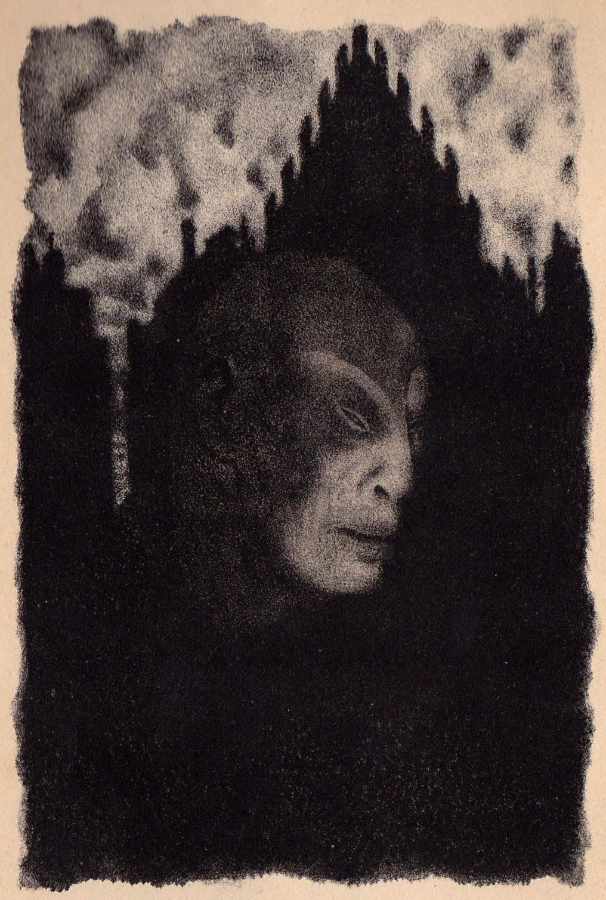
A golem is an animated, anthropomorphic being in Jewish folklore, which is entirely created from inanimate matter (usually clay or mud). The most famous golem narrative involves Judah Loew ben Bezalel, the late 16th-century rabbi of Prague. According to Moment magazine, “the golem is a highly mutable metaphor with seemingly limitless symbolism. It can be a victim or villain, Jew or non-Jew, man or woman—or sometimes both. Over the centuries, it has been used to connote war, community, isolation, hope, and despair.” The word golem occurs once in the Bible in Psalm 139:16, which uses the word for “my light form”, “raw” material, connoting the unfinished human being before God’s eyes. The Mishnah uses the term for an uncultivated person: “Seven characteristics are in an uncultivated person, and seven in a learned one”. In Modern Hebrew, golem is used to mean “dumb” or “helpless”. Similarly, it is often used today as a metaphor for a mindless lunk or entity that serves a man under controlled conditions, but is hostile to him under other conditions. “Golem” passed into Yiddish as goylem to mean someone who is lethargic or beneath a stupor. The oldest stories of golems date to early Judaism. In the Talmud, Adam was initially created as a golem when his dust was “kneaded into a shapeless husk”. Like Adam, all golems are created from mud by those close to divinity, but no anthropogenic golem is fully human. It was believed that golems could be activated by an ecstatic experience induced by the ritualistic use of various letters of the Hebrew alphabet forming a “shem” (any one of the Names of God), wherein the shem was written on a piece of paper and inserted in the mouth or in the forehead of the golem. A golem is inscribed with Hebrew words in some tales, such as the word emét (“truth” in Hebrew) written on its forehead. The golem could then be deactivated by removing the aleph in emét, thus changing the inscription from “truth” to “death”. The most famous golem narrative involves Judah Loew ben Bezalel, the late 16th-century rabbi of Prague, also known as the Maharal, who reportedly “created a golem out of clay from the banks of the Vltava River and brought it to life through rituals and Hebrew incantations to defend the Prague ghetto from anti-Semitic attacks and pogroms”. Depending on the version of the legend, the Jews in Prague were to be either expelled or killed under the rule of Rudolf II, the Holy Roman Emperor. The Golem was called Josef and was known as Yossele. He was said to be able to make himself invisible and summon spirits from the dead. Rabbi Loew deactivated the Golem on Friday evenings by removing the shem before the Sabbath (Saturday) began, so as to let it rest on Sabbath. One Friday evening, Rabbi Loew forgot to remove the shem, and feared that the Golem would desecrate the Sabbath. A different story tells of a golem that fell in love, and when rejected, became the violent monster seen in most accounts. Some versions have the golem eventually going on a murderous rampage. The rabbi then managed to pull the shem from his mouth and immobilize him in front of the synagogue, whereupon the golem fell in pieces. The Golem’s body was stored in the attic genizah of the Old New Synagogue, where it would be restored to life again if needed. Rabbi Loew then forbade anyone except his successors from going into the attic. According to legend, the body of Rabbi Loew’s Golem still lies in the synagogue’s attic. When the attic was renovated in 1883, no evidence of the Golem was found. Some versions of the tale state that the Golem was stolen from the genizah and entombed in a graveyard in Prague’s Žižkov district, where the Žižkov Television Tower now stands. A recent legend tells of a Nazi agent ascending to the synagogue attic, dying under suspicious circumstances thereafter.
Appearance List Classical & Rabbinic Sources: Sefer Yetzirah (c. 3rd–6th century CE) by traditional attribution to Abraham, Talmud Sanhedrin 65b (c. 5th century CE) by Babylonian rabbis, Sefer ha-Iyyun (13th century) by anonymous Kabbalist, Sefer ha-Ḥesheq (13th century) by Eleazar of Worms, Prague Golem Legends (16th century) attributed to Rabbi Judah Loew ben Bezalel (Maharal), Nifla’ot Maharal im ha-Golem (1909) by Yudl Rosenberg. Modern Literary & Film: Der Golem (1915) by Gustav Meyrink, The Golem (1920) film by Paul Wegener and Carl Boese, The Golem (1921) by H. Leivick, Der Golem (1925) by Chayim Bloch, The Golem (1931) by Isaac Bashevis Singer, The Golem (1952) by Elie Wiesel, Golem and Other Stories (1962) by Isaac Bashevis Singer, The Golem (1969) by Nathan Ausubel, The Golem (1972) by David Wisniewski. Academic Studies: Major Trends in Jewish Mysticism (1941) by Gershom Scholem, Jewish Gnosticism, Merkabah Mysticism, and Talmudic Tradition (1960) by Gershom Scholem, The Idea of the Golem (1965) by Gershom Scholem (collected essay), On the Kabbalah and Its Symbolism (1965) by Gershom Scholem, The Golem Legend in Jewish Literature (1968) by Moshe Idel.
Description A golem is an animated, anthropomorphic being in Jewish folklore, which is entirely created from inanimate matter (usually clay or mud). The most famous golem narrative involves Judah Loew ben Bezalel, the late 16th-century rabbi of Prague. According to Moment magazine, “the golem is a highly mutable metaphor with seemingly limitless symbolism. It can be a victim or villain, Jew or non-Jew, man or woman—or sometimes both. Over the centuries, it has been used to connote war, community, isolation, hope, and despair.” The word golem occurs once in the Bible in Psalm 139:16, which uses the word for “my light form”, “raw” material, connoting the unfinished human being before God’s eyes. The Mishnah uses the term for an uncultivated person: “Seven characteristics are in an uncultivated person, and seven in a learned one”. In Modern Hebrew, golem is used to mean “dumb” or “helpless”. Similarly, it is often used today as a metaphor for a mindless lunk or entity that serves a man under controlled conditions, but is hostile to him under other conditions. “Golem” passed into Yiddish as goylem to mean someone who is lethargic or beneath a stupor. The oldest stories of golems date to early Judaism. In the Talmud, Adam was initially created as a golem when his dust was “kneaded into a shapeless husk”. Like Adam, all golems are created from mud by those close to divinity, but no anthropogenic golem is fully human. It was believed that golems could be activated by an ecstatic experience induced by the ritualistic use of various letters of the Hebrew alphabet forming a “shem” (any one of the Names of God), wherein the shem was written on a piece of paper and inserted in the mouth or in the forehead of the golem. A golem is inscribed with Hebrew words in some tales, such as the word emét (“truth” in Hebrew) written on its forehead. The golem could then be deactivated by removing the aleph in emét, thus changing the inscription from “truth” to “death”. The most famous golem narrative involves Judah Loew ben Bezalel, the late 16th-century rabbi of Prague, also known as the Maharal, who reportedly “created a golem out of clay from the banks of the Vltava River and brought it to life through rituals and Hebrew incantations to defend the Prague ghetto from anti-Semitic attacks and pogroms”. Depending on the version of the legend, the Jews in Prague were to be either expelled or killed under the rule of Rudolf II, the Holy Roman Emperor. The Golem was called Josef and was known as Yossele. He was said to be able to make himself invisible and summon spirits from the dead. Rabbi Loew deactivated the Golem on Friday evenings by removing the shem before the Sabbath (Saturday) began, so as to let it rest on Sabbath. One Friday evening, Rabbi Loew forgot to remove the shem, and feared that the Golem would desecrate the Sabbath. A different story tells of a golem that fell in love, and when rejected, became the violent monster seen in most accounts. Some versions have the golem eventually going on a murderous rampage. The rabbi then managed to pull the shem from his mouth and immobilize him in front of the synagogue, whereupon the golem fell in pieces. The Golem’s body was stored in the attic genizah of the Old New Synagogue, where it would be restored to life again if needed. Rabbi Loew then forbade anyone except his successors from going into the attic. According to legend, the body of Rabbi Loew’s Golem still lies in the synagogue’s attic. When the attic was renovated in 1883, no evidence of the Golem was found. Some versions of the tale state that the Golem was stolen from the genizah and entombed in a graveyard in Prague’s Žižkov district, where the Žižkov Television Tower now stands. A recent legend tells of a Nazi agent ascending to the synagogue attic, dying under suspicious circumstances thereafter.