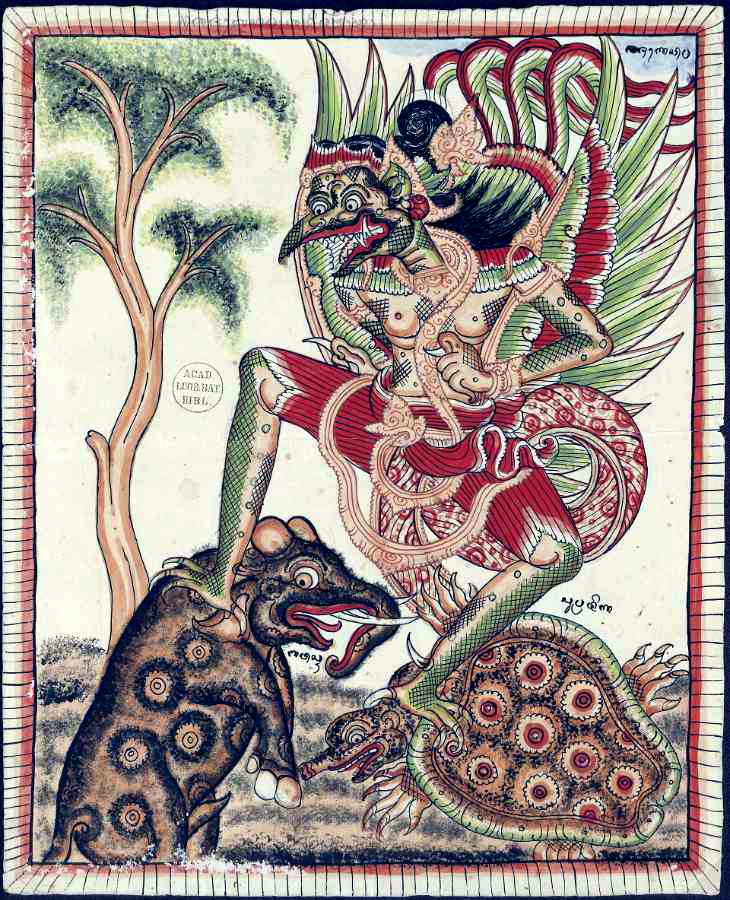
Garuda is a Hindu demigod and divine creature mentioned in the Hindu, Buddhist and Jain faiths. He is primarily depicted as the mount (vahana) of the Hindu god Vishnu. Garuda is described as the king of the birds and a kite-like figure. He is shown either in a zoomorphic form (a giant bird with partially open wings) or an anthropomorphic form (a man with wings and some ornithic features). Garuda is generally portrayed as a protector with the power to swiftly travel anywhere, ever vigilant and an enemy of every serpent. The Shatapatha Brahmana embedded inside the Yajurveda text mentions Garuda as the personification of courage. The Hindu texts on Garuda iconography vary in their details. If in the bird form, he is eagle-like, typically with the wings slightly open as if ready and willing to fly wherever he needs to. In part human-form, he may have an eagle-like nose, beak or legs, his eyes are open and big, his body is the color of emerald, and his wings are golden-yellow. He may be shown with either two or four hands. If he is not carrying Vishnu, he holds a jar of amrita (immortality nectar) in one hand in the rear and an umbrella in the other, while the front pair of hands are in anjali (namaste) posture. If he is carrying Vishnu, the rear hands provide the support for Vishnu’s feet. Garuda’s links to Vishnu – the Hindu god who fights injustice and destroys evil in his various avatars to preserve dharma, has made him an iconic symbol of king’s duty and power, an insignia of royalty or dharma.
Appearance List Vedic References (c. 1500–1000 BCE) – the name “Garuda” is not yet used but an eagle is widely considered an early precursor, Brahmana Texts (c. 1000–800 BCE) – refers to a cosmic bird connected with the gods, Upanishads (c. 800–500 BCE) – divine bird. Mahabharata (c. 400 BCE – 400 CE), Ramayana (c. 500 BCE – 100 BCE), Bhagavata Purana (c. 9th–10th century CE), Garuda Purana (c. 9th–10th century CE), Konjaku Monogatarishū (12th century), Jataka Tales (c. 3rd century BCE – 5th century CE, featuring Garuda as Suparna), Vishnu Purana (c. 4th–5th century CE), Amarushataka (7th century CE), Kakawin Garudeya (c. 11th century CE, Old Javanese epic poem), Reliefs at Borobudur (9th century CE, Indonesia, depicting Garuda), The Mahavamsa (c. 5th–6th century CE, Sri Lanka, mentions Garuda-like beings), Kalika Purana (c. 10th century CE, includes Garuda myths)
Sample Read The Garuḍa purâṇa (Sâroddhâra) [Internet Archive]
Description Garuda is a Hindu demigod and divine creature mentioned in the Hindu, Buddhist and Jain faiths. He is primarily depicted as the mount (vahana) of the Hindu god Vishnu. Garuda is described as the king of the birds and a kite-like figure. He is shown either in a zoomorphic form (a giant bird with partially open wings) or an anthropomorphic form (a man with wings and some ornithic features). Garuda is generally portrayed as a protector with the power to swiftly travel anywhere, ever vigilant and an enemy of every serpent. The Shatapatha Brahmana embedded inside the Yajurveda text mentions Garuda as the personification of courage. The Hindu texts on Garuda iconography vary in their details. If in the bird form, he is eagle-like, typically with the wings slightly open as if ready and willing to fly wherever he needs to. In part human-form, he may have an eagle-like nose, beak or legs, his eyes are open and big, his body is the color of emerald, and his wings are golden-yellow. He may be shown with either two or four hands. If he is not carrying Vishnu, he holds a jar of amrita (immortality nectar) in one hand in the rear and an umbrella in the other, while the front pair of hands are in anjali (namaste) posture. If he is carrying Vishnu, the rear hands provide the support for Vishnu’s feet. Garuda’s links to Vishnu – the Hindu god who fights injustice and destroys evil in his various avatars to preserve dharma, has made him an iconic symbol of king’s duty and power, an insignia of royalty or dharma.