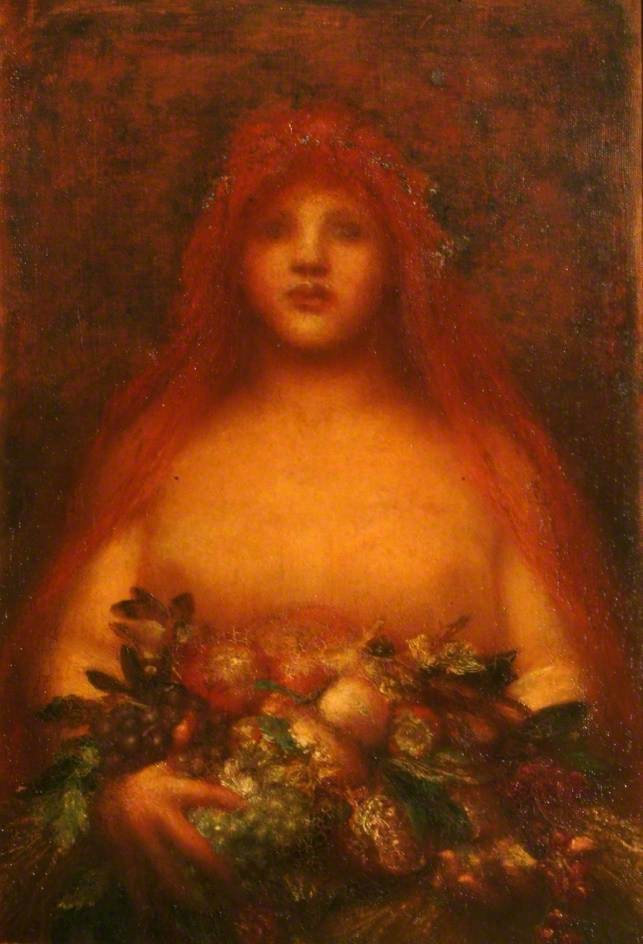
In Greek mythology, Gaia is the personification of Earth. She is the mother of Uranus (Sky), with whom she conceived the Titans (themselves parents of many of the Olympian gods), the Cyclopes, and the Giants, as well as of Pontus (Sea), from whose union she bore the primordial sea gods. Her equivalent in the Roman pantheon was Terra… The Greeks invoked Gaia in their oaths, and she should be aware if one broke his oath. In the Homeric poems she appears usually in forms of oath. In the Iliad, the sacrifice of a black lamb is offered to Gaia and she is invoked in the formula of an oath. Homer considers her a physical distinct existence not clearly conceived in anthropomorphic form. Gaia does not seem to have any personal activity…
Appearance List Theogony (c. 700 BCE) by Hesiod — First literary appearance of Gaia (Gē) as primordial Earth, describes her emergence after Chaos and role as mother of Titans; Works and Days (c. 700 BCE) by Hesiod; Library (Bibliotheca) (1st–2nd century CE); Description of Greece (2nd century CE) by Pausanias; Metamorphoses (8 CE) by Ovid; Theogony (English Translation) (1793); Myths of the Greeks and Romans (1907) by Hélène Adeline Guerber; The Greek Myths (1955) by Robert Graves; The Gods of the Greeks (1951) by Karl Kerényi
Sample Read Theogony (c. 700 BCE) by Hesiod, English translation (1793) [Internet Archive]
Description In Greek mythology, Gaia is the personification of Earth. She is the mother of Uranus (Sky), with whom she conceived the Titans (themselves parents of many of the Olympian gods), the Cyclopes, and the Giants, as well as of Pontus (Sea), from whose union she bore the primordial sea gods. Her equivalent in the Roman pantheon was Terra… The Greeks invoked Gaia in their oaths, and she should be aware if one broke his oath. In the Homeric poems she appears usually in forms of oath. In the Iliad, the sacrifice of a black lamb is offered to Gaia and she is invoked in the formula of an oath. Homer considers her a physical distinct existence not clearly conceived in anthropomorphic form. Gaia does not seem to have any personal activity…