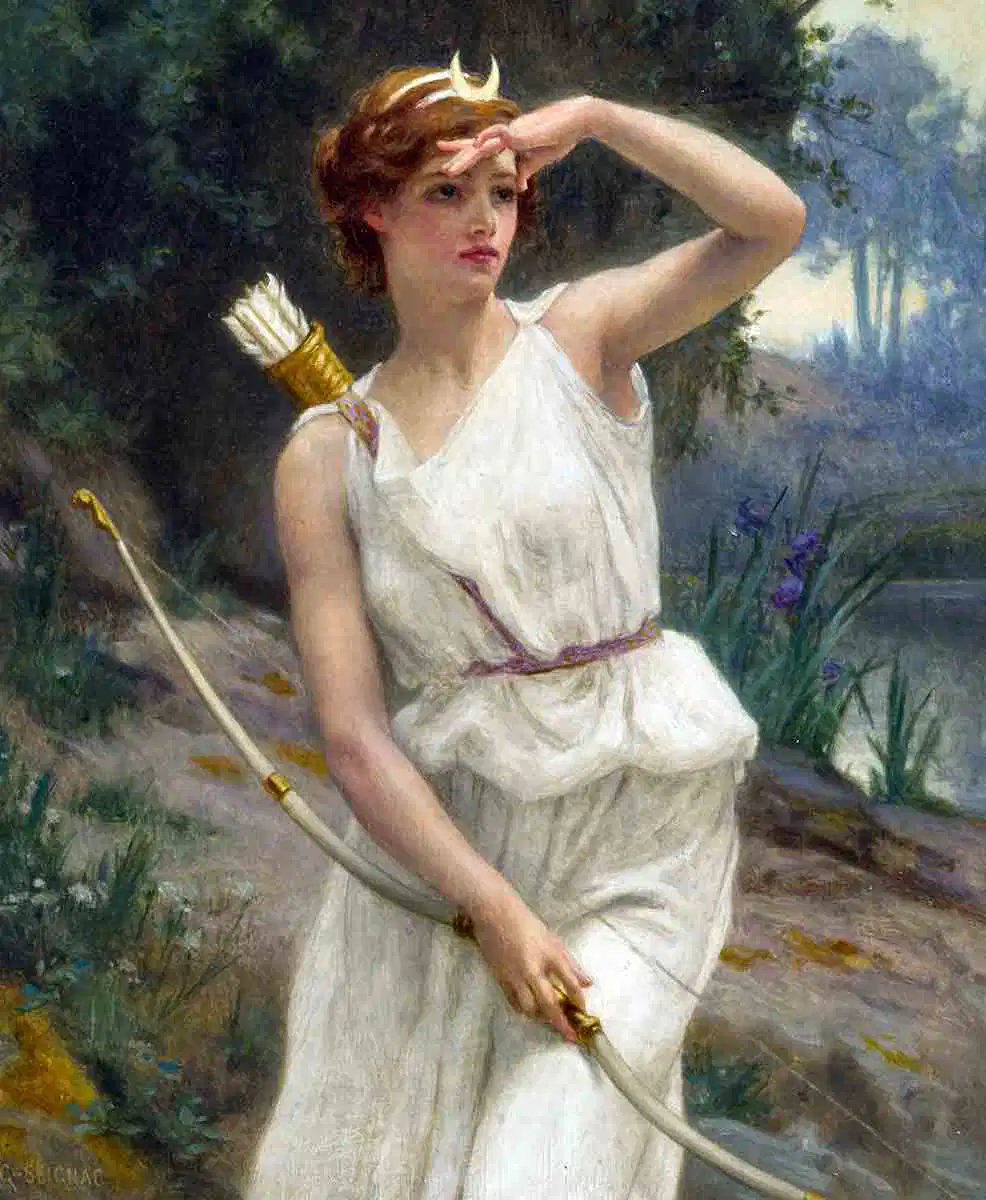
Diana is a goddess in Roman religion, primarily considered a patroness of the countryside and nature, hunters, wildlife, childbirth, crossroads, the night, and the Moon. She is equated with the Greek goddess Artemis, and absorbed much of Artemis’ mythology early in Roman history, including a birth on the island of Delos to parents Jupiter and Latona, and a twin brother, Apollo, though she had an independent origin in Italy. Diana is considered a virgin goddess and protector of childbirth. Historically, Diana made up a triad with two other Roman deities: Egeria the water nymph, her servant and assistant midwife; and Virbius, the woodland god. Diana is revered in modern neopagan religions including Roman neopaganism, Stregheria, and Wicca. In the ancient, medieval, and modern periods, Diana has been considered a triple deity, merged with a goddess of the moon (Luna/Selene) and the underworld (usually Hecate). Worship of Diana probably spread into the city of Rome beginning around 550 BCE, during her Hellenization and combination with the Greek goddess Artemis. By the 3rd century BCE, Diana is found listed among the twelve major gods of the Roman pantheon by the poet Ennius. Though the Capitoline Triad (Jupiter, Juno, and Minerva) were the primary state gods of Rome, early Roman myth did not assign a strict hierarchy to the gods the way Greek mythology did, though the Greek hierarchy would eventually be adopted by Roman religion as well.
Alias Diana
Real Names/Alt Names Diana Nemorensis, “Diana of the Sylvan Glade”
Appearance List Literature: Virgil’s Aeneid (29 to 19 BC), Ovid’s Metamorphoses (8 CE), and Plutarch, Cato the Elder, etc. Many fictional adaptations.
Sample Read A Book of Myths (1915) by Jeanie Lang [Internet Archive]
Description Diana is a goddess in Roman religion, primarily considered a patroness of the countryside and nature, hunters, wildlife, childbirth, crossroads, the night, and the Moon. She is equated with the Greek goddess Artemis, and absorbed much of Artemis’ mythology early in Roman history, including a birth on the island of Delos to parents Jupiter and Latona, and a twin brother, Apollo, though she had an independent origin in Italy. Diana is considered a virgin goddess and protector of childbirth. Historically, Diana made up a triad with two other Roman deities: Egeria the water nymph, her servant and assistant midwife; and Virbius, the woodland god. Diana is revered in modern neopagan religions including Roman neopaganism, Stregheria, and Wicca. In the ancient, medieval, and modern periods, Diana has been considered a triple deity, merged with a goddess of the moon (Luna/Selene) and the underworld (usually Hecate). Worship of Diana probably spread into the city of Rome beginning around 550 BCE, during her Hellenization and combination with the Greek goddess Artemis. By the 3rd century BCE, Diana is found listed among the twelve major gods of the Roman pantheon by the poet Ennius. Though the Capitoline Triad (Jupiter, Juno, and Minerva) were the primary state gods of Rome, early Roman myth did not assign a strict hierarchy to the gods the way Greek mythology did, though the Greek hierarchy would eventually be adopted by Roman religion as well.

 ,
,  ,
,