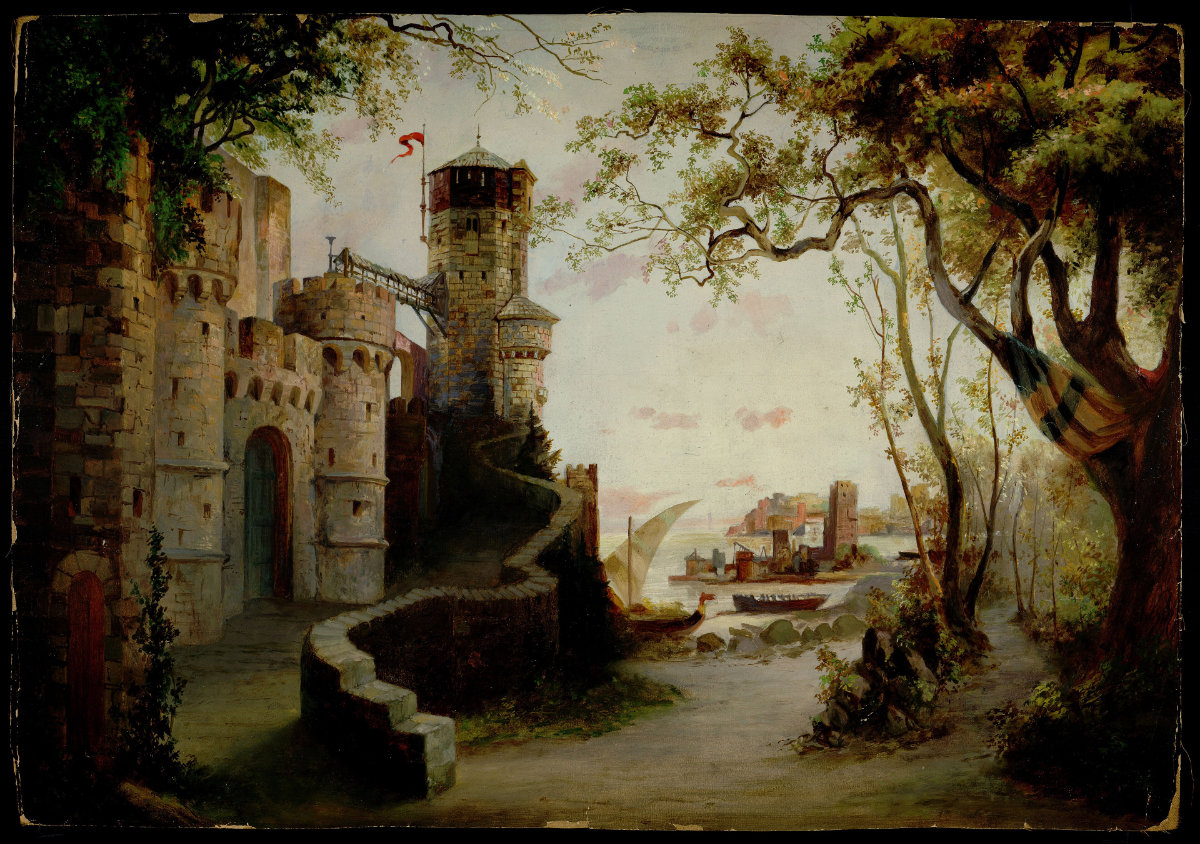
Camelot is a legendary castle and court associated with King Arthur. Absent in the early Arthurian material, Camelot first appeared in 12th-century French romances and, since the Lancelot-Grail cycle, eventually came to be described as the fantastic capital of Arthur’s realm and a symbol of the Arthurian world. Medieval texts locate it somewhere in Great Britain and sometimes associate it with real cities, though more usually its precise location is not revealed. Most scholars regard it as being entirely fictional, its unspecified geography being perfect for chivalric romance writers. Nevertheless, arguments about the location of the “real Camelot” have occurred since the 15th century and continue today in popular works and for tourism purposes.
Appearance List Annales Cambriae (10th century); Historia Regum Britanniae (1136); Merlin by Robert de Boron (late 12th–early 13th c.); The Vulgate Lancelot (13th c.); Le Morte d’Arthur (1485) by Thomas Malory; Ballads of Bravery (1877); The Boy’s King Arthur: Sir Thomas Malory’s History of King Arthur and His Knights of the Round Table by Sidney Lanier (Charles Scribner’s Sons, 1880); The Story of King Arthur and His Knights (1903) by Howard Pyle [Internet Archive]; The Story of the Champions of the Round Table (1905, 1911) by Howard Pyle [Internet Archive]; The Story of Sir Launcelot and His Companions (1907) by Howard Pyle [Internet Archive]; The Story of the Grail and the Passing of King Arthur (1910) by Howard Pyle [Internet Archive]; Tales of the Round Table (1908) by Andrew Lang [Internet Archive]; Myths and Legends of the Celtic Race (1910) by T. W. Rolleston [Internet Archive]; The Legends of King Arthur and His Knights (1912) [Internet Archive]; Idylls of the King (1859) by Alfred Lord Tennyson – 1913 illustrated edition: [Internet Archive]; Legends and Romances of Brittany (1917) by Lewis Spence. Film: Knights of the Round Table (1926) by Rex Ingram (silent, partially lost); Knights of the Round Table (1953) by Richard Thorpe; Lancelot and Guinevere (1963) by Cornel Wilde; The Sword in the Stone (1963) by Walt Disney Productions; Camelot (1967) by Joshua Logan; Excalibur (1981).
Description Camelot is a legendary castle and court associated with King Arthur. Absent in the early Arthurian material, Camelot first appeared in 12th-century French romances and, since the Lancelot-Grail cycle, eventually came to be described as the fantastic capital of Arthur’s realm and a symbol of the Arthurian world. Medieval texts locate it somewhere in Great Britain and sometimes associate it with real cities, though more usually its precise location is not revealed. Most scholars regard it as being entirely fictional, its unspecified geography being perfect for chivalric romance writers. Nevertheless, arguments about the location of the “real Camelot” have occurred since the 15th century and continue today in popular works and for tourism purposes.

 ,
,