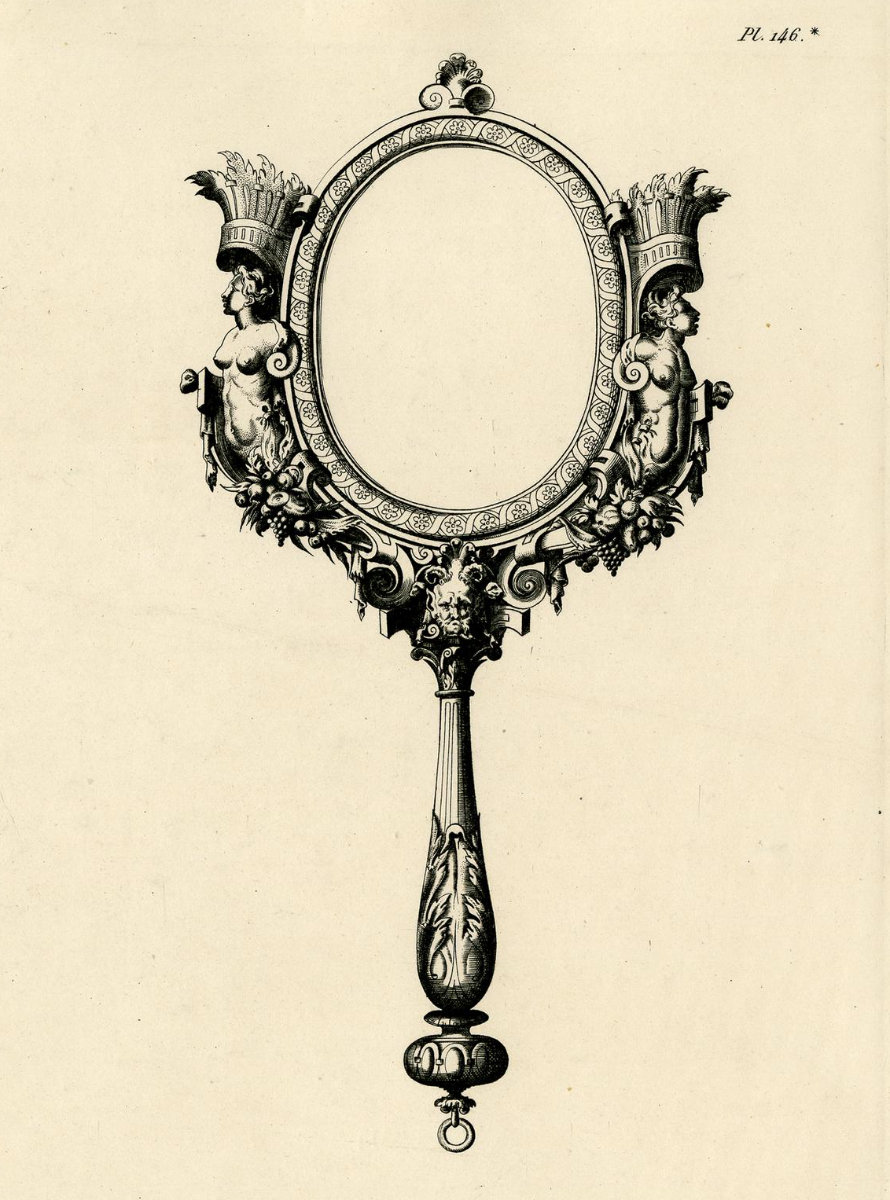
“Offrande à Cypris porte-miroir” presents Mme de Fryvol, a Parisian woman preoccupied with her own image. She continually observes herself in mirrors and reflective surfaces, treating her appearance as a series of artistic creations. She values reflection, illusion, and variation in her appearance, prefers an antique hand mirror, and imagines herself in a Greek past, like an Aphrodite (aka Cypris). Two men, Briffaut (a doctor) and Lavaret (a composer), walk together through the Salon at the Grand Palais. Briffaut speaks at length about art, while Lavaret expresses a desire to be a painter or sculptor. Lavaret reveals that he is in love with a woman who does not reciprocate his feelings. He decides not to declare himself, but instead wishes to offer her a singular gift: a work created by him and then destroyed so that only she will have experienced it. Briffaut proposes a method to realize this plan. Lavaret has composed an opera titled “Hildegonde et Callisthène.” Briffaut arranges for all the performers to be hypnotized so that they will forget the work afterwards. The opera is rehearsed. Lavaret presents the opera to Mme de Fryvol in a private performance at the Opéra-Dramatique, with the audience replaced by flowers. Mme de Fryvol attends and reacts with repeated expressions of pleasure, describing the work as “ravissant,” “délicieux,” and “exquis.” During the performance, Lavaret observes Mme de Fryvol and reflects on his sacrifice, while the text reveals her attention shifting from impressions to reflections, from memories to imagined scenes, and concludes that Lavaret will never know them.
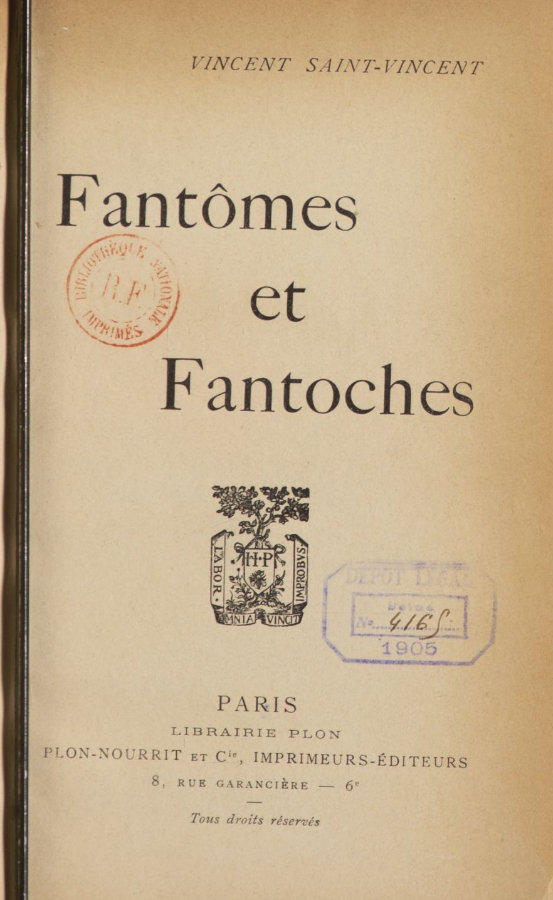
First Appearance “Offrande à Cypris porte-miroir” included in Fantômes et fantoches (1905) by Vincent Saint-Vincent (pseud. of Maurice Renard)
First Publisher Plon-Nourrit
Appearance List “Offrande à Cypris porte-miroir” included in Fantômes et fantoches (1905) by Vincent Saint-Vincent (pseud. of Maurice Renard), Paris: Plon-Nourrit [Gallica BnF]; “Offrande à Cypris porte-miroir” included in Romans et contes fantastiques (1990) by Maurice Renard — collected reissue, Robert Laffont, collection “Bouquins”.
Description “Offrande à Cypris porte-miroir” presents Mme de Fryvol, a Parisian woman preoccupied with her own image. She continually observes herself in mirrors and reflective surfaces, treating her appearance as a series of artistic creations. She values reflection, illusion, and variation in her appearance, prefers an antique hand mirror, and imagines herself in a Greek past, like an Aphrodite (aka Cypris). Two men, Briffaut (a doctor) and Lavaret (a composer), walk together through the Salon at the Grand Palais. Briffaut speaks at length about art, while Lavaret expresses a desire to be a painter or sculptor. Lavaret reveals that he is in love with a woman who does not reciprocate his feelings. He decides not to declare himself, but instead wishes to offer her a singular gift: a work created by him and then destroyed so that only she will have experienced it. Briffaut proposes a method to realize this plan. Lavaret has composed an opera titled “Hildegonde et Callisthène.” Briffaut arranges for all the performers to be hypnotized so that they will forget the work afterwards. The opera is rehearsed. Lavaret presents the opera to Mme de Fryvol in a private performance at the Opéra-Dramatique, with the audience replaced by flowers. Mme de Fryvol attends and reacts with repeated expressions of pleasure, describing the work as “ravissant,” “délicieux,” and “exquis.” During the performance, Lavaret observes Mme de Fryvol and reflects on his sacrifice, while the text reveals her attention shifting from impressions to reflections, from memories to imagined scenes, and concludes that Lavaret will never know them.

 ,
,