The bogeyman is a mythical creature typically used to frighten children into good behaviour. Bogeymen take a variety of different forms and genders around the world, shaped by local customs and culture, but they are most commonly depicted as monsters who punish children for misbehaving. Bogeymen are often invoked by authority figures for the purposes of discouraging a child from a specific act or general misbehaviour. The term is sometimes used as a non-specific personification of, or metonym for, terror – and sometimes the Devil. The word bogeyman, used to describe a monster in English, may have derived from Middle English bugge or bogge, which means ‘frightening specter’, ‘terror’, or ‘scarecrow’. It relates to boggart and bugbear, a bear-like demon (bug) who eats small children. It was also used to mean a general object of dread. The word bugaboo, with a similar pair of meanings, may have arisen as an alteration of bugbear. Bogeyman itself is known from the 15th century, though bogeyman stories are likely to be much older.
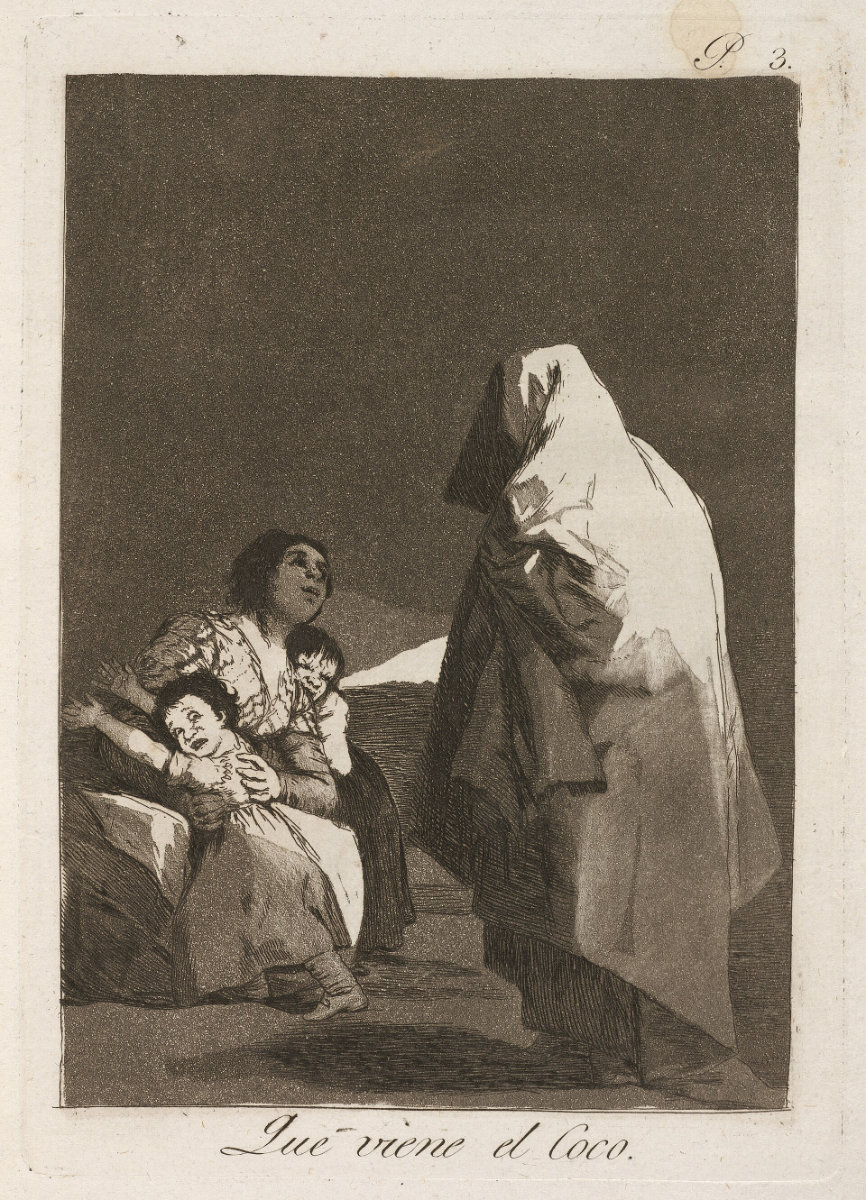
Appearance List Que viene el Coco / Here Comes the Bogey-Man (1799) by Francisco Goya — plate 3 of Los Caprichos, a visual adaptation of the Iberian Coco/Cuco child-frightener; The Joss: A Reversion (1901) by Richard Marsh; Standard Dictionary of Folklore, Mythology, and Legend (1949) ed. Maria Leach; Dictionary of Mythology, Folklore and Symbols (1962) by Gertrude Jobes; “The Boogeyman” (1973) by Stephen King; Kummatty / The Bogeyman (1979) by G. Aravindan — Malayalam fantasy film.
Sample Read ○
Description The bogeyman is a mythical creature typically used to frighten children into good behaviour. Bogeymen take a variety of different forms and genders around the world, shaped by local customs and culture, but they are most commonly depicted as monsters who punish children for misbehaving. Bogeymen are often invoked by authority figures for the purposes of discouraging a child from a specific act or general misbehaviour. The term is sometimes used as a non-specific personification of, or metonym for, terror – and sometimes the Devil. The word bogeyman, used to describe a monster in English, may have derived from Middle English bugge or bogge, which means ‘frightening specter’, ‘terror’, or ‘scarecrow’. It relates to boggart and bugbear, a bear-like demon (bug) who eats small children. It was also used to mean a general object of dread. The word bugaboo, with a similar pair of meanings, may have arisen as an alteration of bugbear. Bogeyman itself is known from the 15th century, though bogeyman stories are likely to be much older.