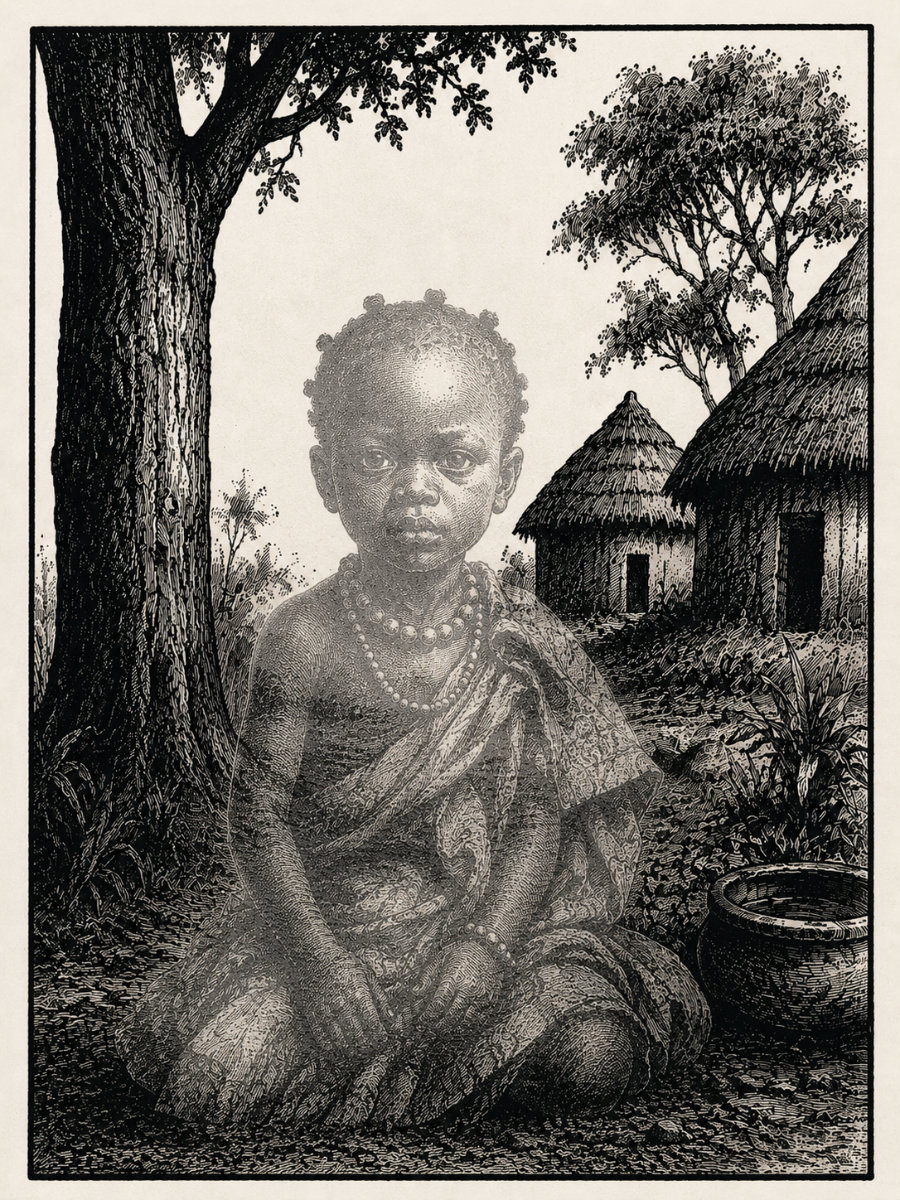
Abiku is a Yoruba word that can be translated as “born to die” and refers to the spirit of a child who dies young. It is derived from (abi) “that which was born” and (iku) “death”. Not only is an Abiku a spirit of a child who dies young (usually considered before puberty or 12 years of age), the belief is that the spirit can return to the same mother multiple times, resulting in multiple short-lived children, or transfer to other mothers. It is the belief that the spirit does not ever plan to “stay put in life” so it is “indifferent to the plight of its mother and her grief.” When not residing in a person, the spirits are believed to live in trees, especially the iroko, baobab and silk-cotton species. They are seen as dangerous, capable of murder, and especially likely to target children on their thirteenth birthday. They are also thought to sometimes (though rarely) eventually reach adulthood.
Appearance List The voice of Africa v. 1 (1913) by Leo Frobenius — valued for early observations and visual documentation despite controversial diffusionist interpretations of African civilization [Smithsonian]; The history of the Yorubas : from the earliest times to the beginning of the British Protectorate (1921) by Rev. Samuel Johnson, Paster of Oyo; ed. Dr. O. (Obadiah) Johnson, Lagos [Internet Archive]; Os africanos no Brasil (1932) by Raymundo Nina Rodrigues; The Religion of the Yorùbá (1948) by J. Olumide Luca; Candomblés da Bahia (first ed. 1948; 2nd ed. 1954) by Edison Carneiro; West African Religion (1949) by Geoffrey Parrinder; Dieux d’Afrique (1954) by Pierre Verger (original edition; later reissued); Olódùmarè: God in Yoruba Belief (1962) by E. Bolaji Idowu; Three Yoruba Plays (1964) by Duro Ladipo; The Shango Cult in Trinidad (1965) by George Eaton Simpson (monograph; first ed. 1965); African Religions in Brazil (French: Les religions africaines au Brésil, 1960) by Roger Bastide; Ifa Divination: Communication Between Gods and Men in West Africa (1969) by William Bascom; Yoruba Beliefs and Sacrificial Rites (1979) by J. Ọmọṣade Awolalu.
Sample Read Yoruba Beliefs and Sacrificial Rites (1979) [Internet Archive]
Description Abiku is a Yoruba word that can be translated as “born to die” and refers to the spirit of a child who dies young. It is derived from (abi) “that which was born” and (iku) “death”. Not only is an Abiku a spirit of a child who dies young (usually considered before puberty or 12 years of age), the belief is that the spirit can return to the same mother multiple times, resulting in multiple short-lived children, or transfer to other mothers. It is the belief that the spirit does not ever plan to “stay put in life” so it is “indifferent to the plight of its mother and her grief.” When not residing in a person, the spirits are believed to live in trees, especially the iroko, baobab and silk-cotton species. They are seen as dangerous, capable of murder, and especially likely to target children on their thirteenth birthday. They are also thought to sometimes (though rarely) eventually reach adulthood.