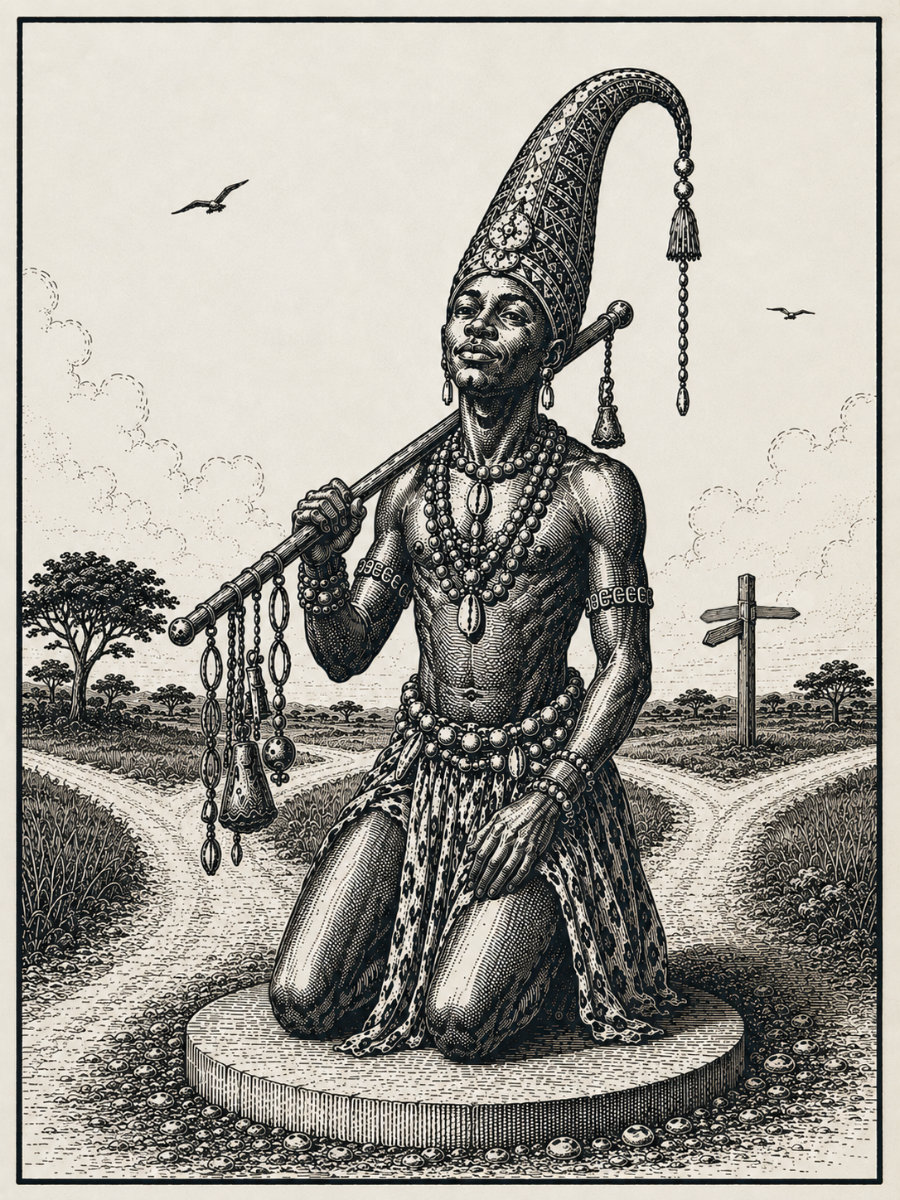
Èṣù is the oriṣa of trickery, chance, crossroads, judgement, duality and languages in the Yoruba religion. Eṣu is a prominent primordial divinity (a delegated Irúnmọlẹ̀ sent by Olodumare) who descended from Ìkọ̀lé Ọ̀run, and the chief enforcer of natural and divine laws. He is in charge of law enforcement and orderliness. As the Yoruba religion spread around the world, the name of this Orisha has varied in different locations, but the beliefs remain similar. Eṣu is the messenger and intermediary between the Ajogun (malevolent spirits), the Oriṣa (benevolent spirits) and ẹ̀dá èniyàn (human beings); he distributes and supervises the distribution of sacrifices (ẹbọ) made by humans to the Oriṣa and Ajogun… Eṣu is powerful and ubiquitous to the extent of having every day of the four-day traditional Yorùbá week as his day of worship (Ọjọ́ Ọ̀ṣẹ̀), unlike all other Irunmọlẹ and Oriṣa (primordial divinities and deified ancestor spirits; “ọjọ́ gbogbo ni ti Èṣù Ọ̀darà”). The cognomen “A bá ni wá ọ̀ràn bá ò rí dá” (He who creates problems for the innocent) highlights the complex nature of Èṣù Ọba Ọ̀dàrà across all strata of Yorùbá society in general and of spiritual communities in particular.
Appearance List The voice of Africa v. 1 (1913) by Leo Frobenius — valued for early observations and visual documentation despite controversial diffusionist interpretations of African civilization [Smithsonian]; The history of the Yorubas : from the earliest times to the beginning of the British Protectorate (1921) by Rev. Samuel Johnson, Paster of Oyo; ed. Dr. O. (Obadiah) Johnson, Lagos [Internet Archive]; Os africanos no Brasil (1932) by Raymundo Nina Rodrigues; The Religion of the Yorùbá (1948) by J. Olumide Luca; Candomblés da Bahia (first ed. 1948; 2nd ed. 1954) by Edison Carneiro; West African Religion (1949) by Geoffrey Parrinder; Dieux d’Afrique (1954) by Pierre Verger (original edition; later reissued); Olódùmarè: God in Yoruba Belief (1962) by E. Bolaji Idowu; Three Yoruba Plays (1964) by Duro Ladipo; The Shango Cult in Trinidad (1965) by George Eaton Simpson (monograph; first ed. 1965); African Religions in Brazil (French: Les religions africaines au Brésil, 1960) by Roger Bastide; Ifa Divination: Communication Between Gods and Men in West Africa (1969) by William Bascom; Yoruba Beliefs and Sacrificial Rites (1979) by J. Ọmọṣade Awolalu.
Sample Read Yoruba Beliefs and Sacrificial Rites (1979) [Internet Archive]
Description Èṣù is the oriṣa of trickery, chance, crossroads, judgement, duality and languages in the Yoruba religion. Eṣu is a prominent primordial divinity (a delegated Irúnmọlẹ̀ sent by Olodumare) who descended from Ìkọ̀lé Ọ̀run, and the chief enforcer of natural and divine laws. He is in charge of law enforcement and orderliness. As the Yoruba religion spread around the world, the name of this Orisha has varied in different locations, but the beliefs remain similar. Eṣu is the messenger and intermediary between the Ajogun (malevolent spirits), the Oriṣa (benevolent spirits) and ẹ̀dá èniyàn (human beings); he distributes and supervises the distribution of sacrifices (ẹbọ) made by humans to the Oriṣa and Ajogun… Eṣu is powerful and ubiquitous to the extent of having every day of the four-day traditional Yorùbá week as his day of worship (Ọjọ́ Ọ̀ṣẹ̀), unlike all other Irunmọlẹ and Oriṣa (primordial divinities and deified ancestor spirits; “ọjọ́ gbogbo ni ti Èṣù Ọ̀darà”). The cognomen “A bá ni wá ọ̀ràn bá ò rí dá” (He who creates problems for the innocent) highlights the complex nature of Èṣù Ọba Ọ̀dàrà across all strata of Yorùbá society in general and of spiritual communities in particular.