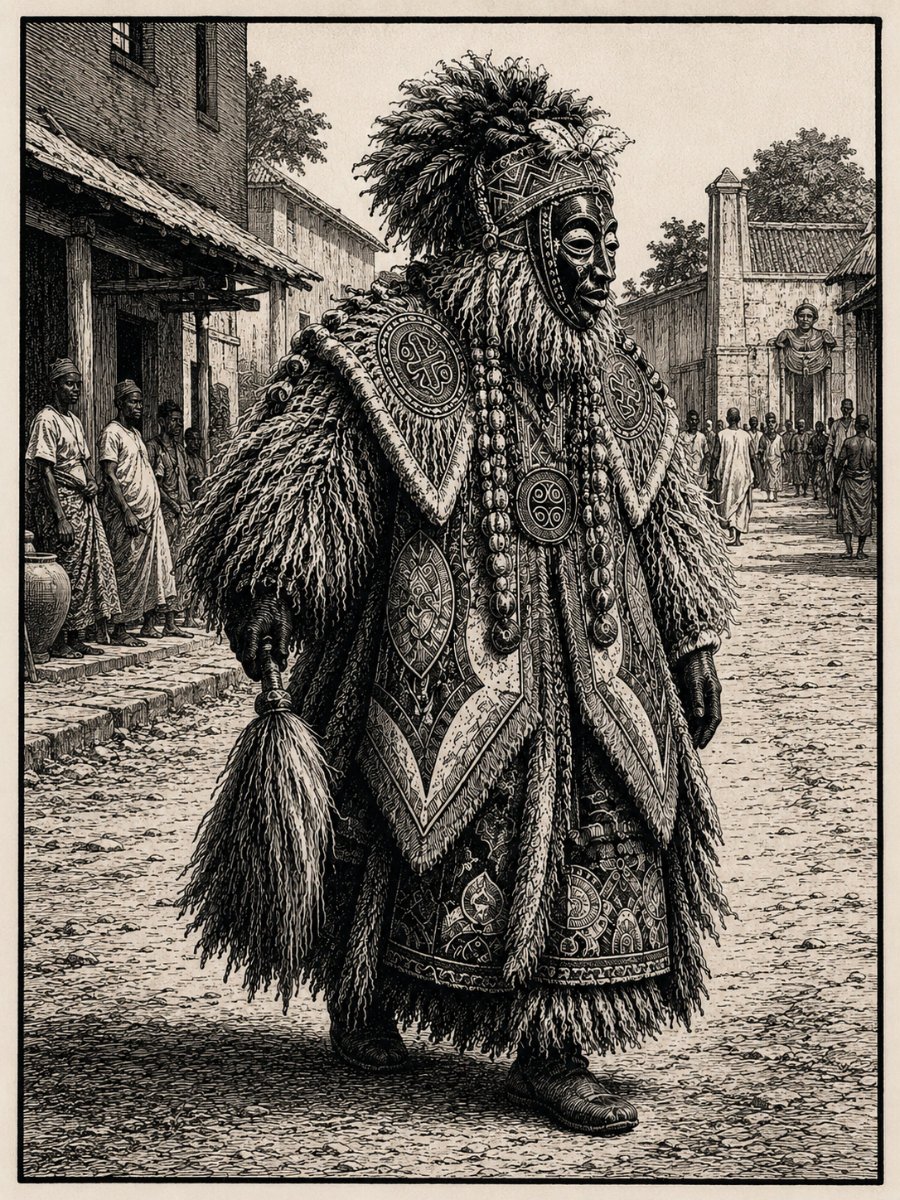
Egungun in the broadest sense is any Yoruba masquerade or masked, costumed figure. More specifically, it is a Yoruba masquerade for ancestor reverence, or the ancestors themselves as a collective force… Egungun is a visible manifestation of the spirits of departed ancestors who periodically revisit the human community for remembrance, celebration, and blessings… The classification of Egun or Egungun types, might appear to be a fairly straightforward task, but in fact it is extremely complex deciphering the comprehension of indigenous taxonomies… Based on cultural affinities in the southwestern Nigerian portion of Yorubaland, the following egungun names can be identified: Danafojura and Awodagbese in Ogbomoso, Alapansanpa in Ibadan, and Feleru in Ilobu, Osun State… In the Yoruba religion, the annual ceremonies in honor of the dead serve as a means of assuring their ancestors a place among the living. They believe the ancestors have the responsibility to compel the living to uphold the ethical standards of the past generations of their clan, town or family. The Egungun are celebrated in festivals, known as Odun Egungun, and in family ritual through the masquerade custom… In matters that deal with whole communities, Egungun priests and initiates who are trained in ancestral communication, ancestral elevation and funerary rites are assigned to invoke and bring out the ancestors. They wear elaborate costumes as masquerades. Through drumming and dance, the Egungun robed performers are believed to become possessed by the spirits of the ancestors, as manifested as a single entity. The Egungun spiritually cleans the community; through the dramatic acting and miming of the robed priests, they demonstrate both ethical and amoral behavior that have occurred since their last visit. In this way, they expose the strengths and weaknesses of the community to encourage behavior more befitting of their descendants. When this performance is completed, the performers as Egungun give messages, warnings and blessings to the assembled spectators… Cloth plays an important role in the world of the Yoruba. Their beliefs equate nakedness with infancy, insanity, or the lack of social responsibility. More elaborate dress reflects social power and prestige. In performances honoring ancestors, exquisite cloth is the major medium for the masker’s transformation. An Egungun costume is composed of multiple layers of cloth lappets made from expensive and prestigious textiles, expressing the wealth and status of a family as well as the power of the ancestor… The multiple hidden and visible layers of fabric used to create an Egungun costume signify the sacred and the worldly, respectively. The layers, used in combination, suggest the reunion of the departed and the living…
Alias Egúngún
Real Names/Alt Names Eégún, Ará Ọ̀run, The Collective Dead
Appearance List The voice of Africa v. 1 (1913) by Leo Frobenius — valued for early observations and visual documentation despite controversial diffusionist interpretations of African civilization [Smithsonian]; The history of the Yorubas : from the earliest times to the beginning of the British Protectorate (1921) by Rev. Samuel Johnson, Paster of Oyo; ed. Dr. O. (Obadiah) Johnson, Lagos [Internet Archive]; Os africanos no Brasil (1932) by Raymundo Nina Rodrigues; The Religion of the Yorùbá (1948) by J. Olumide Luca; Candomblés da Bahia (first ed. 1948; 2nd ed. 1954) by Edison Carneiro; West African Religion (1949) by Geoffrey Parrinder; Dieux d’Afrique (1954) by Pierre Verger (original edition; later reissued); Olódùmarè: God in Yoruba Belief (1962) by E. Bolaji Idowu; Three Yoruba Plays (1964) by Duro Ladipo; The Shango Cult in Trinidad (1965) by George Eaton Simpson (monograph; first ed. 1965); African Religions in Brazil (French: Les religions africaines au Brésil, 1960) by Roger Bastide; Ifa Divination: Communication Between Gods and Men in West Africa (1969) by William Bascom; Yoruba Beliefs and Sacrificial Rites (1979) by J. Ọmọṣade Awolalu.
Sample Read Yoruba Beliefs and Sacrificial Rites (1979) [Internet Archive]
Description Egungun in the broadest sense is any Yoruba masquerade or masked, costumed figure. More specifically, it is a Yoruba masquerade for ancestor reverence, or the ancestors themselves as a collective force… Egungun is a visible manifestation of the spirits of departed ancestors who periodically revisit the human community for remembrance, celebration, and blessings… The classification of Egun or Egungun types, might appear to be a fairly straightforward task, but in fact it is extremely complex deciphering the comprehension of indigenous taxonomies… Based on cultural affinities in the southwestern Nigerian portion of Yorubaland, the following egungun names can be identified: Danafojura and Awodagbese in Ogbomoso, Alapansanpa in Ibadan, and Feleru in Ilobu, Osun State… In the Yoruba religion, the annual ceremonies in honor of the dead serve as a means of assuring their ancestors a place among the living. They believe the ancestors have the responsibility to compel the living to uphold the ethical standards of the past generations of their clan, town or family. The Egungun are celebrated in festivals, known as Odun Egungun, and in family ritual through the masquerade custom… In matters that deal with whole communities, Egungun priests and initiates who are trained in ancestral communication, ancestral elevation and funerary rites are assigned to invoke and bring out the ancestors. They wear elaborate costumes as masquerades. Through drumming and dance, the Egungun robed performers are believed to become possessed by the spirits of the ancestors, as manifested as a single entity. The Egungun spiritually cleans the community; through the dramatic acting and miming of the robed priests, they demonstrate both ethical and amoral behavior that have occurred since their last visit. In this way, they expose the strengths and weaknesses of the community to encourage behavior more befitting of their descendants. When this performance is completed, the performers as Egungun give messages, warnings and blessings to the assembled spectators… Cloth plays an important role in the world of the Yoruba. Their beliefs equate nakedness with infancy, insanity, or the lack of social responsibility. More elaborate dress reflects social power and prestige. In performances honoring ancestors, exquisite cloth is the major medium for the masker’s transformation. An Egungun costume is composed of multiple layers of cloth lappets made from expensive and prestigious textiles, expressing the wealth and status of a family as well as the power of the ancestor… The multiple hidden and visible layers of fabric used to create an Egungun costume signify the sacred and the worldly, respectively. The layers, used in combination, suggest the reunion of the departed and the living…