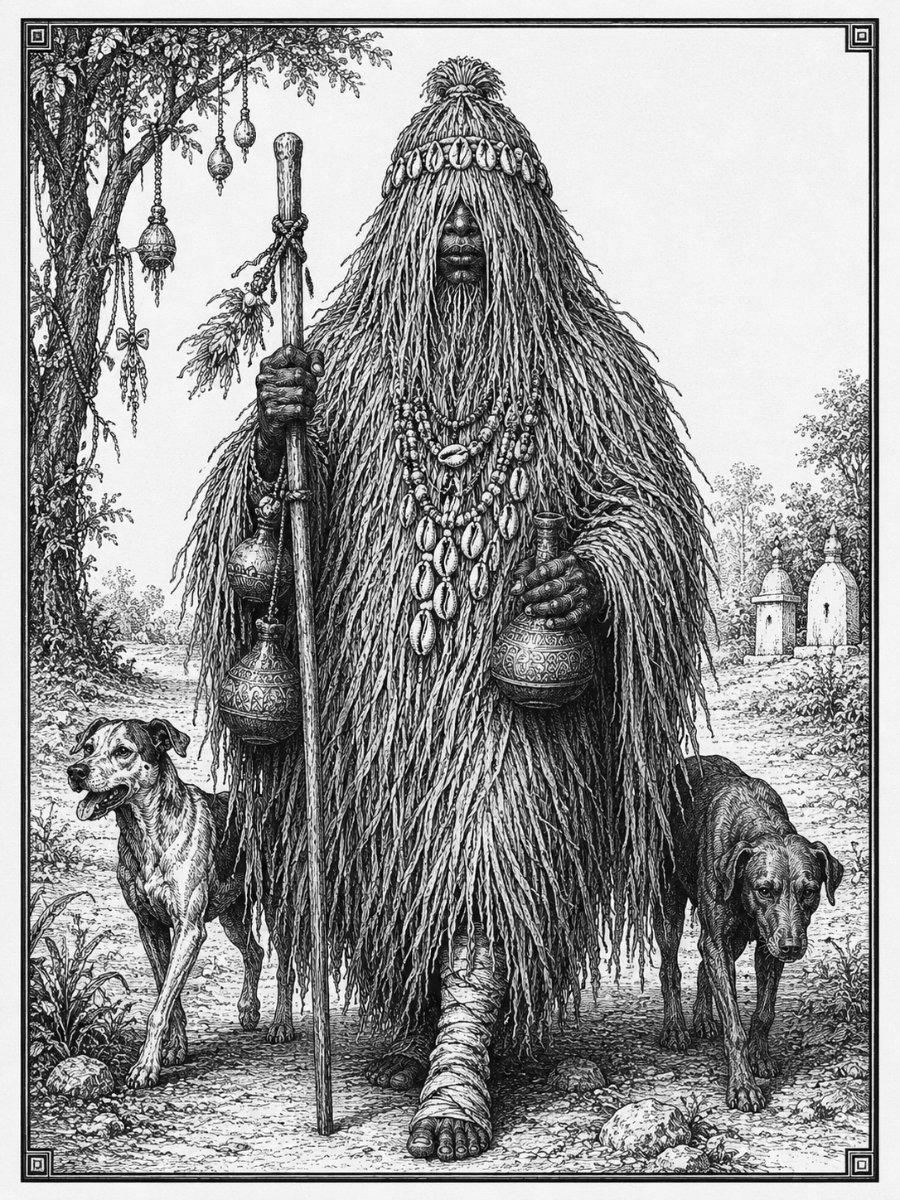
Babalú-Aye is one of the Oriṣa or manifestations of the Supreme Deity Olodumare in the Yoruba religion of West Africa. Babalú-Aye is a spirit of the Earth and is strongly associated with healing and illness. He promotes the cure for illnesses. He is always close to Iku (the force responsible for taking life), as he promotes healing for those who are close to death. However, some fear Obaluaye because he is believed to bring disease upon humans, including smallpox, for which he is known as Ṣọpọna. His cult powers and spells are used against all kinds of diseases, but particularly against skin diseases, inflammation, and airborne diseases that can cause epidemics. They are also used to cure people with seizure problems, epilepsy, and catalepsy. Heat is also a property of Babalu-Ayé. Fever, the body heating up to expel a disease, is believed to be Babalu-Ayé acting on the human body, as well as the heat that comes from the depths of the earth. Therefore, any kind of sacrifice or offering to this oriṣa must be done during the day, when the temperature is higher. Usually considered hobbled by disease, he universally takes grains as offerings.
Alias Babalú-Ayé
Real Names/Alt Names Ọbalúayé, Ṣọ̀npọ̀nná, Oluaye, Omolu, Ṣọpọna, Ayé (Trinidad), Obaluaiye
Appearance List The voice of Africa v. 1 (1913) by Leo Frobenius — valued for early observations and visual documentation despite controversial diffusionist interpretations of African civilization [Smithsonian]; The history of the Yorubas : from the earliest times to the beginning of the British Protectorate (1921) by Rev. Samuel Johnson, Paster of Oyo; ed. Dr. O. (Obadiah) Johnson, Lagos [Internet Archive]; Os africanos no Brasil (1932) by Raymundo Nina Rodrigues; The Religion of the Yorùbá (1948) by J. Olumide Luca; Candomblés da Bahia (first ed. 1948; 2nd ed. 1954) by Edison Carneiro; West African Religion (1949) by Geoffrey Parrinder; Dieux d’Afrique (1954) by Pierre Verger (original edition; later reissued); Olódùmarè: God in Yoruba Belief (1962) by E. Bolaji Idowu; Three Yoruba Plays (1964) by Duro Ladipo; The Shango Cult in Trinidad (1965) by George Eaton Simpson (monograph; first ed. 1965); African Religions in Brazil (French: Les religions africaines au Brésil, 1960) by Roger Bastide; Ifa Divination: Communication Between Gods and Men in West Africa (1969) by William Bascom; Yoruba Beliefs and Sacrificial Rites (1979) by J. Ọmọṣade Awolalu.
Sample Read Yoruba Beliefs and Sacrificial Rites (1979) [Internet Archive]
Description Babalú-Aye is one of the Oriṣa or manifestations of the Supreme Deity Olodumare in the Yoruba religion of West Africa. Babalú-Aye is a spirit of the Earth and is strongly associated with healing and illness. He promotes the cure for illnesses. He is always close to Iku (the force responsible for taking life), as he promotes healing for those who are close to death. However, some fear Obaluaye because he is believed to bring disease upon humans, including smallpox, for which he is known as Ṣọpọna. His cult powers and spells are used against all kinds of diseases, but particularly against skin diseases, inflammation, and airborne diseases that can cause epidemics. They are also used to cure people with seizure problems, epilepsy, and catalepsy. Heat is also a property of Babalu-Ayé. Fever, the body heating up to expel a disease, is believed to be Babalu-Ayé acting on the human body, as well as the heat that comes from the depths of the earth. Therefore, any kind of sacrifice or offering to this oriṣa must be done during the day, when the temperature is higher. Usually considered hobbled by disease, he universally takes grains as offerings.