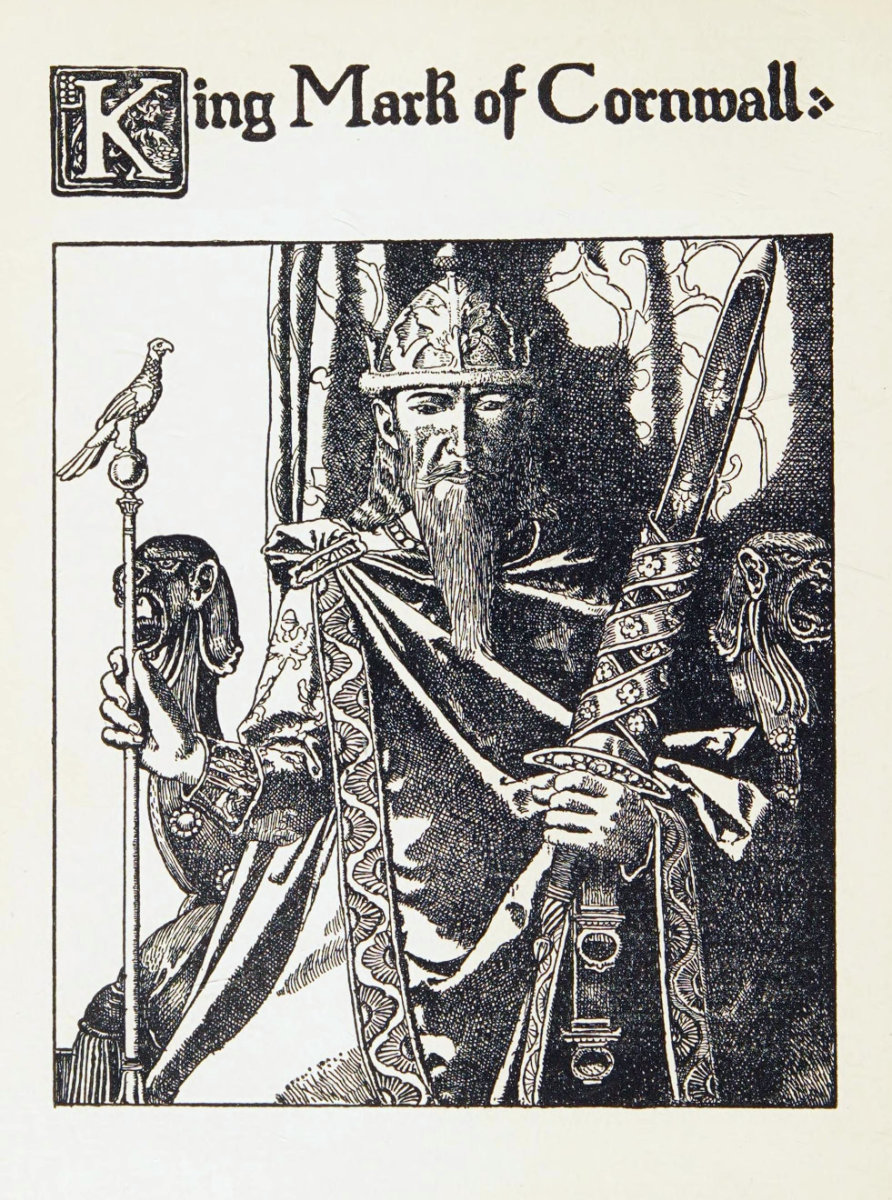
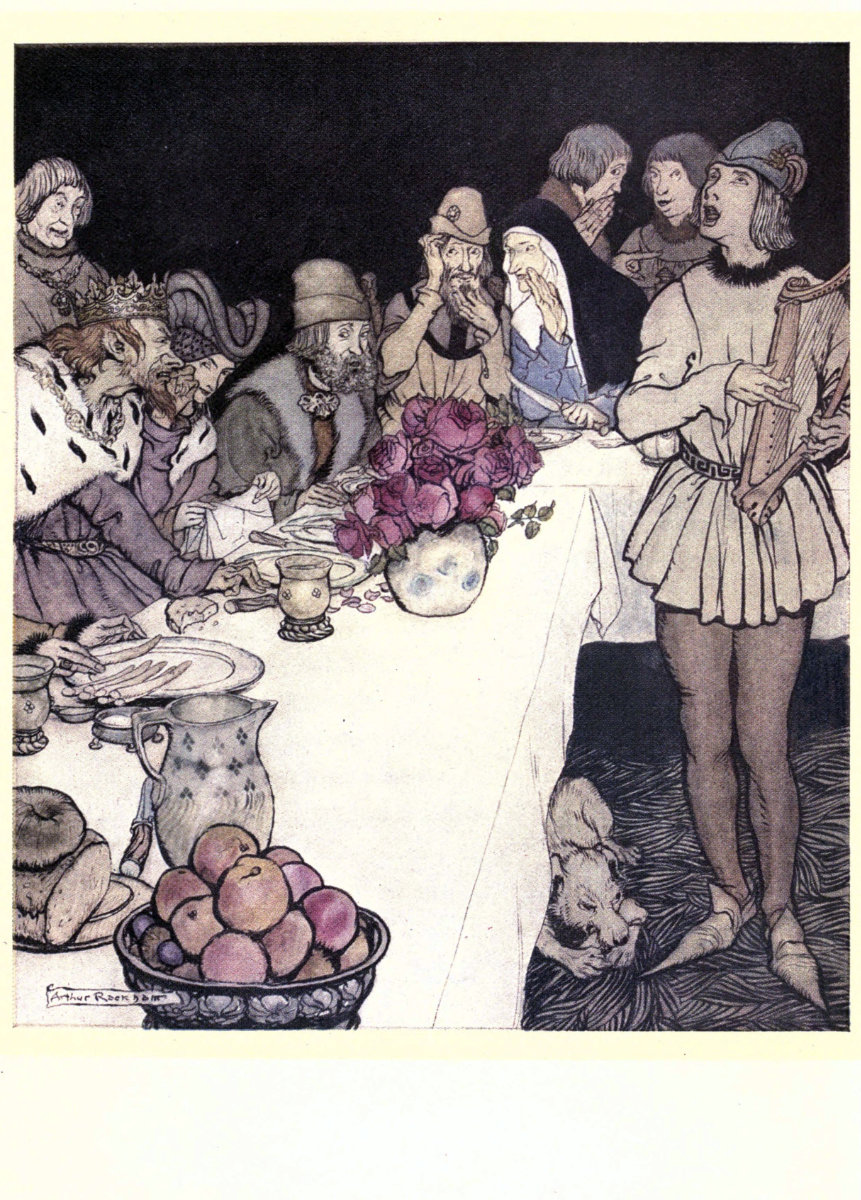
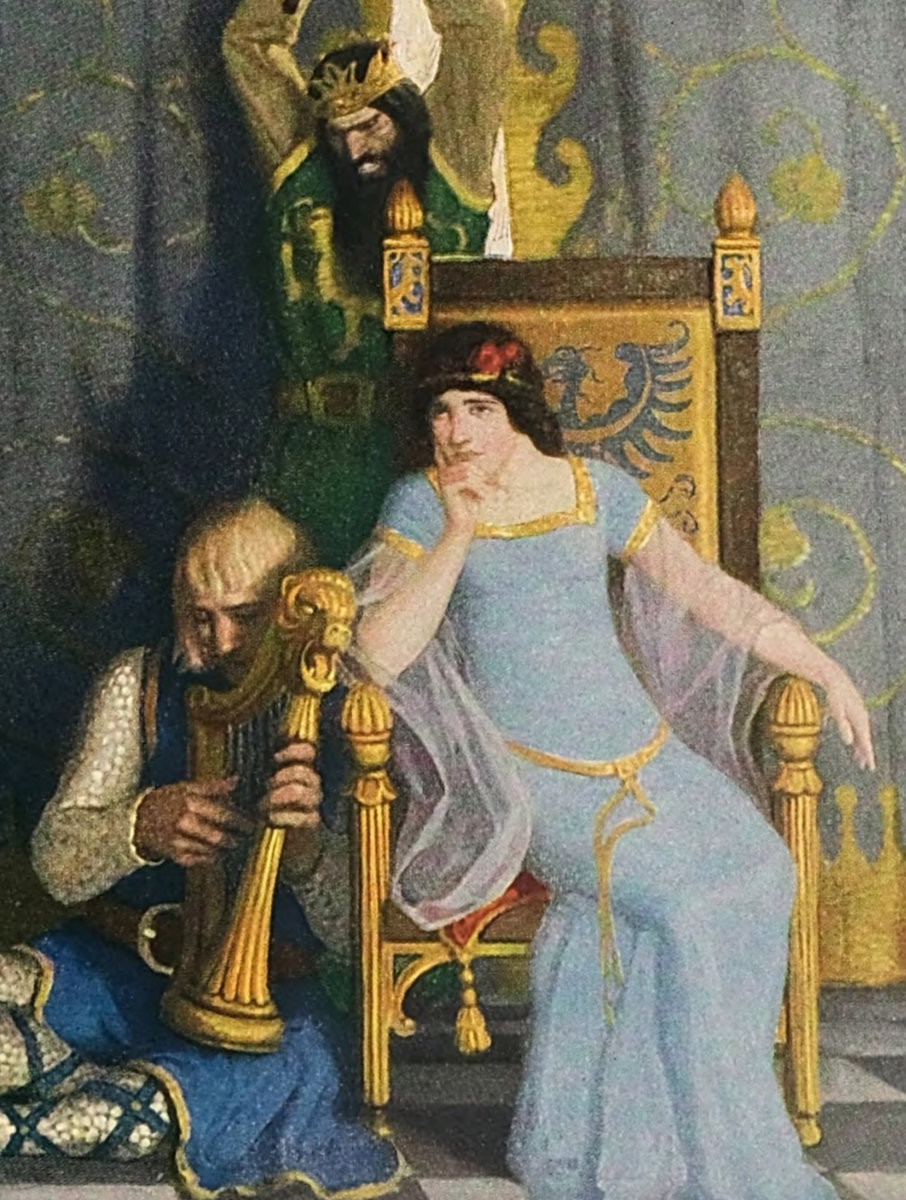
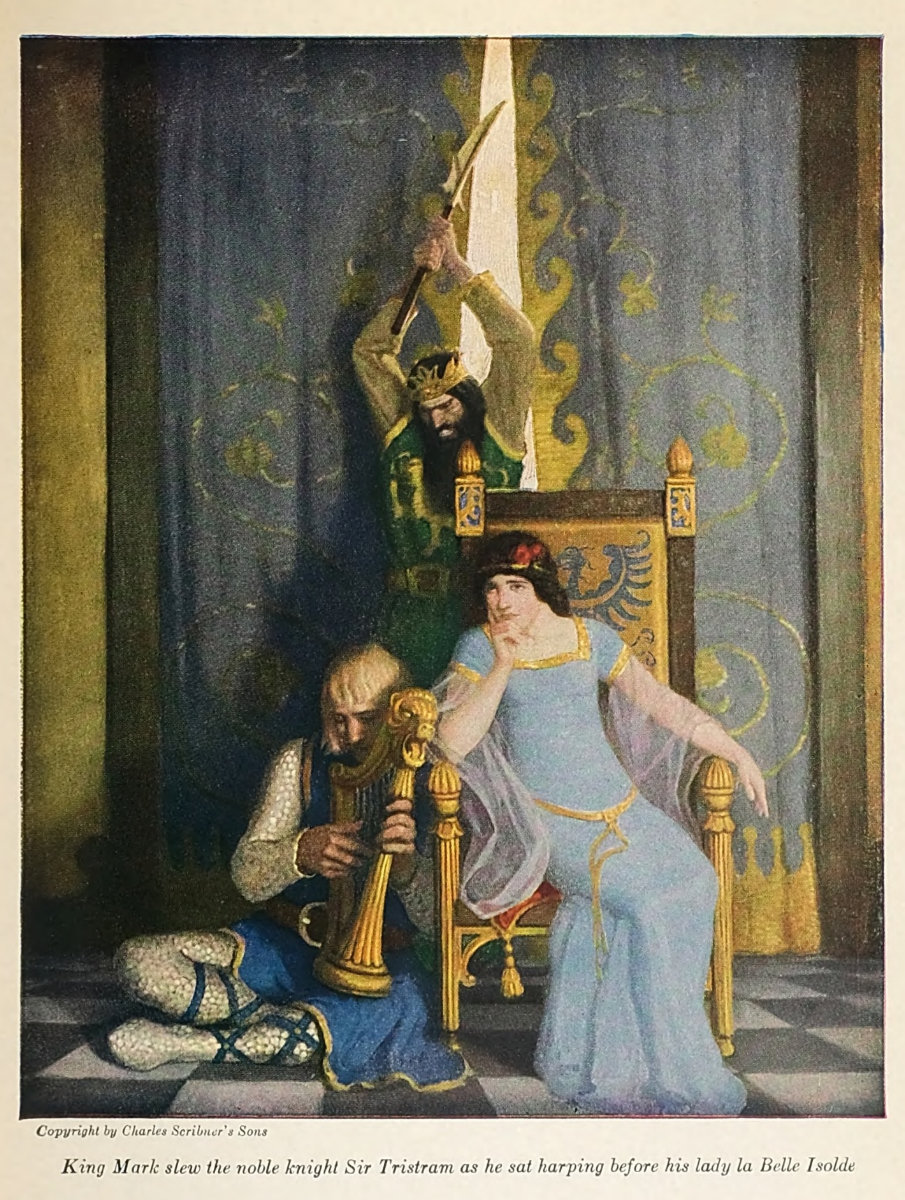
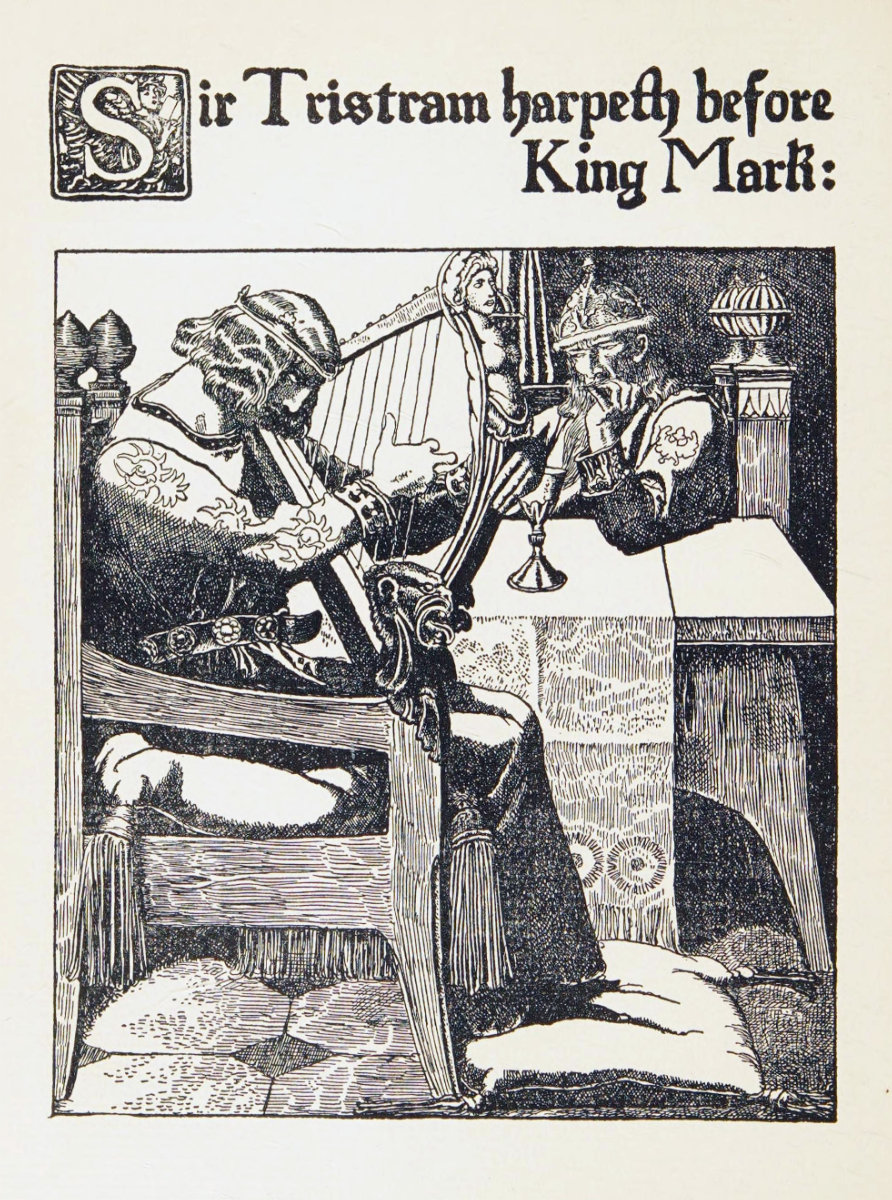
Mark of Cornwall was a sixth-century King of Cornwall, possibly identical with King Conomor… In most versions of the story of Tristan and Iseult, King Mark of Cornwall is Tristan’s uncle… Mark sends Tristan as his proxy to bring his young bride, Princess Iseult, from Ireland. Tristan and Iseult fall in love and, with the help of a magic potion, have one of the stormiest love affairs in medieval literature. Mark suspects the affair, and his suspicions are eventually confirmed. In some versions he sends for Tristan to be hanged, and banishes Iseult to a leper colony. Tristan escapes the hanging, and rescues Iseult from her confinement. Mark later discovers this, and eventually forgives them; Iseult returns to Mark, and Tristan leaves the country. The story is cyclical, with Mark repeatedly suspecting Tristan and Iseult of adultery and then believing that they are innocent… King Mark has a gruesome role in Alfred, Lord Tennyson’s poetry cycle Idylls of the King. While Arthur and many of his knights are taking on the court of the Red Knight, Lancelot is called upon to judge “The Tournament of the Dead Innocence.” The tournament quickly becomes a mockery, full of insults and broken rules. Tristram (Tristan) is the winner of the tournament, winning all the rubies from the necklace. He then breaks with tradition in presenting them to a woman, saying: “This day my Queen of Beauty is not here”. This enrages the crowd, and many say that “All courtesy is dead,” and “The glory of our Round Table is no more.” Tristram, who in this version marries Isolt of the White Hands, carries his winnings to Mark’s wife Queen Isolt (who is upset that Tristram married another woman). They mock each other briefly before Tristram puts the necklace around Isolt’s neck and leans down to kiss her. Mark appears as his lips touch her, killing Tristram with a sword…
Appearance List Tristan (c. 1150–1170) by Thomas of Britain; Le Roman de Tristan (late 12th c.) by Béroul; Tristrant und Isalde (late 12th c.) by Eilhart von Oberg; Tristan und Isolde (c. 1210) by Gottfried von Strassburg; Le Roman de Tristan en prose (13th c.) by Anonymous — integrates Tristan into the Arthurian world; Le Morte d’Arthur (1485) by Thomas Malory; Tristan und Isolde (1865) by Richard Wagner — opera; The Boy’s King Arthur: Sir Thomas Malory’s History of King Arthur and His Knights of the Round Table by Sidney Lanier (Charles Scribner’s Sons, 1880); Tristram of Lyonesse, and Other Poems (1882) by Algernon Charles Swinburne; Le Roman de Tristan et Iseut (1900) by Joseph Bédier; The Romance of Tristram and Iseult (1910) by Joseph Bédier — illustrated edition; The Story of the Champions of the Round Table (1905, 1911) by Howard Pyle [Internet Archive]. Film: Tristan et Yseult (1920) by Maurice Mariaud; L’Éternel retour / The Eternal Return (1943) by Jean Delannoy, screenplay by Jean Cocteau.
Description Mark of Cornwall was a sixth-century King of Cornwall, possibly identical with King Conomor… In most versions of the story of Tristan and Iseult, King Mark of Cornwall is Tristan’s uncle… Mark sends Tristan as his proxy to bring his young bride, Princess Iseult, from Ireland. Tristan and Iseult fall in love and, with the help of a magic potion, have one of the stormiest love affairs in medieval literature. Mark suspects the affair, and his suspicions are eventually confirmed. In some versions he sends for Tristan to be hanged, and banishes Iseult to a leper colony. Tristan escapes the hanging, and rescues Iseult from her confinement. Mark later discovers this, and eventually forgives them; Iseult returns to Mark, and Tristan leaves the country. The story is cyclical, with Mark repeatedly suspecting Tristan and Iseult of adultery and then believing that they are innocent… King Mark has a gruesome role in Alfred, Lord Tennyson’s poetry cycle Idylls of the King. While Arthur and many of his knights are taking on the court of the Red Knight, Lancelot is called upon to judge “The Tournament of the Dead Innocence.” The tournament quickly becomes a mockery, full of insults and broken rules. Tristram (Tristan) is the winner of the tournament, winning all the rubies from the necklace. He then breaks with tradition in presenting them to a woman, saying: “This day my Queen of Beauty is not here”. This enrages the crowd, and many say that “All courtesy is dead,” and “The glory of our Round Table is no more.” Tristram, who in this version marries Isolt of the White Hands, carries his winnings to Mark’s wife Queen Isolt (who is upset that Tristram married another woman). They mock each other briefly before Tristram puts the necklace around Isolt’s neck and leans down to kiss her. Mark appears as his lips touch her, killing Tristram with a sword…

 ,
,  ,
,  ,
,  ,
, 