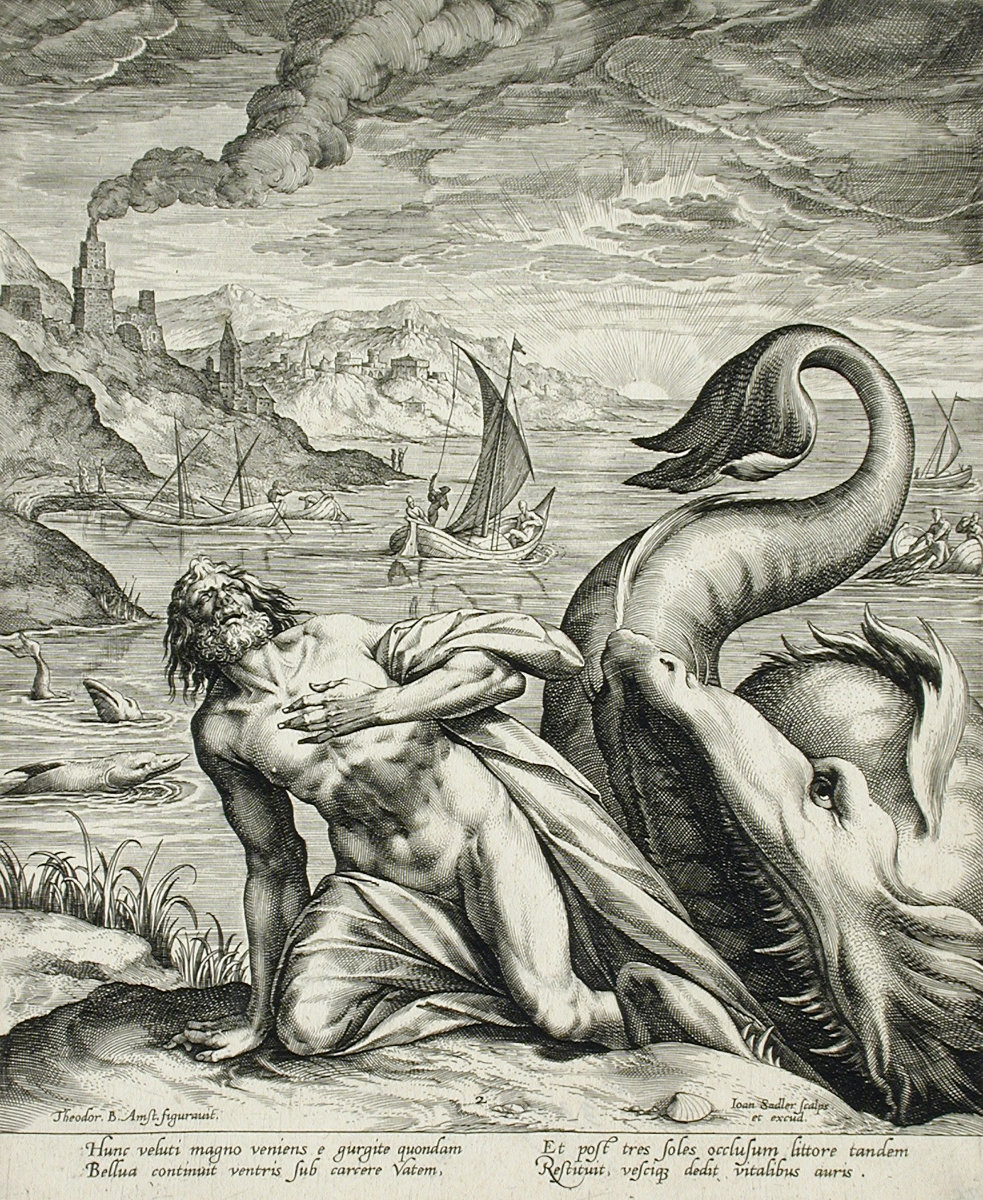
Jonah the son of Amittai or Jonas was a Jewish prophet from Gath-hepher in the Northern Kingdom of Israel around the 8th century BCE according to the Hebrew Bible. He is the central figure of the Book of Jonah, one of the minor prophets, which details his reluctance in delivering the judgment of God to the city of Nineveh (near present-day Mosul) in the Neo-Assyrian Empire. After he is swallowed by a large sea creature and then released, he returns to the divine mission. In Judaism, the story of Jonah represents the teaching of repentance in Judaism, the ability to repent to God for forgiveness. In the New Testament of Christianity, Jesus calls himself “greater than Jonah” and promises the Pharisees “the sign of Jonah” when referring to his resurrection. Early Christian interpreters viewed Jonah as a type of Jesus. Jonah in Islam is regarded as a prophet and the narrative of Jonah appears in a surah of the Quran named after him, Yūnus… Although the creature that swallowed Jonah is often depicted in art and culture as a whale, the Hebrew text uses the phrase “large fish”. In the 17th century and early 18th century, the species of the fish that swallowed Jonah was the subject of speculation by naturalists, who interpreted the story as an account of a historical incident. Some modern scholars of folklore, on the other hand, note similarities between Jonah and other legendary religious figures, like the Indian yogi Matsyendranatha “Lord of the Fishes”, the Sumerian king Gilgamesh, and the Greek hero Jason…
Appearance List Book of Jonah in Hebrew Bible (c. 8th–5th century BCE); Septuagint (Greek translation, 3rd–2nd century BCE); Dead Sea Scrolls fragments (c. 175–25 BCE); Crosby–Schøyen Codex (c. 3rd century CE) — Coptic manuscript; Codex Vaticanus / Codex Sinaiticus (4th century CE); New Testament (1st century CE) — cited in Gospels (Matthew, Luke); Antiquities of the Jews (c. 93 CE) by Flavius Josephus [Internet Archive]; King James Version (1611); The Wonder Book of Bible Stories (1904) by Logan Marshall. Film: Film: Jonah and the Whale (1909) — Vitagraph silent.
Sample Read The Wonder Book of Bible Stories (1904) by Logan Marshall [Internet Archive]
Description Jonah the son of Amittai or Jonas was a Jewish prophet from Gath-hepher in the Northern Kingdom of Israel around the 8th century BCE according to the Hebrew Bible. He is the central figure of the Book of Jonah, one of the minor prophets, which details his reluctance in delivering the judgment of God to the city of Nineveh (near present-day Mosul) in the Neo-Assyrian Empire. After he is swallowed by a large sea creature and then released, he returns to the divine mission. In Judaism, the story of Jonah represents the teaching of repentance in Judaism, the ability to repent to God for forgiveness. In the New Testament of Christianity, Jesus calls himself “greater than Jonah” and promises the Pharisees “the sign of Jonah” when referring to his resurrection. Early Christian interpreters viewed Jonah as a type of Jesus. Jonah in Islam is regarded as a prophet and the narrative of Jonah appears in a surah of the Quran named after him, Yūnus… Although the creature that swallowed Jonah is often depicted in art and culture as a whale, the Hebrew text uses the phrase “large fish”. In the 17th century and early 18th century, the species of the fish that swallowed Jonah was the subject of speculation by naturalists, who interpreted the story as an account of a historical incident. Some modern scholars of folklore, on the other hand, note similarities between Jonah and other legendary religious figures, like the Indian yogi Matsyendranatha “Lord of the Fishes”, the Sumerian king Gilgamesh, and the Greek hero Jason…

 ,
,  ,
,