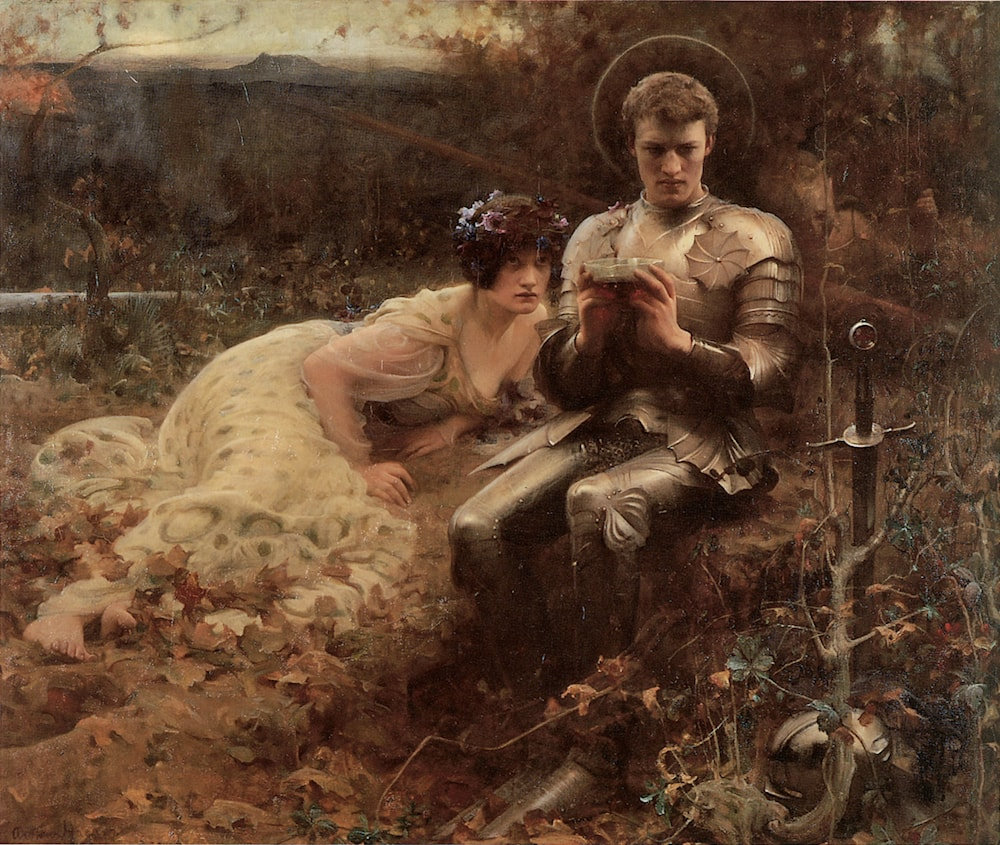
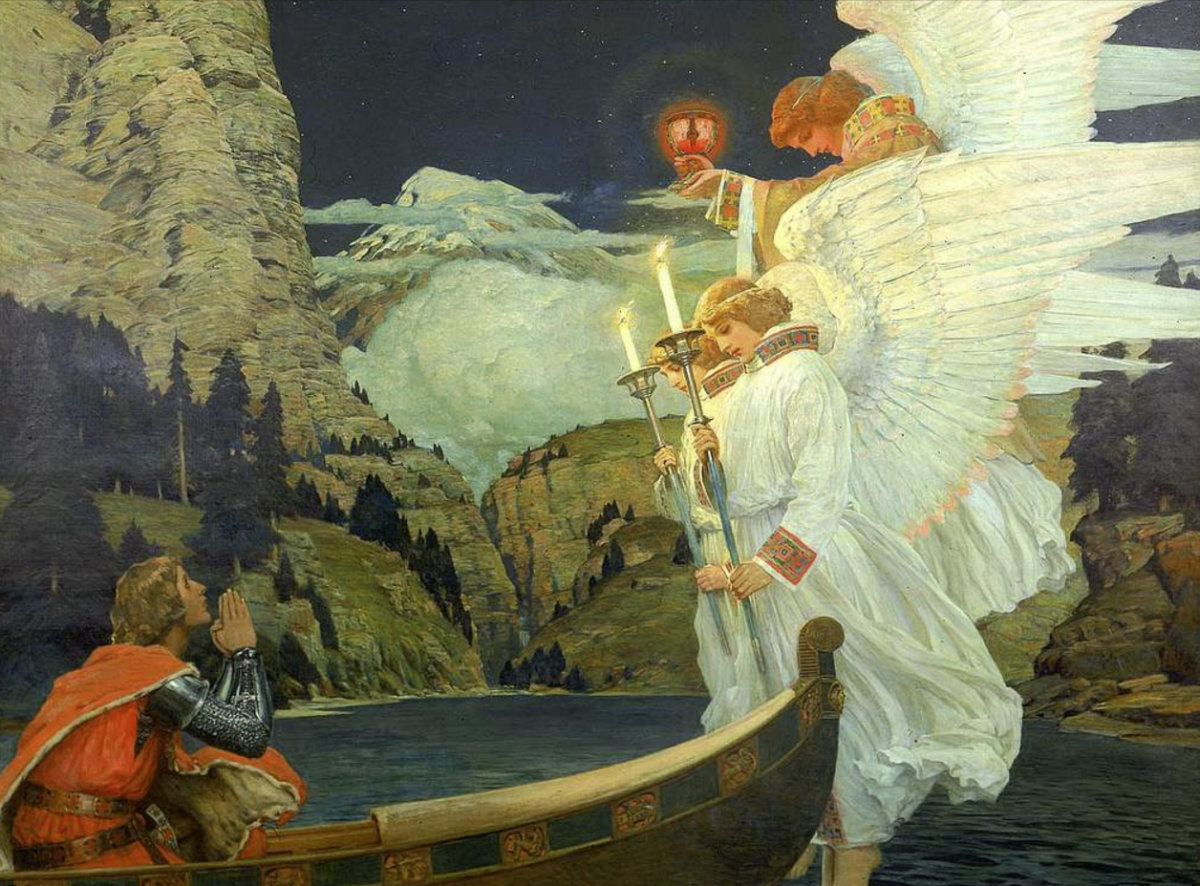
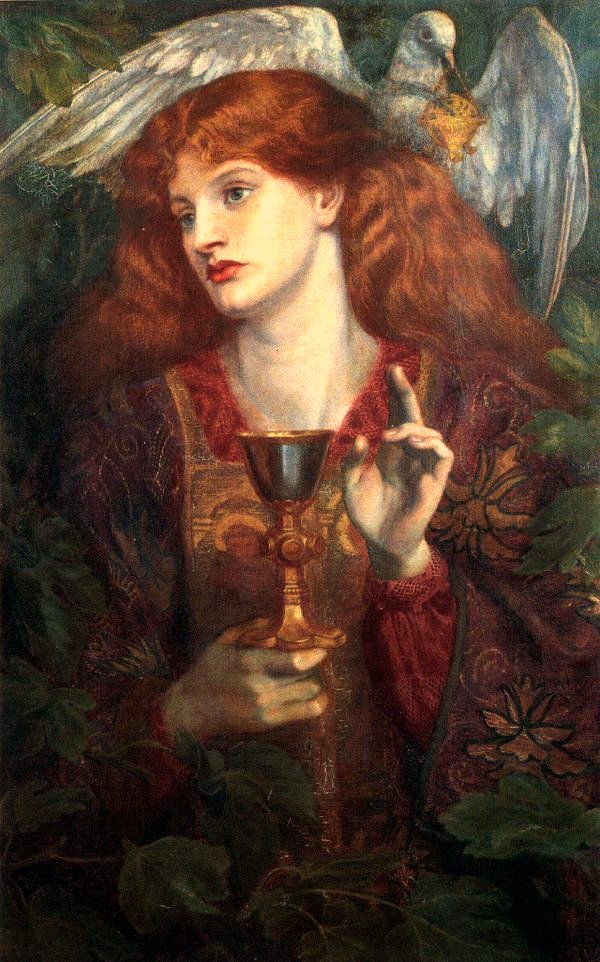
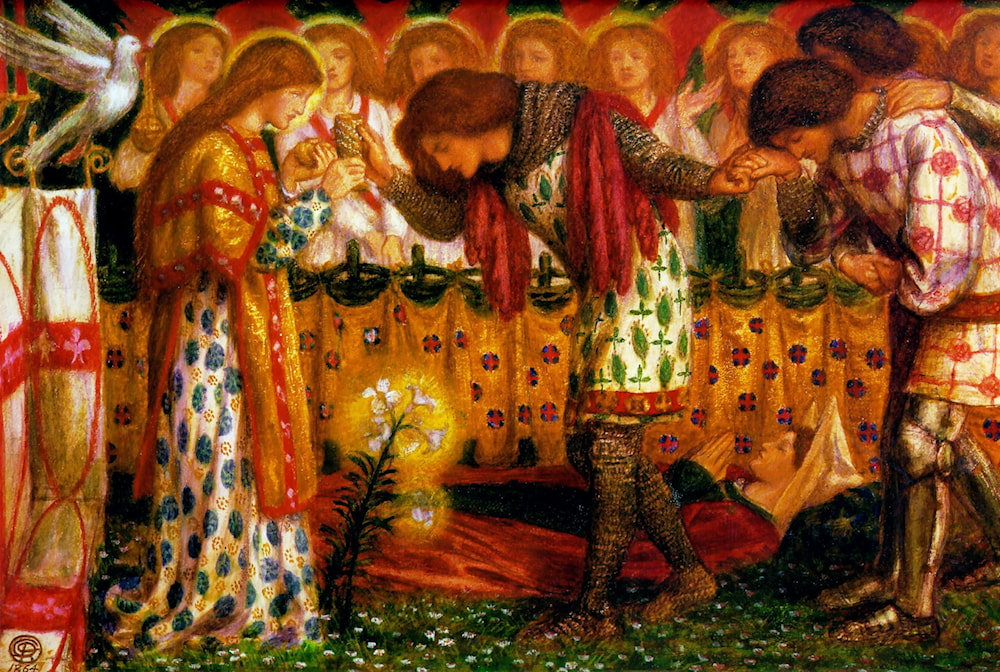
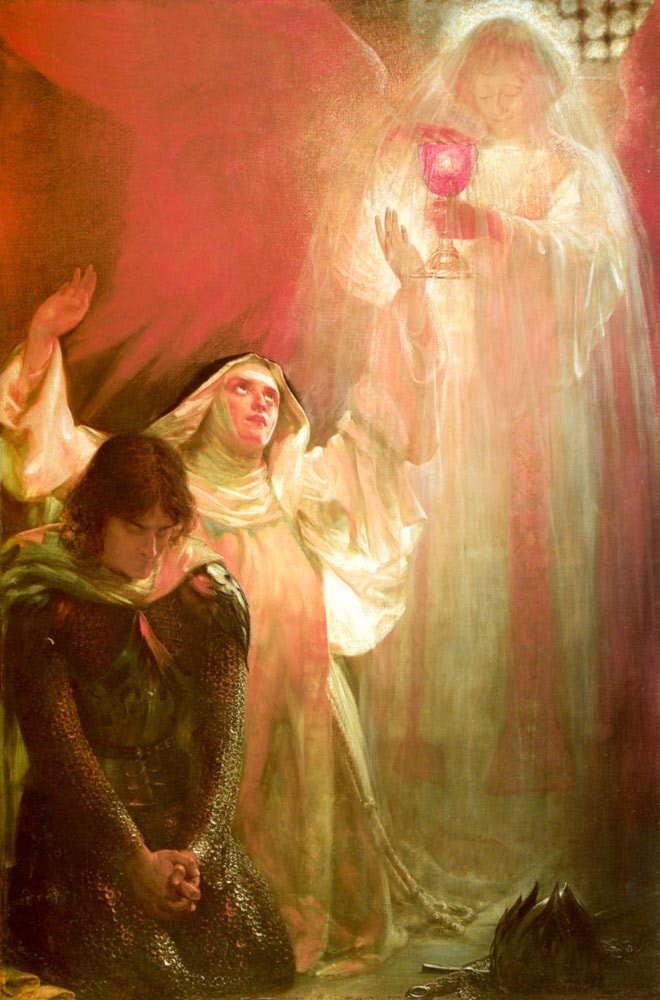
The Holy Grail is a treasure that serves as an important motif in Arthurian literature. Various traditions describe the Holy Grail as a cup, dish, or stone with miraculous healing powers, sometimes providing eternal youth or sustenance in infinite abundance, often guarded in the custody of the Fisher King and located in the hidden Grail castle. By analogy, any elusive object or goal of great significance may be perceived as a “holy grail” by those seeking such. A mysterious “grail” (Old French: graal or greal), wondrous but not unequivocally holy, first appears in Perceval, the Story of the Grail, an unfinished chivalric romance written by Chrétien de Troyes around 1190. Chrétien’s story inspired many continuations, translators and interpreters in the later-12th and early-13th centuries… Writing soon after Chrétien, Robert de Boron in Joseph d’Arimathie [fr] portrayed the Grail as Jesus’s vessel from the Last Supper, which Joseph of Arimathea used to catch Christ’s blood at the crucifixion. Thereafter, the Holy Grail became interwoven with the legend of the Holy Chalice, the Last Supper cup, an idea continued in works such as the Lancelot-Grail cycle, and subsequently the 15th-century Le Morte d’Arthur. In this form, it is now a popular theme in modern culture, and has become the subject of folklore studies, pseudohistorical writings, works of fiction, and conspiracy theories…
Alias Holy Grail
Real Names/Alt Names Sangreal, Saint Graal, Sanct Grael, Graal Santel, Greal Sanctaidd, Gral
Appearance List Perceval, the Story of the Grail (c. 1180) by Chrétien de Troyes; Parzival (c. 1200–1210) by Wolfram von Eschenbach; Perlesvaus (early 13th c.); Queste del Saint Graal (c. 1220–1230); Vulgate Cycle (13th c.); Le Morte d’Arthur (1485) by Thomas Malory; Parzival (1833) — scholarly for modern Grail studies; Idylls of the King (1859–1885) by Alfred Lord Tennyson; The Story of the Champions of the Round Table (1905, 1911) by Howard Pyle [Internet Archive]; The Story of the Grail and the Passing of King Arthur (1910) by Howard Pyle [Internet Archive]; From Ritual to Romance (1920) by Jessie L. Weston. Film: Parsifal (1912) by Mario Caserini; Monty Python and the Holy Grail (1975) by Monty Python.
Sample Read The Story of the Champions of the Round Table (1905, 1911) by Howard Pyle [Internet Archive]
Description The Holy Grail is a treasure that serves as an important motif in Arthurian literature. Various traditions describe the Holy Grail as a cup, dish, or stone with miraculous healing powers, sometimes providing eternal youth or sustenance in infinite abundance, often guarded in the custody of the Fisher King and located in the hidden Grail castle. By analogy, any elusive object or goal of great significance may be perceived as a “holy grail” by those seeking such. A mysterious “grail” (Old French: graal or greal), wondrous but not unequivocally holy, first appears in Perceval, the Story of the Grail, an unfinished chivalric romance written by Chrétien de Troyes around 1190. Chrétien’s story inspired many continuations, translators and interpreters in the later-12th and early-13th centuries… Writing soon after Chrétien, Robert de Boron in Joseph d’Arimathie [fr] portrayed the Grail as Jesus’s vessel from the Last Supper, which Joseph of Arimathea used to catch Christ’s blood at the crucifixion. Thereafter, the Holy Grail became interwoven with the legend of the Holy Chalice, the Last Supper cup, an idea continued in works such as the Lancelot-Grail cycle, and subsequently the 15th-century Le Morte d’Arthur. In this form, it is now a popular theme in modern culture, and has become the subject of folklore studies, pseudohistorical writings, works of fiction, and conspiracy theories…

 ,
,  ,
,  ,
,  ,
,  ,
,  ,
,