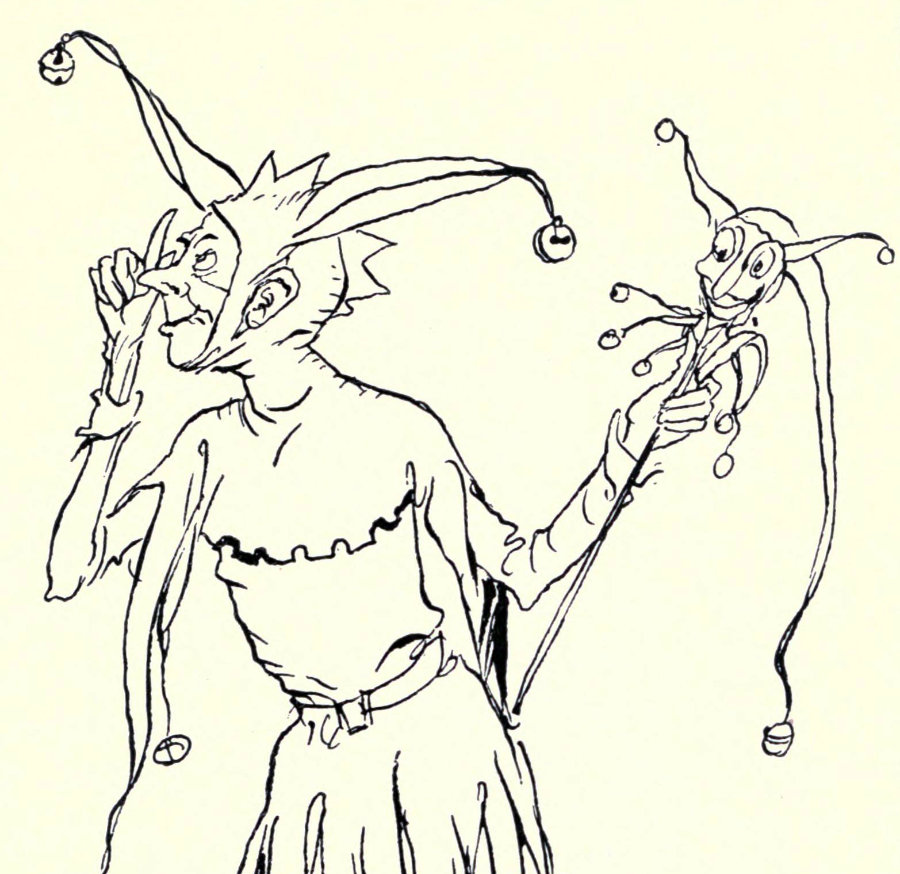
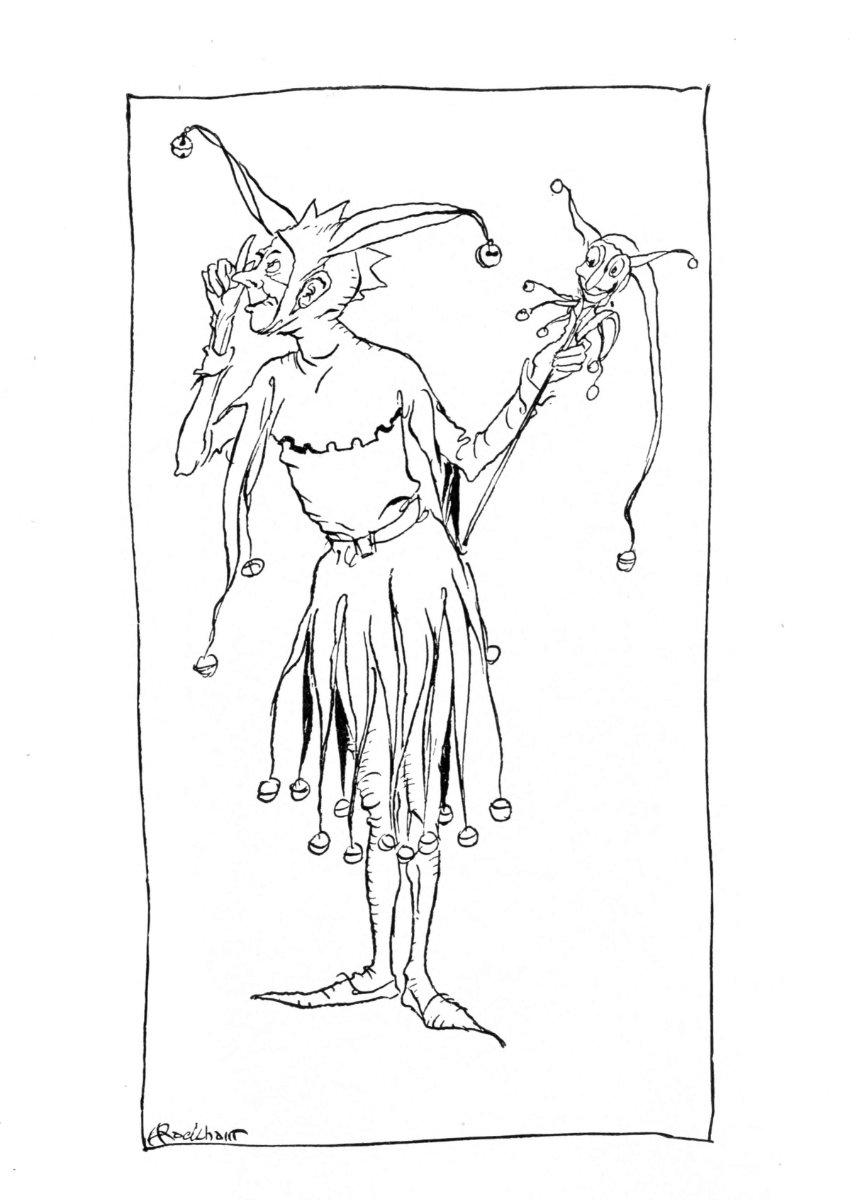
Dagonet is a Knight of the Round Table in Arthurian legend, introduced in Lancelot-Grail Cycle. His depictions and characterisations variously portray a foolish and cowardly knight, a violently deranged madman, and ultimately (since the Prose Tristan) the now-iconic image of King Arthur’s court jester… His first appearance is in the early 13th-century Vulgate Cycle. Known there as Daguenet the Fool (or the Coward) in the Vulgate Lancelot or Danguenes the Craven of Carlion (Caerleon) in the Vulgate Merlin, he is a hapless, dimwitted knight mocked by others. In one episode, he notably “captures” and actually rescues (inadvertently) the hero Lancelot by finding a horse carrying the unconscious knight, and triumphantly leading them to Queen Guinevere. His epiteth “the fool” (le fou) is not used to indicate his profession… In a markedly more positive (and best known today) characterization by Thomas Malory in his seminal Le Morte d’Arthur, adapting him from the Prose Tristan while adding new Dagonet material, he is King Arthur’s court fool who has been knighted as an award for his loyalty and comedic talents. The Knights of the Round Table use him to play practical jokes on their rivals or their enemies, at the same time protecting him from harm. In a rewrite of a scene from the Prose Tristan, Kay arranges for Brunor to joust with Dagonet at his first tournament in order to deprive him of the honour of defeating a true knight. On another occasion, Arthur’s men point out Dagonet, dressed in Mordred’s armor, to King Mark and tell him he is Lancelot; the cowardly monarch then flees screaming into the forest, chased by Dagonet…
Alias Dagonet, King Arthur’s Fool
Real Names/Alt Names Daguenet, Daguenes, Daguenez, Danguenes
Appearance List Annales Cambriae (10th century); Historia Regum Britanniae (1136); Merlin by Robert de Boron (late 12th–early 13th c.); The Vulgate Lancelot (13th c.); Le Morte d’Arthur (1485) by Thomas Malory; Ballads of Bravery (1877); The Boy’s King Arthur: Sir Thomas Malory’s History of King Arthur and His Knights of the Round Table by Sidney Lanier (Charles Scribner’s Sons, 1880); The Story of King Arthur and His Knights (1903) by Howard Pyle [Internet Archive]; The Story of the Champions of the Round Table (1905, 1911) by Howard Pyle [Internet Archive]; The Story of Sir Launcelot and His Companions (1907) by Howard Pyle [Internet Archive]; The Story of the Grail and the Passing of King Arthur (1910) by Howard Pyle [Internet Archive]; Tales of the Round Table (1908) by Andrew Lang [Internet Archive]; Myths and Legends of the Celtic Race (1910) by T. W. Rolleston [Internet Archive]; The Legends of King Arthur and His Knights (1912) [Internet Archive]; Idylls of the King (1859) by Alfred Lord Tennyson – 1913 illustrated edition: [Internet Archive]; Legends and Romances of Brittany (1917) by Lewis Spence. Film: Knights of the Round Table (1926) by Rex Ingram (silent, partially lost); Knights of the Round Table (1953) by Richard Thorpe; Lancelot and Guinevere (1963) by Cornel Wilde; The Sword in the Stone (1963) by Walt Disney Productions; Camelot (1967) by Joshua Logan; Excalibur (1981).
Description Dagonet is a Knight of the Round Table in Arthurian legend, introduced in Lancelot-Grail Cycle. His depictions and characterisations variously portray a foolish and cowardly knight, a violently deranged madman, and ultimately (since the Prose Tristan) the now-iconic image of King Arthur’s court jester… His first appearance is in the early 13th-century Vulgate Cycle. Known there as Daguenet the Fool (or the Coward) in the Vulgate Lancelot or Danguenes the Craven of Carlion (Caerleon) in the Vulgate Merlin, he is a hapless, dimwitted knight mocked by others. In one episode, he notably “captures” and actually rescues (inadvertently) the hero Lancelot by finding a horse carrying the unconscious knight, and triumphantly leading them to Queen Guinevere. His epiteth “the fool” (le fou) is not used to indicate his profession… In a markedly more positive (and best known today) characterization by Thomas Malory in his seminal Le Morte d’Arthur, adapting him from the Prose Tristan while adding new Dagonet material, he is King Arthur’s court fool who has been knighted as an award for his loyalty and comedic talents. The Knights of the Round Table use him to play practical jokes on their rivals or their enemies, at the same time protecting him from harm. In a rewrite of a scene from the Prose Tristan, Kay arranges for Brunor to joust with Dagonet at his first tournament in order to deprive him of the honour of defeating a true knight. On another occasion, Arthur’s men point out Dagonet, dressed in Mordred’s armor, to King Mark and tell him he is Lancelot; the cowardly monarch then flees screaming into the forest, chased by Dagonet…