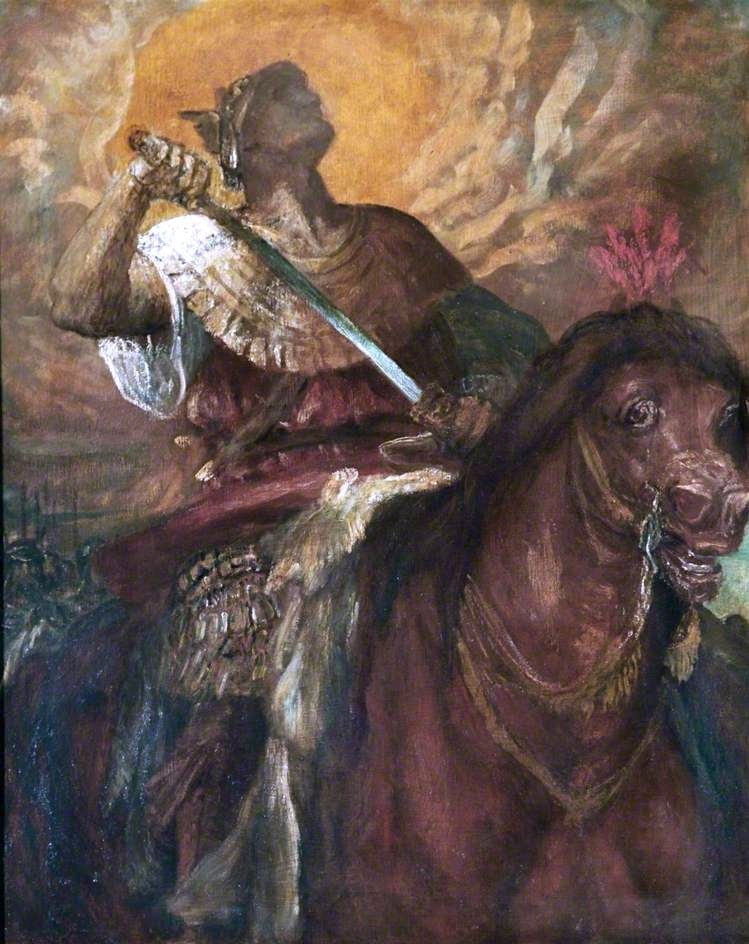
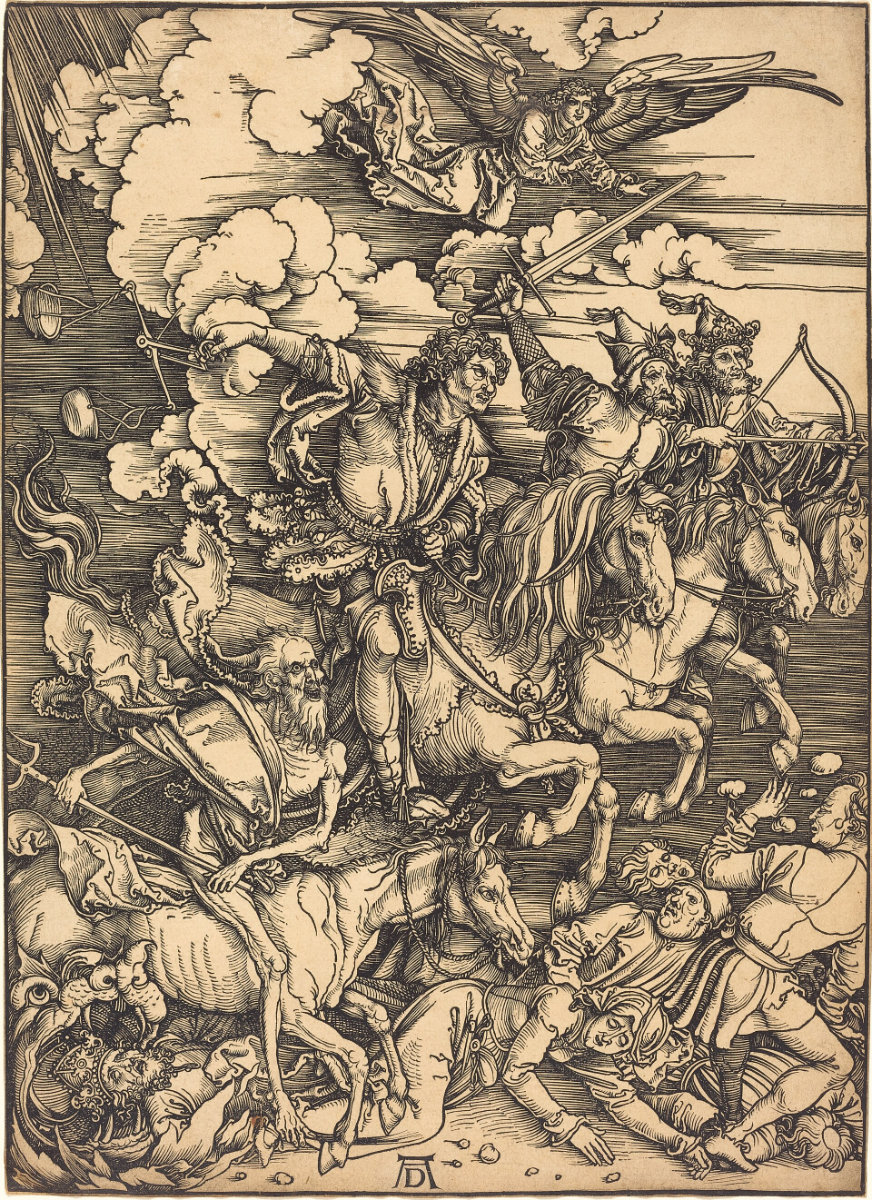
The Four Horsemen of the Apocalypse are figures in the Book of Revelation in the New Testament of the Bible, a piece of apocalypse literature attributed to John of Patmos, and generally regarded as dating from about AD 95. Similar allusions are contained in the Old Testament books of Ezekiel and Zechariah, written centuries prior. Though the text only provides a name for the fourth horseman, subsequent commentary often identifies them as personifications of Conquest (Zelus), War (Ares), Famine (Limos/Fames), and Death (Mors/Thanatos)… In John’s revelation the first horseman rides a white horse, carries a bow, and is given a crown as a figure of conquest (Zelus), perhaps invoking the Antichrist. The second carries a sword and rides a red horse as the creator of (civil) war (Ares), conflict, and strife. The third, a food merchant, rides a black horse symbolizing famine (Limos) and carries a pair of scales. The fourth and final horse is pale, upon it rides Death (Mors), accompanied by Hades (despite not being the same concept as the Greek God and Underworld with the same name, it was influenced by both as an intermediate realm (similar to the Asphodel Meadows) between Heaven (Ouranos) and Hell (Tartarus), like the Greek God was an intermediate between the other Gods). “They were given authority over a quarter of the Earth, to kill with sword, famine and plague, and by means of the beasts of the Earth.” Christianity typically interprets the Four Horsemen as a vision of harbingers of the Last Judgment, setting a divine end-time upon the world.
Appearance List Book of Revelation (c. 95 CE) — Rev. 6:1–8 [Internet Archive]; Exposition of the Apocalypse (published 1733) by Isaac Newton [Internet Archive]; The Four Horsemen of the Apocalypse (1916) [Internet Archive]. Film: The Four Horsemen of the Apocalypse (1921) — directed by Rex Ingram; The Four Horsemen of the Apocalypse (1962) — directed by Vincente Minnelli.
Sample Read The King James Version of the Bible [PG]
Description The Four Horsemen of the Apocalypse are figures in the Book of Revelation in the New Testament of the Bible, a piece of apocalypse literature attributed to John of Patmos, and generally regarded as dating from about AD 95. Similar allusions are contained in the Old Testament books of Ezekiel and Zechariah, written centuries prior. Though the text only provides a name for the fourth horseman, subsequent commentary often identifies them as personifications of Conquest (Zelus), War (Ares), Famine (Limos/Fames), and Death (Mors/Thanatos)… In John’s revelation the first horseman rides a white horse, carries a bow, and is given a crown as a figure of conquest (Zelus), perhaps invoking the Antichrist. The second carries a sword and rides a red horse as the creator of (civil) war (Ares), conflict, and strife. The third, a food merchant, rides a black horse symbolizing famine (Limos) and carries a pair of scales. The fourth and final horse is pale, upon it rides Death (Mors), accompanied by Hades (despite not being the same concept as the Greek God and Underworld with the same name, it was influenced by both as an intermediate realm (similar to the Asphodel Meadows) between Heaven (Ouranos) and Hell (Tartarus), like the Greek God was an intermediate between the other Gods). “They were given authority over a quarter of the Earth, to kill with sword, famine and plague, and by means of the beasts of the Earth.” Christianity typically interprets the Four Horsemen as a vision of harbingers of the Last Judgment, setting a divine end-time upon the world.