“La Félure” (“The Crack” in English) is presented as the final pages of a novelist’s journal, dated 16 October 1902, and published after his death in an asylum. He records the events of the previous day in order to understand a supernatural occurrence. He recounts waking in a poor attic room, owing rent and lacking money for food, while awaiting a payment from his uncle. He reviews the progress of a literary work that has expanded from a short piece into something longer. While examining his notes, he finds that he cannot fully form one key character, Burton: although the role is defined, he cannot determine the character’s physical appearance or nature. He joins acquaintances at a café and participates in a discussion about artistic creation, during which it is suggested that his characters derive from observation rather than invention. Afterward, remaining alone, he resumes mentally constructing the incomplete figure. The figure becomes defined in almost all aspects, except for certain details. While observing the people around him, he suddenly perceives, seated nearby, the very figure he has just formed in thought, matching the imagined traits. Instead of perception producing thought, his thought has produced a real person. However, as written Burton is not passive but dangerous. Fearing the murder scene Farges had planned, he leaves the café and returns to his room, pursued. Farges edits his manuscript, deleting the murder scene. This immediately alters reality. When Burton enters, he no longer attempts murder, but instead demands money for a debt, taking on another role drawn from Farges’ memory. Farges pays him, and Burton leaves. Farges rewrites the ending again so that Burton becomes despairing and commits suicide by jumping into the Seine. Farges goes to the morgue to confirm his death.
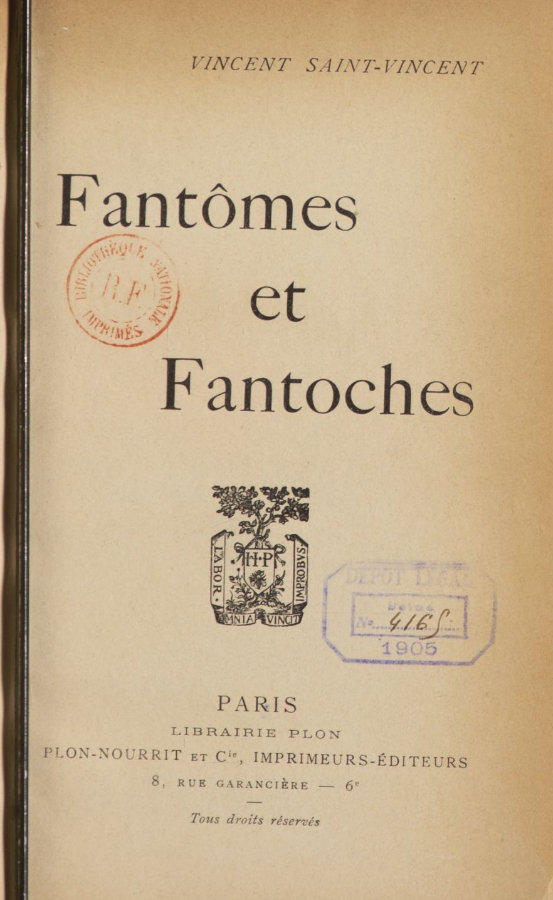
First Appearance “La Félure” included in Fantômes et fantoches (1905) by Vincent Saint-Vincent (pseud. of Maurice Renard)
First Publisher Plon-Nourrit
Appearance List “La Félure” included in Fantômes et fantoches (1905) by Vincent Saint-Vincent (pseud. of Maurice Renard), Paris: Plon-Nourrit [Gallica BnF]; “La Félure” included in Romans et contes fantastiques (1990) by Maurice Renard — collected reissue, Robert Laffont, collection “Bouquins”
Description “La Félure” (“The Crack” in English) is presented as the final pages of a novelist’s journal, dated 16 October 1902, and published after his death in an asylum. He records the events of the previous day in order to understand a supernatural occurrence. He recounts waking in a poor attic room, owing rent and lacking money for food, while awaiting a payment from his uncle. He reviews the progress of a literary work that has expanded from a short piece into something longer. While examining his notes, he finds that he cannot fully form one key character, Burton: although the role is defined, he cannot determine the character’s physical appearance or nature. He joins acquaintances at a café and participates in a discussion about artistic creation, during which it is suggested that his characters derive from observation rather than invention. Afterward, remaining alone, he resumes mentally constructing the incomplete figure. The figure becomes defined in almost all aspects, except for certain details. While observing the people around him, he suddenly perceives, seated nearby, the very figure he has just formed in thought, matching the imagined traits. Instead of perception producing thought, his thought has produced a real person. However, as written Burton is not passive but dangerous. Fearing the murder scene Farges had planned, he leaves the café and returns to his room, pursued. Farges edits his manuscript, deleting the murder scene. This immediately alters reality. When Burton enters, he no longer attempts murder, but instead demands money for a debt, taking on another role drawn from Farges’ memory. Farges pays him, and Burton leaves. Farges rewrites the ending again so that Burton becomes despairing and commits suicide by jumping into the Seine. Farges goes to the morgue to confirm his death.
Source Eidolon Station
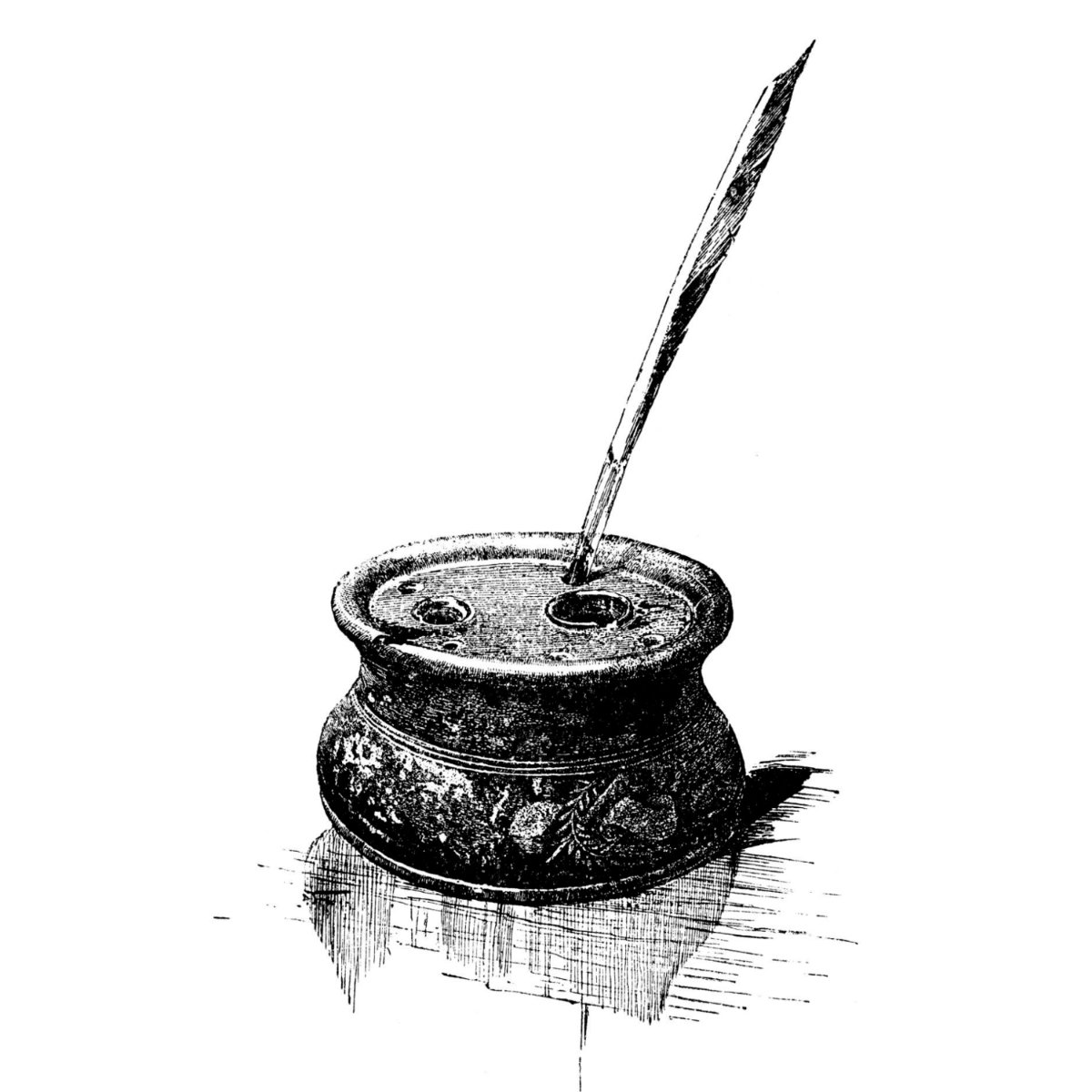
19th-century American wood engraving of Abraham Lincoln’s inkstand, likely published in an illustrated periodical such as Harper’s Weekly (c. 1865–1870)