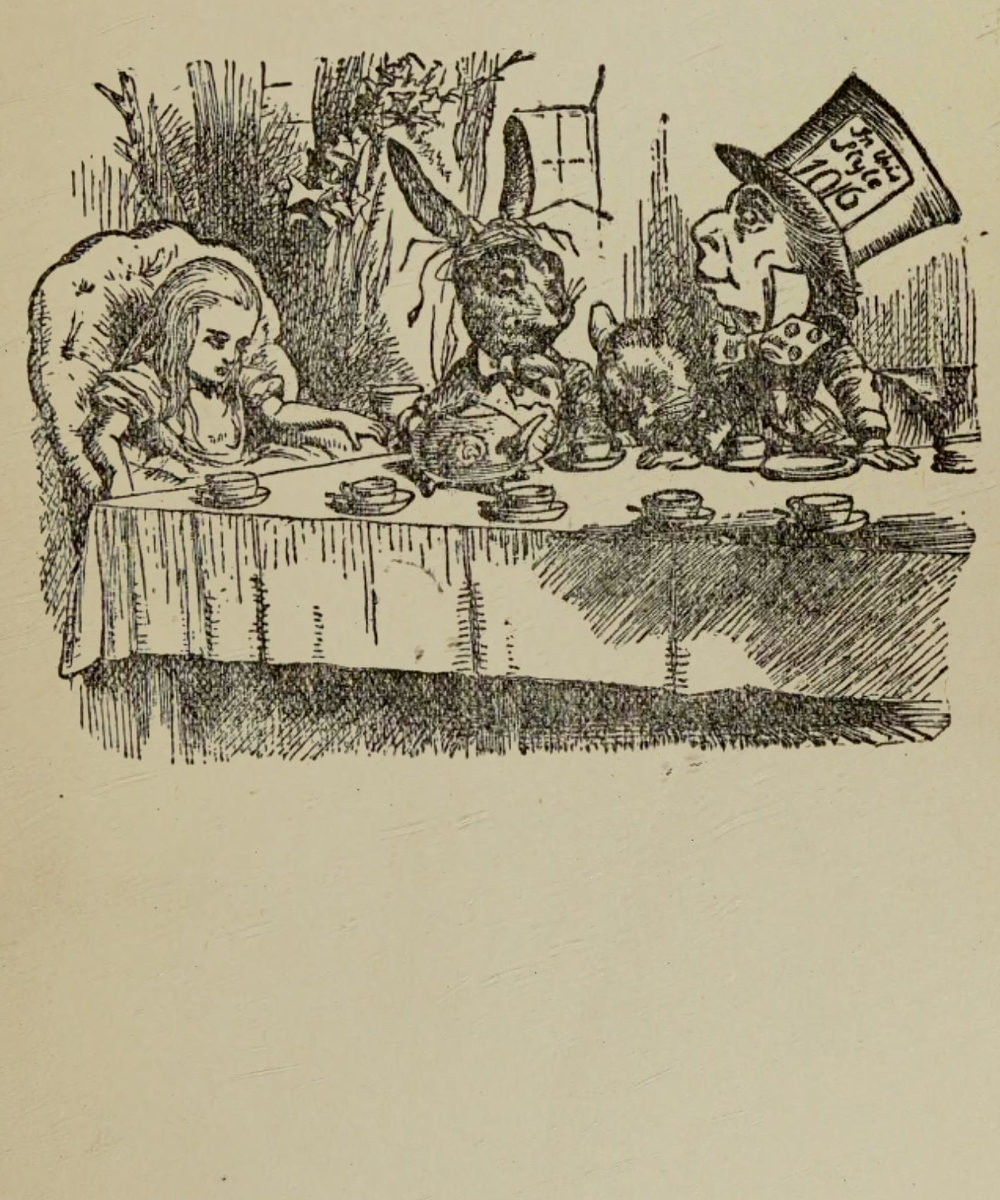
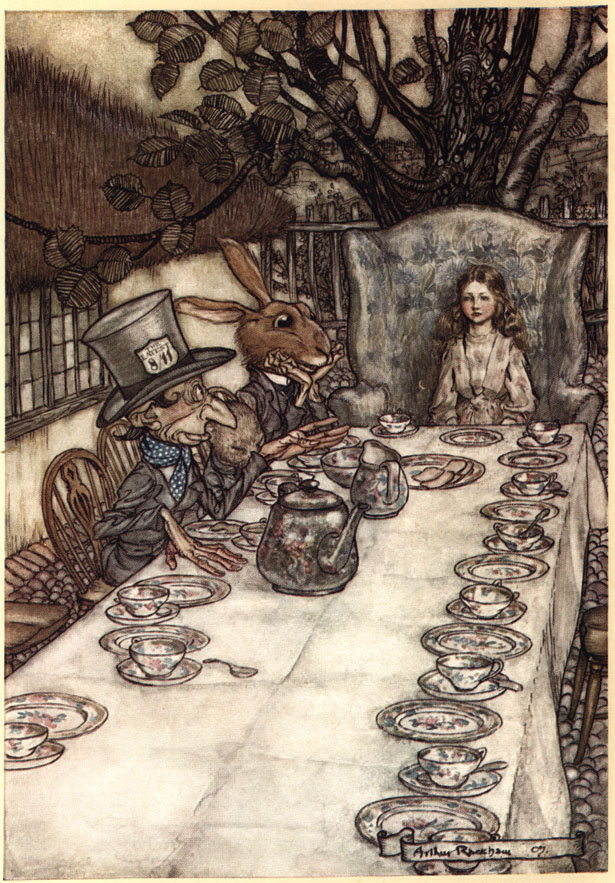
The March Hare (called Haigha in Through the Looking-Glass) is a character most famous for appearing in the tea party scene in Lewis Carroll’s 1865 book Alice’s Adventures in Wonderland. The main character, Alice, hypothesizes, “The March Hare will be much the most interesting, and perhaps as this is May it won’t be raving mad – at least not so mad as it was in March.” “Mad as a March hare” is a common British English phrase, both now and in Carroll’s time, and appears in John Heywood’s collection of proverbs published in 1546. It is reported in The Annotated Alice by Martin Gardner that this proverb is based on popular belief about hares’ behaviour at the beginning of the long breeding season, which lasts from February to September in Britain… Like the character’s friend, the Hatter, the March Hare feels compelled to always behave as though it is tea-time because the Hatter supposedly “murdered the time” whilst singing for the Queen of Hearts. Sir John Tenniel’s illustration also shows him with straw on his head, a common way to depict madness in Victorian times.
First Appearance Alice’s Adventures in Wonderland (1865)
First Publisher Macmillan
Appearance List Literature: Alice’s Adventures in Wonderland (1865, 1866) by Lewis Carroll, Through the Looking-Glass, and What Alice Found There (1872), The Nursery “Alice” (1890) early color/illustrated nursery edition), The Annotated Alice (1960). Film: Alice in Wonderland (1903) directed by Cecil Hepworth & Percy Stow, Alice’s Adventures in Wonderland (1910) directed by Edwin S. Porter (Edison), Alice in Wonderland (1915) directed by W. W. Young, Alice in Wonderland (1933) directed by Norman Z. McLeod (Paramount), Alice in Wonderland (1949) directed by Dallas Bower (stop-motion puppets), Alice in Wonderland (1951, Disney), Alice in Wonderland (1966, BBC), Alice’s Adventures in Wonderland (1972) musical directed by William Sterling.
Sample Read Alice’s Adventures In Wonderland By Lewis Carroll, Illustrated by John Tenniel (1910) [Internet Archive]
Description The March Hare (called Haigha in Through the Looking-Glass) is a character most famous for appearing in the tea party scene in Lewis Carroll’s 1865 book Alice’s Adventures in Wonderland. The main character, Alice, hypothesizes, “The March Hare will be much the most interesting, and perhaps as this is May it won’t be raving mad – at least not so mad as it was in March.” “Mad as a March hare” is a common British English phrase, both now and in Carroll’s time, and appears in John Heywood’s collection of proverbs published in 1546. It is reported in The Annotated Alice by Martin Gardner that this proverb is based on popular belief about hares’ behaviour at the beginning of the long breeding season, which lasts from February to September in Britain… Like the character’s friend, the Hatter, the March Hare feels compelled to always behave as though it is tea-time because the Hatter supposedly “murdered the time” whilst singing for the Queen of Hearts. Sir John Tenniel’s illustration also shows him with straw on his head, a common way to depict madness in Victorian times.