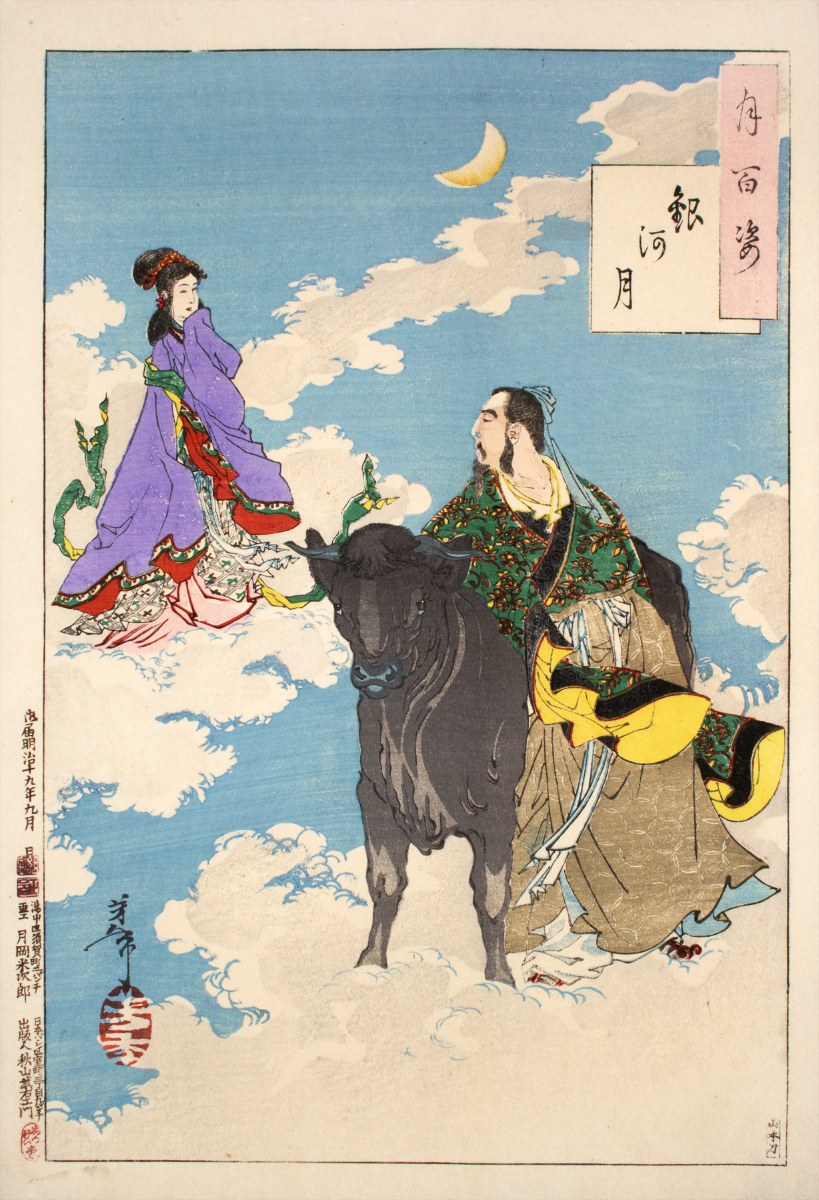
The Cowherd and the Weaver Girl are characters found in Chinese mythology and appear eponymously in a romantic Chinese folk tale. The story tells of the romance between Zhinü (織女; the weaver girl, symbolized by the star Vega) and Niulang (牛郎; the cowherd, symbolized by the star Altair). Despite their love for each other, their romance was forbidden, and thus they were banished to opposite sides of the heavenly river (symbolizing the Milky Way). Once a year, on the seventh day of the seventh lunar month, a flock of magpies would form a bridge to reunite the lovers for a single day. Though there are many variations of the story, the earliest-known reference to this famous myth dates back to a poem from the Classic of Poetry from over 2600 years ago… In Japan, the story revolves around the romance between the deities Orihime and Hikoboshi.
Alias Weaver Maiden
Real Names/Alt Names Zhinü (織女), Weaver Girl, Weaving Lady
First Appearance Shijing “Xiao Ya • Da Dong” (Zhou, 11th–7th c. BCE)
First Publisher ○
Appearance List Shijing “Xiao Ya • Da Dong” (Zhou, 11th–7th c. BCE); Han-period yuefu poem “迢迢牽牛星” (late Han, 1st–2nd c. CE); Man’yōshū (8th century; Eng. trans. 1969) by Nippon Gakujutsu Shinkōkai (translators) — Early Japanese poems featuring the Weaver Maiden; Japanese Fairy World: Stories from the Wonder-Lore of Japan (1880) by William Elliot Griffis — includes a chapter on the Star Festival (Tanabata); One Hundred Aspects of the Moon: The Moon of the Milky Way (1886) by Tsukioka Yoshitoshi — depicts Weaver Maiden’s reunion across the Milky Way; The Japanese Fairy Book (1903; 1922 ed.) by Yei Theodora Ozaki — includes “The Star Lovers” (Tanabata); The Romance of the Milky Way and Other Studies & Stories (1905) by Lafcadio Hearn — essay on the Tanabata legend and observances; Myths & Legends of Japan (1912) by F. Hadland Davis — retells the Star Lovers/Tanabata myth; The Chinese Fairy Book (1921) edited/translated by Richard Wilhelm — “The Herd-Boy and the Weaving-Maiden”; Myths and Legends of China (1922) by E. T. C. Werner — includes the Weaver Girl and Cowherd legend.
Sample Read The Romance of the Milky Way and Other Studies & Stories (1905) by Lafcadio Hearn [Internet Archive]
Description The Cowherd and the Weaver Girl are characters found in Chinese mythology and appear eponymously in a romantic Chinese folk tale. The story tells of the romance between Zhinü (織女; the weaver girl, symbolized by the star Vega) and Niulang (牛郎; the cowherd, symbolized by the star Altair). Despite their love for each other, their romance was forbidden, and thus they were banished to opposite sides of the heavenly river (symbolizing the Milky Way). Once a year, on the seventh day of the seventh lunar month, a flock of magpies would form a bridge to reunite the lovers for a single day. Though there are many variations of the story, the earliest-known reference to this famous myth dates back to a poem from the Classic of Poetry from over 2600 years ago… In Japan, the story revolves around the romance between the deities Orihime and Hikoboshi.