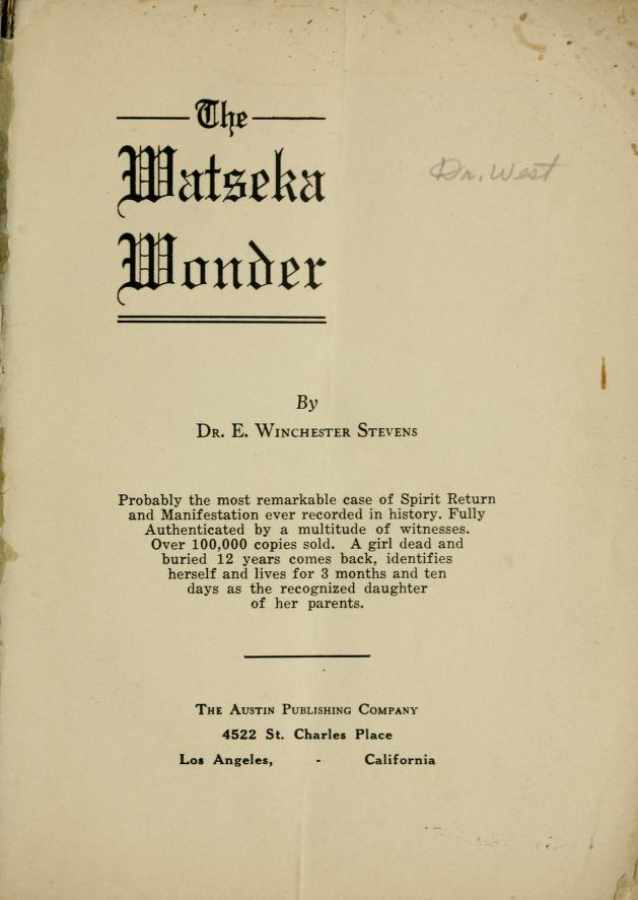
Watseka Wonder is the name given to the alleged spiritual possession of fourteen-year-old Lurancy Vennum of Watseka, Illinois in the late 19th century. Mary Lurancy Vennum was born in 1864 near Watseka, Illinois. In the summer of 1877 she suffered a series of epileptic fits, often lapsing into unconsciousness. After awakening, she told her family that she had been to heaven, had seen angels, and had visited her younger brother and sister who had died before her. As Vennum’s fits became more frequent, physicians advised there was nothing more they could do, and by January 1878 it was decided she should be placed in an insane asylum. A neighbor and devout Spiritist Asa B. Roff convinced Vennum’s parents not to commit her, and instead to call in a physician who was himself a Spiritist, E. Winchester Stevens. In 1878, physician and Spiritist E. Winchester Stevens examined Vennum. Stevens accounts were published in the leading Spiritist journal of the time, The Religio-Philosophical Journal, and later in an 1887 book entitled The Watseka Wonder in which he described Vennum as “the most remarkable case of spirit return and manifestation ever recorded in history.” According to Stevens, Vennum’s character would change suddenly, from morose and sullen, to “mystic and imaginary trances” in which she described joyous trips to heaven and visits with angels. According to Stevens, Vennum often spoke in different voices and became several different people, including an old woman named Katrina Hogan and a young man named Willie Canning. Stevens claims she remembered the names of several people who had died and had possessed her body, and later chose to be possessed by the soul of Asa Roff’s deceased daughter, Mary Roff. Psychical researcher Richard Hodgson of the American Society for Psychical Research was also convinced that Vennum was possessed by Roff’s spirit. William James briefly mentioned the case in his book The Principles of Psychology (1890). James commented that it is “perhaps as extreme a case of ‘possession’ of the modern sort as one can find.” According to Stevens and Hodgson, Vennum allowed Mary Roff to possess her body for about fifteen weeks during which time she could allegedly recognize all Roff’s friends and relatives, was familiar with all of the objects in the Roff home, and could retell incidents and stories from Roff’s childhood and her past life. Convinced that Vennum was a reincarnation of their daughter, the Roff family allowed the girl to live with them for several weeks. Stevens wrote that when Vennum later married, Roff’s spirit supposedly inhabited Vennum, resulting in a painless childbirth for her.
Appearance List Literature: The Principles of Psychology by William James (1890), Studies in Psychical Research by F. Podmore (1897), Psychology and Common Life: A Survey of the Present Results of Psychical Research with Special Reference to their Bearings upon the Interests of Every Day Life by Frank Sargent Hoffman (1903), Historic Ghosts and Ghost Hunters by Henry Addington Bruce (1908), The Watseka Wonder: A Narrative of Startling Phenomena Occurring in the Case of Mary Lurancy Vennum by E. Winchester Stevens (1887) [Internet Archive], The Watseka Wonder by E. Winchester Stevens (1928) [Illinois Library] [Internet Archive]. Radio: “The Girl With the Dual Personality” for Out of the Night (radio drama, 1949). Podcast: Astonishing Legends: Episode 215-216 The Watseka Wonder.
Sample Read Astonishing Legends: Episode 215 The Watseka Wonder Part 1 [YT]
Description Watseka Wonder is the name given to the alleged spiritual possession of fourteen-year-old Lurancy Vennum of Watseka, Illinois in the late 19th century. Mary Lurancy Vennum was born in 1864 near Watseka, Illinois. In the summer of 1877 she suffered a series of epileptic fits, often lapsing into unconsciousness. After awakening, she told her family that she had been to heaven, had seen angels, and had visited her younger brother and sister who had died before her. As Vennum’s fits became more frequent, physicians advised there was nothing more they could do, and by January 1878 it was decided she should be placed in an insane asylum. A neighbor and devout Spiritist Asa B. Roff convinced Vennum’s parents not to commit her, and instead to call in a physician who was himself a Spiritist, E. Winchester Stevens. In 1878, physician and Spiritist E. Winchester Stevens examined Vennum. Stevens accounts were published in the leading Spiritist journal of the time, The Religio-Philosophical Journal, and later in an 1887 book entitled The Watseka Wonder in which he described Vennum as “the most remarkable case of spirit return and manifestation ever recorded in history.” According to Stevens, Vennum’s character would change suddenly, from morose and sullen, to “mystic and imaginary trances” in which she described joyous trips to heaven and visits with angels. According to Stevens, Vennum often spoke in different voices and became several different people, including an old woman named Katrina Hogan and a young man named Willie Canning. Stevens claims she remembered the names of several people who had died and had possessed her body, and later chose to be possessed by the soul of Asa Roff’s deceased daughter, Mary Roff. Psychical researcher Richard Hodgson of the American Society for Psychical Research was also convinced that Vennum was possessed by Roff’s spirit. William James briefly mentioned the case in his book The Principles of Psychology (1890). James commented that it is “perhaps as extreme a case of ‘possession’ of the modern sort as one can find.” According to Stevens and Hodgson, Vennum allowed Mary Roff to possess her body for about fifteen weeks during which time she could allegedly recognize all Roff’s friends and relatives, was familiar with all of the objects in the Roff home, and could retell incidents and stories from Roff’s childhood and her past life. Convinced that Vennum was a reincarnation of their daughter, the Roff family allowed the girl to live with them for several weeks. Stevens wrote that when Vennum later married, Roff’s spirit supposedly inhabited Vennum, resulting in a painless childbirth for her.