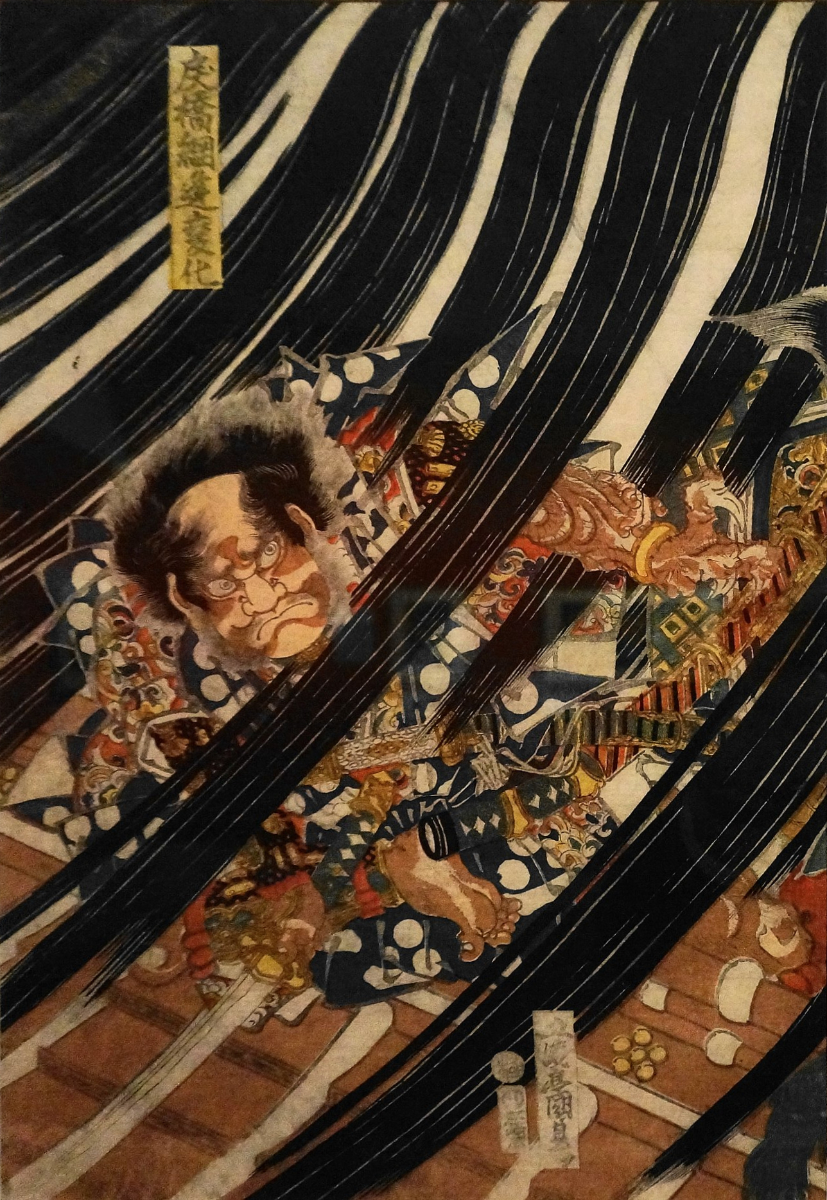
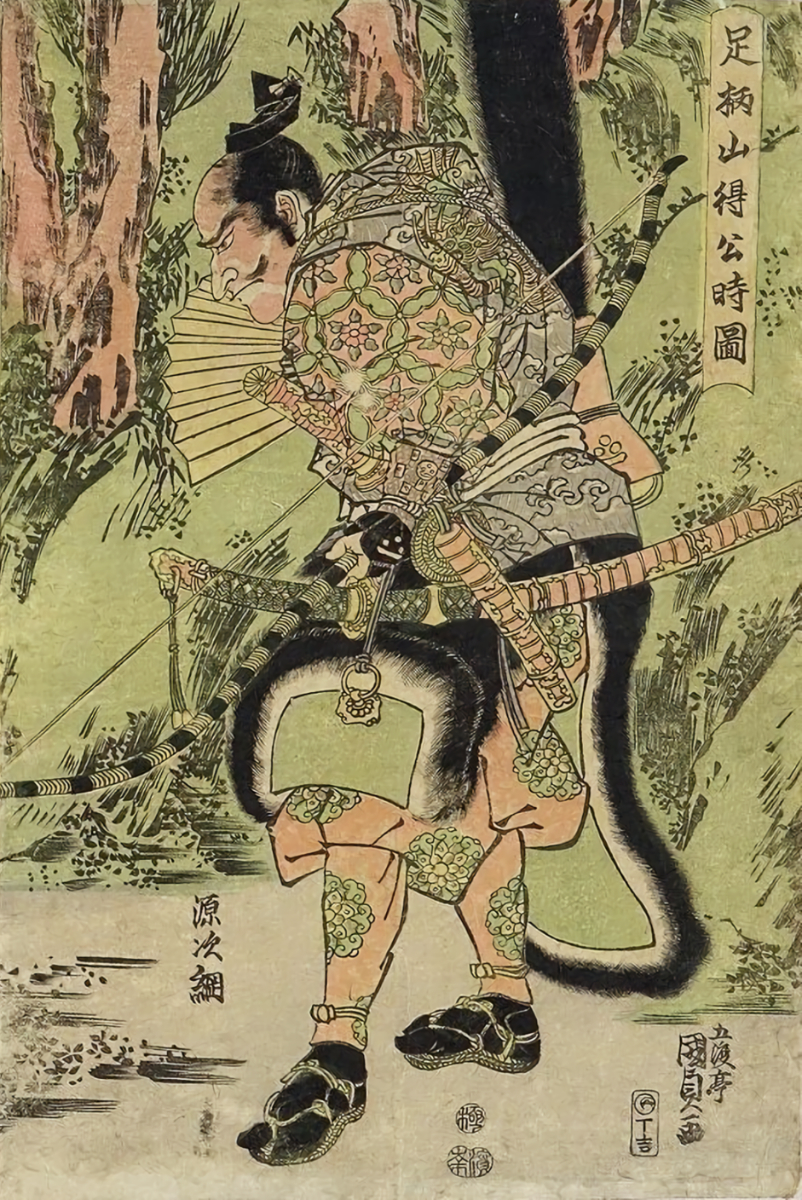
Watanabe no Tsuna (渡辺 綱) (953–1025) was a Japanese samurai of the Heian period and a companion in arms of Minamoto no Yorimitsu (also known as Raikō), one of the earliest samurai to be famed for his military exploits in a number of tales and legends. Tsuna features in many of Yorimitsu’s legendary adventures, and aids him in fighting many monsters, beasts and demons. His most famous feat is the defeat of the oni Ibaraki-doji, the principal follower of Shuten-doji. He fought Ibaraki-doji single-handedly at the Rashomon gate at the southern end of Suzaku-oji, the central North-South street in the old capital Heian-kyō (now Kyoto). In the battle, Tsuna amputated Ibaraki-doji’s arm with a tachi (Japanese long sword), nicknamed the “Higekiri”. This sword was forged at the same time as the “Hizamaru” used by Minamoto no Yorimitsu to repel tsuchigumo.
First Appearance Historical figure (b. 953 – d. 1025)
First Publisher ○
Appearance List Konjaku Monogatari-shū (c. 1120) — anonymous setsuwa anthology; Uji Shūi Monogatari (13th c.) — anonymous setsuwa anthology (D. E. Mills trans., 1970); Kokon Chōmonjū (1254) by Tachibana no Narisue; Tsuchigumo Sōshi (c. 14th c.) picture-scroll (emaki) by anonymous; Ōeyama Ekotoba (14th c.) picture-scroll (emaki) of Shuten-dōji’s defeat by anonymous; Otogi-zōshi: Shuten-dōji (Muromachi period) prose tale (multiple texts/printings; widely circulated in Otogi Bunko); Otogi-zōshi: Rashōmon (Muromachi period) prose tale — Rashōmon/Ibaraki arm episode; The Warrior Watanabe no Tsuna Fighting the Demon at Rashōmon (c. 1780s) woodblock print by Katsukawa Shunshō; Watanabe no Tsuna and the Demon of Rashōmon (1887–88) woodblock prints/variants by Tsukioka Yoshitoshi; Legend in Japanese Art (1908) by Henri L. Joly — art-historical survey with Raikō/Tsuna/Shuten imagery.
Description Watanabe no Tsuna (渡辺 綱) (953–1025) was a Japanese samurai of the Heian period and a companion in arms of Minamoto no Yorimitsu (also known as Raikō), one of the earliest samurai to be famed for his military exploits in a number of tales and legends. Tsuna features in many of Yorimitsu’s legendary adventures, and aids him in fighting many monsters, beasts and demons. His most famous feat is the defeat of the oni Ibaraki-doji, the principal follower of Shuten-doji. He fought Ibaraki-doji single-handedly at the Rashomon gate at the southern end of Suzaku-oji, the central North-South street in the old capital Heian-kyō (now Kyoto). In the battle, Tsuna amputated Ibaraki-doji’s arm with a tachi (Japanese long sword), nicknamed the “Higekiri”. This sword was forged at the same time as the “Hizamaru” used by Minamoto no Yorimitsu to repel tsuchigumo.


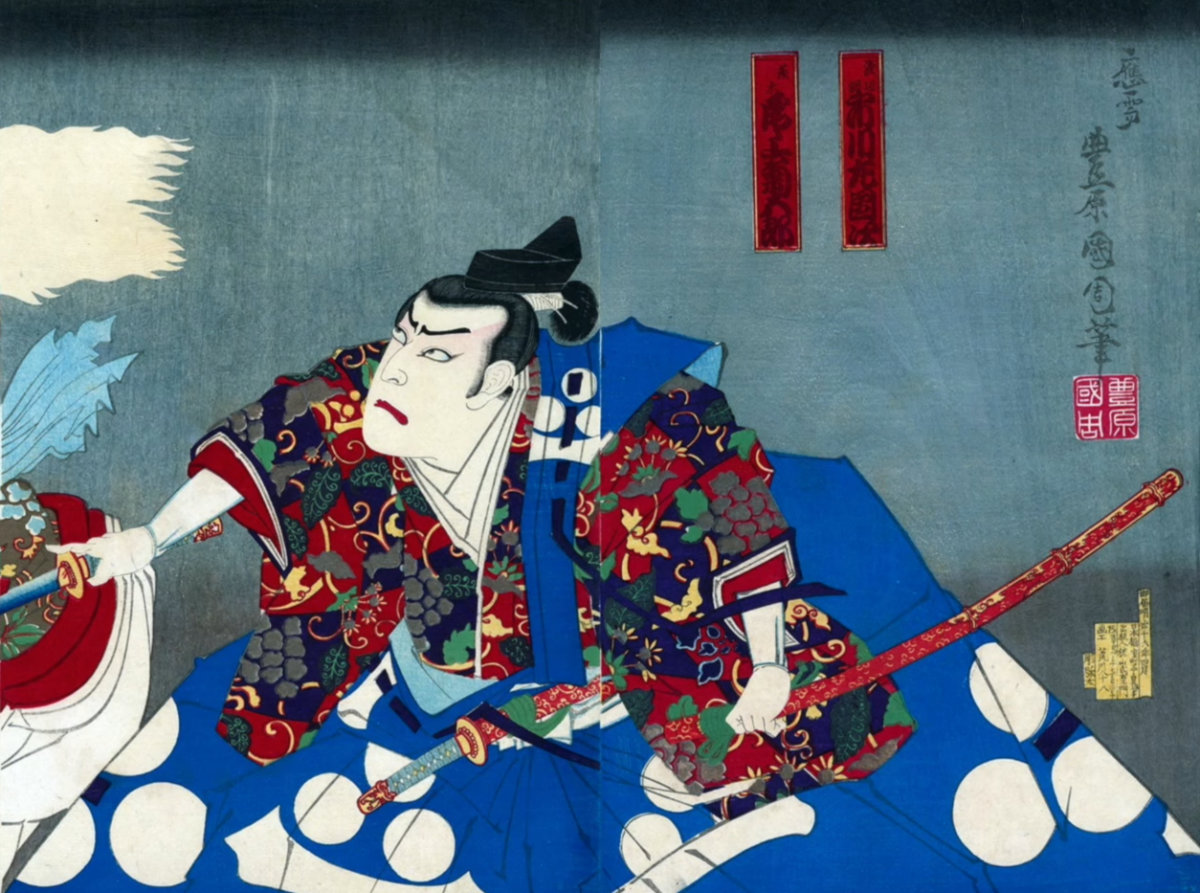 ,
,  ,
,