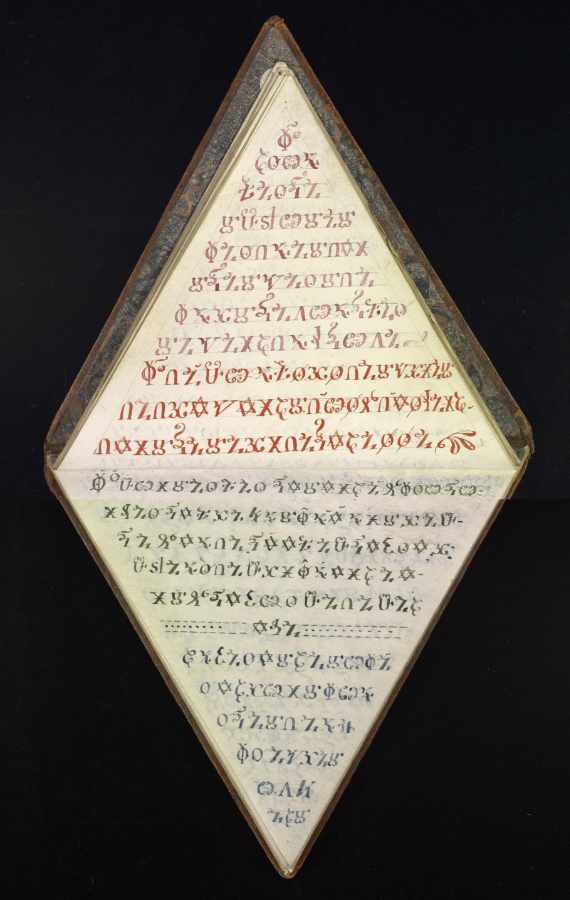
The Triangular Book of St. Germain or The Triangular Manuscript is an untitled 18th-century French text written in code, and attributed to the legendary Count of St. Germain. It takes its name from its physical shape: the binding and sheets of vellum that comprise the manuscript are in the shape of an equilateral triangle. The text, once deciphered, details a magical operation through which a person can perform feats of magic, notably the discovery of treasure and extension of life. The manuscript begins with a short Latin inscription mentioning that this is a gift given by Count of St. Germain, followed by an illustration of a winged dragon. All the text beyond this point, including the inscriptions belonging to the diagrams, is in cipher. The book describes a ritual aimed at achieving one of three goals: discovering the location of certain valuable objects (goals 1 and 2) and life extension (goal 3). The former requires performing the ritual during a full solar eclipse. The latter can be performed at any time, but it requires wearing a specific longevity amulet, which the manuscript then refers to in a diagram. The ritual described in the Triangular Manuscript resembles those described in the Heptameron, a handbook of ritual magic sometimes attributed to Pietro d’Abano that appeared around the 16th century in Europe.
Description The Triangular Book of St. Germain or The Triangular Manuscript is an untitled 18th-century French text written in code, and attributed to the legendary Count of St. Germain. It takes its name from its physical shape: the binding and sheets of vellum that comprise the manuscript are in the shape of an equilateral triangle. The text, once deciphered, details a magical operation through which a person can perform feats of magic, notably the discovery of treasure and extension of life. The manuscript begins with a short Latin inscription mentioning that this is a gift given by Count of St. Germain, followed by an illustration of a winged dragon. All the text beyond this point, including the inscriptions belonging to the diagrams, is in cipher. The book describes a ritual aimed at achieving one of three goals: discovering the location of certain valuable objects (goals 1 and 2) and life extension (goal 3). The former requires performing the ritual during a full solar eclipse. The latter can be performed at any time, but it requires wearing a specific longevity amulet, which the manuscript then refers to in a diagram. The ritual described in the Triangular Manuscript resembles those described in the Heptameron, a handbook of ritual magic sometimes attributed to Pietro d’Abano that appeared around the 16th century in Europe.