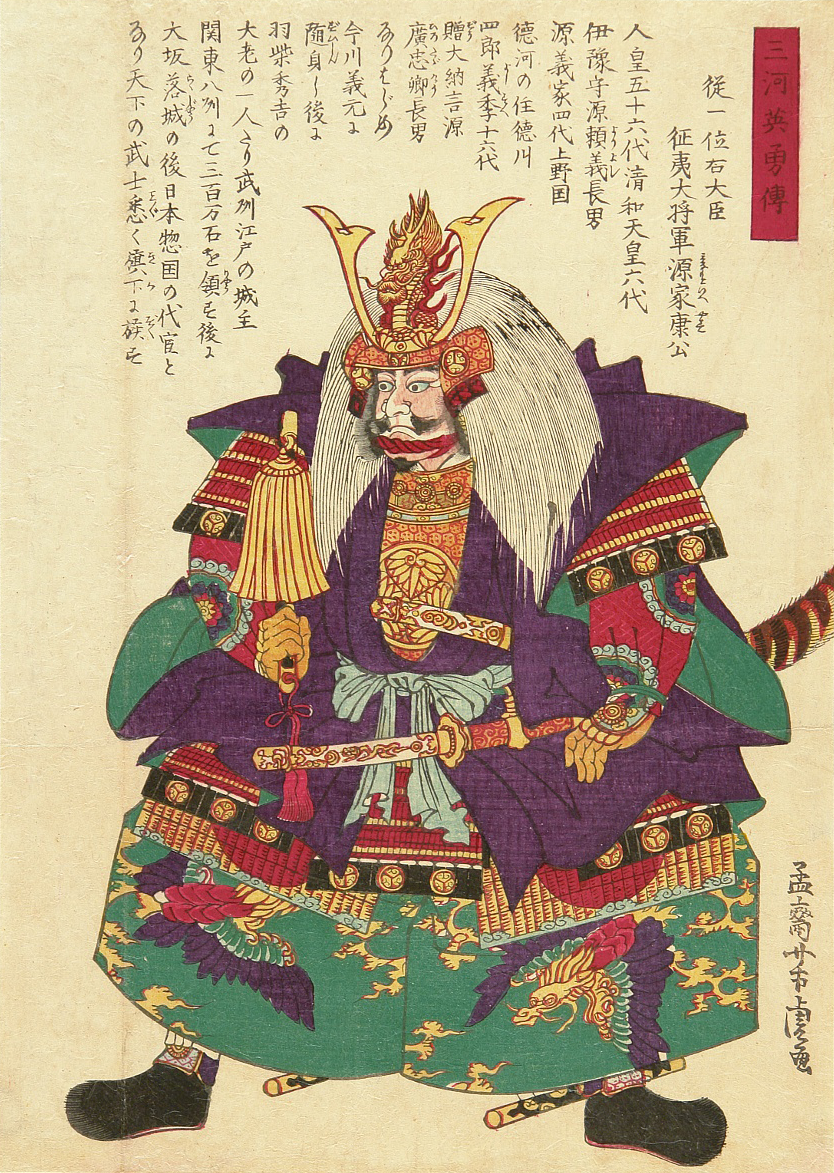
Tokugawa Ieyasu (born Matsudaira Takechiyo; January 31, 1543 – June 1, 1616) was the founder and first shōgun of the Tokugawa shogunate of Japan, which ruled from 1603 until the Meiji Restoration in 1868. He was the third of the three “Great Unifiers” of Japan, along with his former lord Oda Nobunaga and fellow Oda subordinate Toyotomi Hideyoshi. The son of a minor daimyo, Ieyasu once lived as a hostage under daimyo Imagawa Yoshimoto on behalf of his father. He later succeeded as daimyo after his father’s death, serving as ally, vassal, and general of the Oda clan, and building up his strength under Oda Nobunaga. After Oda Nobunaga’s death, Ieyasu was briefly a rival of Toyotomi Hideyoshi, before declaring his allegiance to Toyotomi and fighting on his behalf. Under Toyotomi, Ieyasu was relocated to the Kanto plains in eastern Japan, away from the Toyotomi power base in Osaka. He built his castle in the fishing village of Edo (now Tokyo). He became the most powerful daimyo and the most senior officer under the Toyotomi regime. Ieyasu preserved his strength during Toyotomi’s failed attempts to conquer Korea. After Hideyoshi’s death and the Battle of Sekigahara, Ieyasu seized power in 1600. He received appointment as shōgun in 1603, and voluntarily resigned from his position in 1605, although he still held the de facto control of government until his death in 1616. He implemented a set of careful rules known as the bakuhan system. This system used precisely graded rewards and punishments to encourage (or compel) the daimyo and samurai to live in peace with each other under the Tokugawa Shogunate.
First Appearance Historical figure (b. 1543 – d. 1616)
First Publisher ○
Appearance List A History of Japan, Vol. 2: During the Century of Early Foreign Intercourse, 1542–1651 (1903) by James Murdoch; The Maker of Modern Japan: The Life of Tokugawa Ieyasu (1937) by A. L. Sadler; A History of Japan, 1334–1615 (1961) by George B. Sansom; Politics in the Tokugawa Bakufu, 1600–1843 (1967) by Conrad D. Totman; The Samurai: A Military History (1977) by Stephen R. Turnbull
Sample Read A History of Japan, Vol. 2, 1542-1651 [Internet Archive]
Description Tokugawa Ieyasu (born Matsudaira Takechiyo; January 31, 1543 – June 1, 1616) was the founder and first shōgun of the Tokugawa shogunate of Japan, which ruled from 1603 until the Meiji Restoration in 1868. He was the third of the three “Great Unifiers” of Japan, along with his former lord Oda Nobunaga and fellow Oda subordinate Toyotomi Hideyoshi. The son of a minor daimyo, Ieyasu once lived as a hostage under daimyo Imagawa Yoshimoto on behalf of his father. He later succeeded as daimyo after his father’s death, serving as ally, vassal, and general of the Oda clan, and building up his strength under Oda Nobunaga. After Oda Nobunaga’s death, Ieyasu was briefly a rival of Toyotomi Hideyoshi, before declaring his allegiance to Toyotomi and fighting on his behalf. Under Toyotomi, Ieyasu was relocated to the Kanto plains in eastern Japan, away from the Toyotomi power base in Osaka. He built his castle in the fishing village of Edo (now Tokyo). He became the most powerful daimyo and the most senior officer under the Toyotomi regime. Ieyasu preserved his strength during Toyotomi’s failed attempts to conquer Korea. After Hideyoshi’s death and the Battle of Sekigahara, Ieyasu seized power in 1600. He received appointment as shōgun in 1603, and voluntarily resigned from his position in 1605, although he still held the de facto control of government until his death in 1616. He implemented a set of careful rules known as the bakuhan system. This system used precisely graded rewards and punishments to encourage (or compel) the daimyo and samurai to live in peace with each other under the Tokugawa Shogunate.