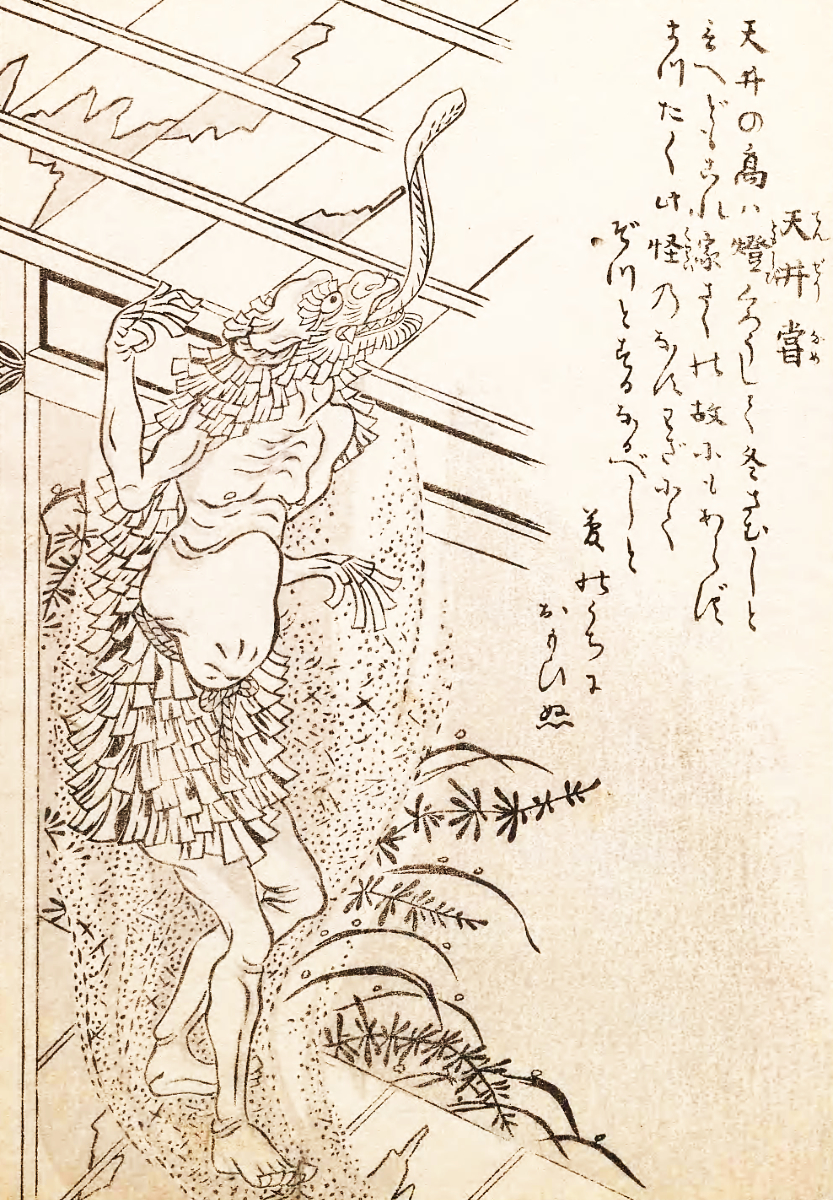
Tenjōname is a tall yōkai with a very long tongue. It appears in houses with tall ceilings, particularly in the cold months when light cannot reach all the way to ceiling and casts weird shadows into the rafters. It’s body is covered with strips of paper which resemble a matoi—the paper flags carried by Edo period firemen. Tenjōname is named for its primary activity: licking ceilings. The older a house gets, the more dust and grime collects in hard-to-clean places such as the ceiling. This attracts tenjōname, who lick the dirty ceilings to feed on the filth. The telltale sign that a tenjōname has been licking a ceiling is the appearance of dark stains and splotches on ceilings, walls, and support pillars. Tenjōname first appears in Toriyama Sekien’s Hyakki tsurezure bukuro, although its appearance seems to be inspired by older yōkai scrolls. Like many of the entries in that book, it appears to be a pun based on one of the essays in Yoshida Kenkō’s Tsurezure gusa. Essay number fifty five gives advice on building a house, and states that too high a ceiling would make winters feel too cold and lamplight seem to dark. Toriyama Sekien references this essay in his description of tenjōname. Although it is not specifically stated, based on its appearance and the fact that most of the yōkai in Hyakki tsurezure bukuro are tsukumogami, it is likely that tenjōname is a transformed matoi.
Description Tenjōname is a tall yōkai with a very long tongue. It appears in houses with tall ceilings, particularly in the cold months when light cannot reach all the way to ceiling and casts weird shadows into the rafters. It’s body is covered with strips of paper which resemble a matoi—the paper flags carried by Edo period firemen. Tenjōname is named for its primary activity: licking ceilings. The older a house gets, the more dust and grime collects in hard-to-clean places such as the ceiling. This attracts tenjōname, who lick the dirty ceilings to feed on the filth. The telltale sign that a tenjōname has been licking a ceiling is the appearance of dark stains and splotches on ceilings, walls, and support pillars. Tenjōname first appears in Toriyama Sekien’s Hyakki tsurezure bukuro, although its appearance seems to be inspired by older yōkai scrolls. Like many of the entries in that book, it appears to be a pun based on one of the essays in Yoshida Kenkō’s Tsurezure gusa. Essay number fifty five gives advice on building a house, and states that too high a ceiling would make winters feel too cold and lamplight seem to dark. Toriyama Sekien references this essay in his description of tenjōname. Although it is not specifically stated, based on its appearance and the fact that most of the yōkai in Hyakki tsurezure bukuro are tsukumogami, it is likely that tenjōname is a transformed matoi.