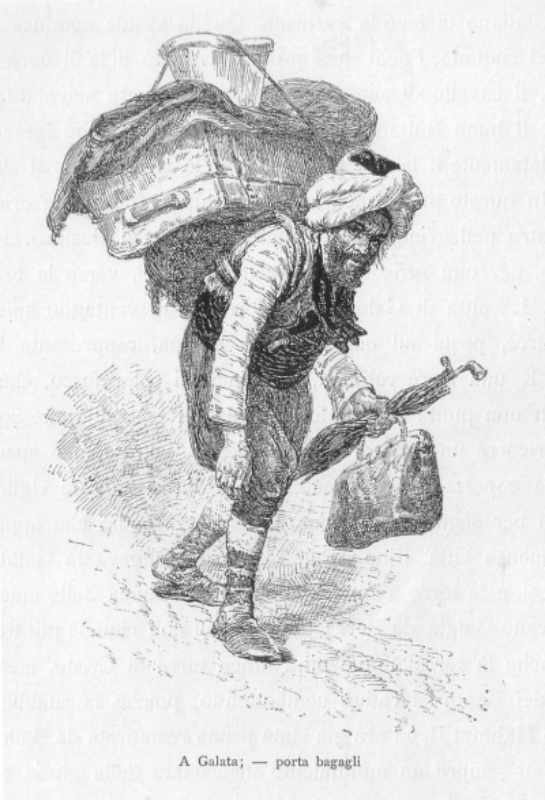
Sinbad the Sailor is a fictional mariner and the hero of a story-cycle of Arabic origin. He is described as hailing from Baghdad during the early Abbasid Caliphate (8th and 9th centuries A.D.). In the course of seven voyages throughout the seas east of Africa and south of Asia, he has fantastic adventures in magical realms, encountering monsters and witnessing supernatural phenomena. The tales of Sinbad are a relatively late addition to the One Thousand and One Nights – they do not feature in the earliest 14th-century manuscript, and they appear as an independent cycle in 18th- and 19th-century collections. The tale reflects the trend within the Abbasid realm of Arab and Muslim sailors exploring the world. The stories display the folk and themes present in works of that time. The Abbasid reign was known as a period of great economic and social growth. Arab and Muslim traders would seek new trading routes and people to trade with. This process of growth is reflected in the Sinbad tales. Like the 1001 Nights, the Sinbad story-cycle has a frame story which goes as follows: in the days of Harun al-Rashid, Caliph of Baghdad, a poor porter (one who carries goods for others in the market and throughout the city) pauses to rest on a bench outside the gate of a rich merchant’s house, where he complains to God about the injustice of a world which allows the rich to live in ease while he must toil and yet remain poor. The owner of the house hears and sends for the porter, finding that they are both named Sinbad. The rich Sinbad tells the poor Sinbad that he became wealthy “by Fortune and Fate” in the course of seven wondrous voyages, which he then proceeds to relate.
Appearance List Literary: One Thousand and One Nights, or Arabian Nights with first English-language edition c. 1706–1721, The Arabian Nights: Their Best-known Tales by Smith, Wiggin, and Parrish (1909), et. al.
Sample Read The Arabian Nights: Their Best-known Tales by Smith, Wiggin, and Parrish [PG]
Description Sinbad the Sailor is a fictional mariner and the hero of a story-cycle of Arabic origin. He is described as hailing from Baghdad during the early Abbasid Caliphate (8th and 9th centuries A.D.). In the course of seven voyages throughout the seas east of Africa and south of Asia, he has fantastic adventures in magical realms, encountering monsters and witnessing supernatural phenomena. The tales of Sinbad are a relatively late addition to the One Thousand and One Nights – they do not feature in the earliest 14th-century manuscript, and they appear as an independent cycle in 18th- and 19th-century collections. The tale reflects the trend within the Abbasid realm of Arab and Muslim sailors exploring the world. The stories display the folk and themes present in works of that time. The Abbasid reign was known as a period of great economic and social growth. Arab and Muslim traders would seek new trading routes and people to trade with. This process of growth is reflected in the Sinbad tales. Like the 1001 Nights, the Sinbad story-cycle has a frame story which goes as follows: in the days of Harun al-Rashid, Caliph of Baghdad, a poor porter (one who carries goods for others in the market and throughout the city) pauses to rest on a bench outside the gate of a rich merchant’s house, where he complains to God about the injustice of a world which allows the rich to live in ease while he must toil and yet remain poor. The owner of the house hears and sends for the porter, finding that they are both named Sinbad. The rich Sinbad tells the poor Sinbad that he became wealthy “by Fortune and Fate” in the course of seven wondrous voyages, which he then proceeds to relate.