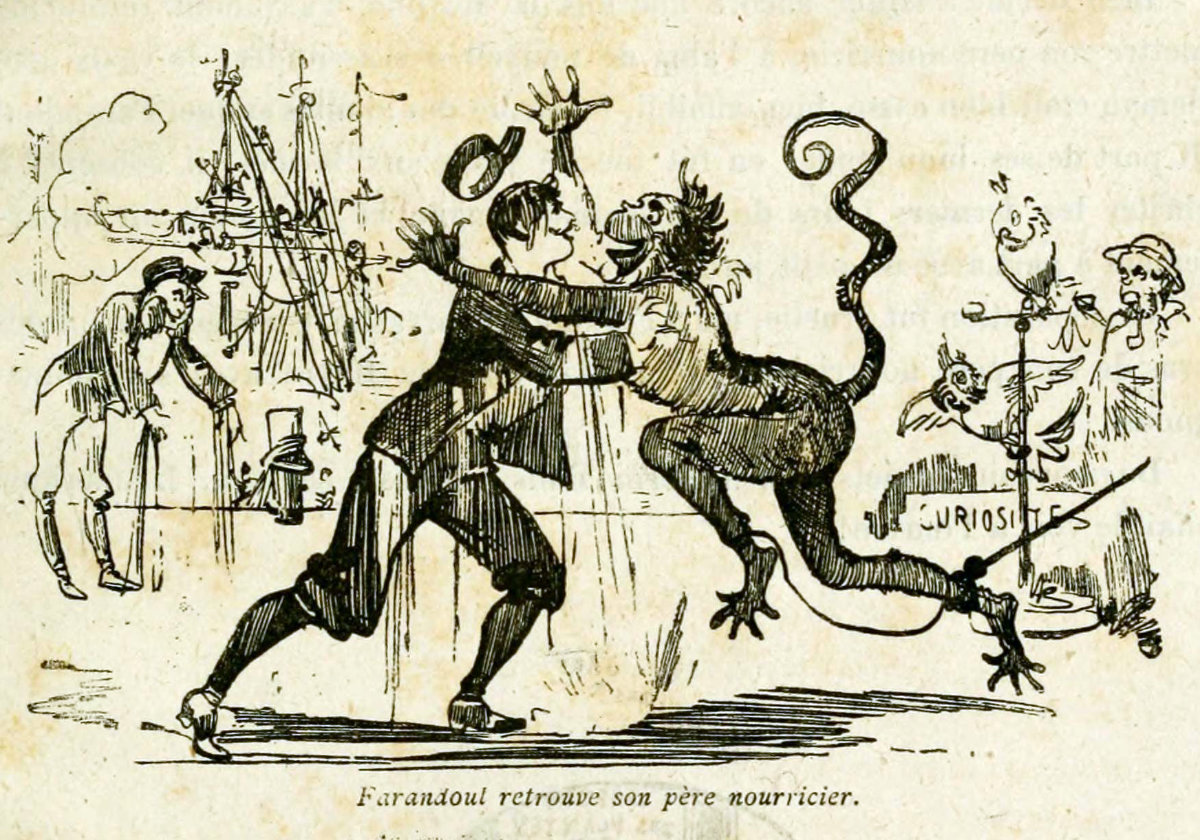
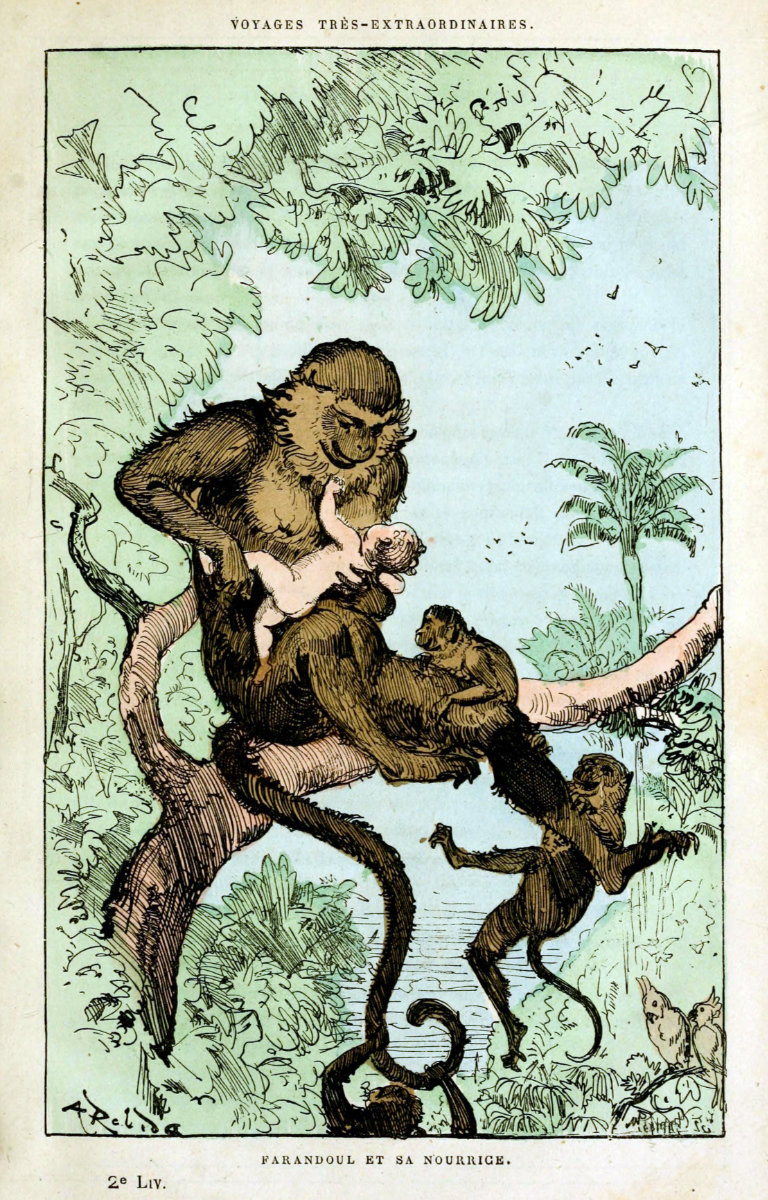
The adventure began with a shipwreck, during which Saturnin, aged 4 months and 7 days, in his cradle, washed up on an island populated by monkeys. Adopted, he became as agile as them. At 11, aware of his difference, he left his tribe, took to the sea on a palm trunk, and was picked up by a ship. He learned quickly, becoming a leader among men, but also among animals. A battle with pirates brought him back to his tribe of monkeys, of which he makes an armed, educated and civilized regiment, and achieves repeated victories. Designed, as its title suggests, as a parody of Jules Verne’s Extraordinary Voyages, the hero Saturnin Farandoul lives incredible adventures around the world and meets a large number of characters created by Jules Verne, teaming up with Captain Nemo to conquer Australia, battling Philéas Fogg in the American Civil War, meeting Hector Servadac in orbit around Saturn, stealing a white elephant from Michel Strogoff in Siberia, and challenging Captain Hatteras at the North Pole. The 1879 novel, initially published in parts by the Librairie Illustrée and Librairie Dreyfous, was reissued in one volume the same year with a fold-out and historiated map of the adventures of Saturnin Farandoul. Based on an 1882 reissue, the novel can be divided into five parts: “The Monkey King”, “Around the World in More than 80 Days”, “The Four Queens”, “In Search of the White Elephant”, and “His Excellency Mr. Governor of the North Pole”.
First Appearance “The Extraordinary Voyages of Saturnino Farandoul, in the Five or Six Parts of the World and in All Countries Known and Unknown to Mr Jules Verne” serialized in Librairie Illustrée and Librairie Dreyfous (1879)
First Publisher ○
Appearance List The Extraordinary Voyages of Saturnino Farandoul, in the Five or Six Parts of the World and in All Countries Known and Unknown to Mr Jules Verne (1879, 1882 reissue), which includes Ptie 1 The King of the Monkeys [Internet Archive]; Ptie 2 Around the world in more than 80 days; Ptie 3 The Four Queens; Ptie 4 In search of the white elephant; Ptie 5 His Excellency the Governor of the North Pole. Film: The Extraordinary Adventures of Saturnino Farandola (1913).
Sample Read The Extraordinary Voyages of Saturnino Farandola — Ptie. 1 The King of the Monkeys (1879) [Internet Archive]
Description The adventure began with a shipwreck, during which Saturnin, aged 4 months and 7 days, in his cradle, washed up on an island populated by monkeys. Adopted, he became as agile as them. At 11, aware of his difference, he left his tribe, took to the sea on a palm trunk, and was picked up by a ship. He learned quickly, becoming a leader among men, but also among animals. A battle with pirates brought him back to his tribe of monkeys, of which he makes an armed, educated and civilized regiment, and achieves repeated victories. Designed, as its title suggests, as a parody of Jules Verne’s Extraordinary Voyages, the hero Saturnin Farandoul lives incredible adventures around the world and meets a large number of characters created by Jules Verne, teaming up with Captain Nemo to conquer Australia, battling Philéas Fogg in the American Civil War, meeting Hector Servadac in orbit around Saturn, stealing a white elephant from Michel Strogoff in Siberia, and challenging Captain Hatteras at the North Pole. The 1879 novel, initially published in parts by the Librairie Illustrée and Librairie Dreyfous, was reissued in one volume the same year with a fold-out and historiated map of the adventures of Saturnin Farandoul. Based on an 1882 reissue, the novel can be divided into five parts: “The Monkey King”, “Around the World in More than 80 Days”, “The Four Queens”, “In Search of the White Elephant”, and “His Excellency Mr. Governor of the North Pole”.


 ,
,