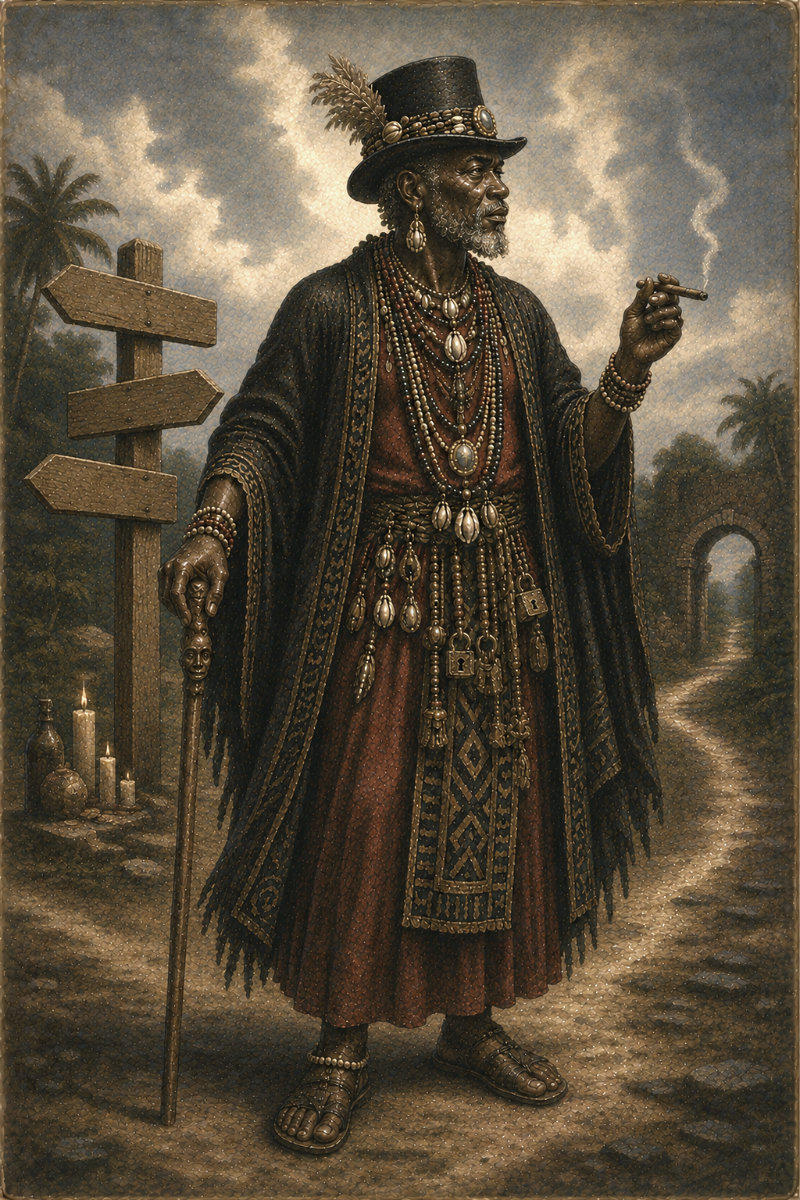
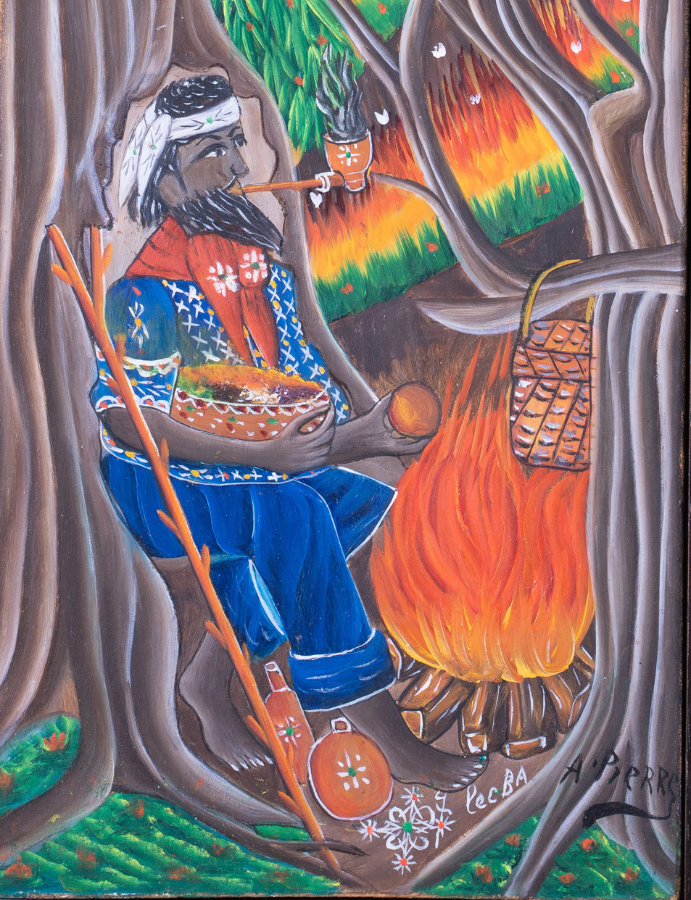
Papa Legba is a Lwa in Haitian Vodou and Louisiana Voodoo, who serves as the intermediary between the Lwa and humanity. He stands at a spiritual crossroads and gives (or denies) permission to speak with the spirits of Guineé, and is believed to speak all human languages. In Haiti, he is the great elocutioner. Legba facilitates communication, speech, and understanding. He is commonly associated with dogs. Papa Legba is invoked at the beginning of every ceremony. Papa Legba has his origins in the historic West African kingdom of Dahomey, located within present-day Benin. He usually appears as an old man on a crutch or with a cane, wearing a broad-brimmed straw hat and smoking a pipe, or drinking dark rum. The dog is sacred to him. Legba is syncretized with Saint Peter, Saint Lazarus, and Saint Anthony. His veve incorporates a walking cane on the right side. Offerings to him typically include candy. Legba is a favorite Lwa of children due to his jolly, grandpa-like image. He is often tasked with babysitting and distracting children (a typical male role in the matrilineal religion) while more serious rituals are being performed by the adults.
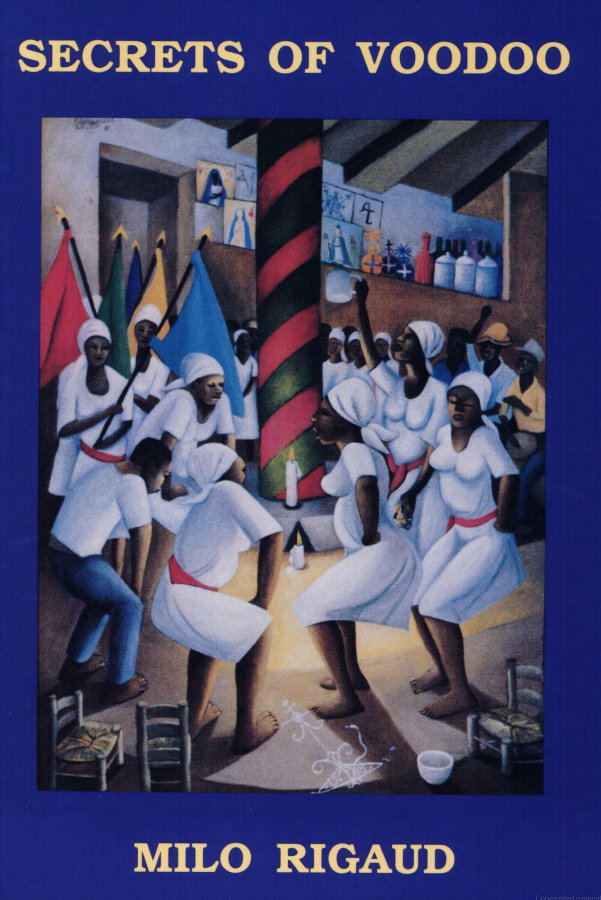
Appearance List Literature: Dahomey: An Ancient West African Kingdom (1938) by Melville J. Herskovits, Tell My Horse (1938) by Zora Neale Hurston, Divine Horsemen: The Living Gods of Haiti (1953) by Maya Deren, La tradition voudoo et le voudoo haïtien (1953) by Milo Rigaud, Le vaudou haïtien (1958) by Alfred Métraux, Dahomean Narrative: A Cross-Cultural Analysis (1958) by Melville J. Herskovits & Frances S. Herskovits, Flash of the Spirit: African & Afro-American Art & Philosophy (1983) by Robert Farris Thompson, “Who Is That Fellow in the Many-Colored Cap? Transformations of Eshu in Old and New World Mythologies” in Journal of American Folklore (1987) by Donald Cosentino. Film: Divine Horsemen: The Living Gods of Haiti (1985) by Maya Deren.
Sample Read Dahomey: An Ancient West African Kingdom (1938) [Internet Archive]
Description Papa Legba is a Lwa in Haitian Vodou and Louisiana Voodoo, who serves as the intermediary between the Lwa and humanity. He stands at a spiritual crossroads and gives (or denies) permission to speak with the spirits of Guineé, and is believed to speak all human languages. In Haiti, he is the great elocutioner. Legba facilitates communication, speech, and understanding. He is commonly associated with dogs. Papa Legba is invoked at the beginning of every ceremony. Papa Legba has his origins in the historic West African kingdom of Dahomey, located within present-day Benin. He usually appears as an old man on a crutch or with a cane, wearing a broad-brimmed straw hat and smoking a pipe, or drinking dark rum. The dog is sacred to him. Legba is syncretized with Saint Peter, Saint Lazarus, and Saint Anthony. His veve incorporates a walking cane on the right side. Offerings to him typically include candy. Legba is a favorite Lwa of children due to his jolly, grandpa-like image. He is often tasked with babysitting and distracting children (a typical male role in the matrilineal religion) while more serious rituals are being performed by the adults.

 ,
,