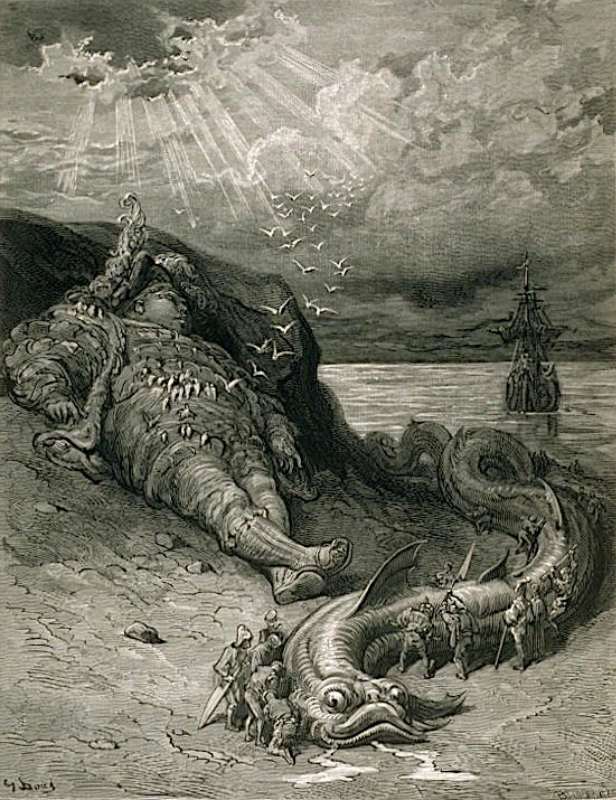
The Horrible and Terrifying Deeds and Words of the Very Renowned Pantagruel King of the Dipsodes, Son of the Great Giant Gargantua (French: Les horribles et épouvantables faits et prouesses du très renommé Pantagruel Roi des Dipsodes, fils du Grand Géant Gargantua) was published around 1532 under the pen name Alcofribas Nasier, an anagram of François Rabelais. The narrative begins with the origin of giants; Pantagruel’s particular genealogy; and his birth. His childhood is briefly covered, before his father sends him away to the universities. He acquires a great reputation. On receiving a letter with news that his father has been translated to Fairyland by Morgan le Fay; and that the Dipsodes, hearing of it, have invaded his land, and are besieging a city: Pantagruel and his companions depart. Through subterfuge, might, and urine, the besieged city is relieved, and residents invited to invade the Dipsodes, who mostly surrender to Pantagruel as he and his army visit their towns. During a downpour, Pantagruel shelters his army with his tongue, and the narrator travels into Pantagruel’s mouth. He returns some months later, and learns that the hostilities are over. After the success of Pantagruel, Rabelais revisited and revised his source material, producing an improved narrative of the life and deeds of Pantagruel’s father: The Very Horrific Life of Great Gargantua, Father of Pantagruel (French: La vie très horrifique du grand Gargantua, père de Pantagruel), commonly known as Gargantua. The narrative begins with Gargantua’s birth and childhood. He impresses his father (Grandgousier) with his intelligence, and is entrusted to a tutor. This education renders him a great fool, and he is later sent to Paris with a new tutor. After Gargantua’s reeducation, a war escalates between bakers and shephards in a neighbouring land. Gargantua leads a well-orchestrated assault, and defeats the enemy. The Third Book of Pantagruel is concerned with debts, marriage, and a plan to consult the Divine Bottle. In The Fourth Book of Pantagruel, Pantagruel and companions put to sea for their voyage toward the Divine Bottle, Bacbuc. They meet a storm, which they endure, kill a sea-monster, and are attacked by Chitterlings. Fierce culinary combat ensues, but is peaceably resolved, having been interrupted by a flying pig-monster. The Fifth Book of Pantagruel chronicles the further journeyings of Pantagruel and his friends.
Description The Horrible and Terrifying Deeds and Words of the Very Renowned Pantagruel King of the Dipsodes, Son of the Great Giant Gargantua (French: Les horribles et épouvantables faits et prouesses du très renommé Pantagruel Roi des Dipsodes, fils du Grand Géant Gargantua) was published around 1532 under the pen name Alcofribas Nasier, an anagram of François Rabelais. The narrative begins with the origin of giants; Pantagruel’s particular genealogy; and his birth. His childhood is briefly covered, before his father sends him away to the universities. He acquires a great reputation. On receiving a letter with news that his father has been translated to Fairyland by Morgan le Fay; and that the Dipsodes, hearing of it, have invaded his land, and are besieging a city: Pantagruel and his companions depart. Through subterfuge, might, and urine, the besieged city is relieved, and residents invited to invade the Dipsodes, who mostly surrender to Pantagruel as he and his army visit their towns. During a downpour, Pantagruel shelters his army with his tongue, and the narrator travels into Pantagruel’s mouth. He returns some months later, and learns that the hostilities are over. After the success of Pantagruel, Rabelais revisited and revised his source material, producing an improved narrative of the life and deeds of Pantagruel’s father: The Very Horrific Life of Great Gargantua, Father of Pantagruel (French: La vie très horrifique du grand Gargantua, père de Pantagruel), commonly known as Gargantua. The narrative begins with Gargantua’s birth and childhood. He impresses his father (Grandgousier) with his intelligence, and is entrusted to a tutor. This education renders him a great fool, and he is later sent to Paris with a new tutor. After Gargantua’s reeducation, a war escalates between bakers and shephards in a neighbouring land. Gargantua leads a well-orchestrated assault, and defeats the enemy. The Third Book of Pantagruel is concerned with debts, marriage, and a plan to consult the Divine Bottle. In The Fourth Book of Pantagruel, Pantagruel and companions put to sea for their voyage toward the Divine Bottle, Bacbuc. They meet a storm, which they endure, kill a sea-monster, and are attacked by Chitterlings. Fierce culinary combat ensues, but is peaceably resolved, having been interrupted by a flying pig-monster. The Fifth Book of Pantagruel chronicles the further journeyings of Pantagruel and his friends.