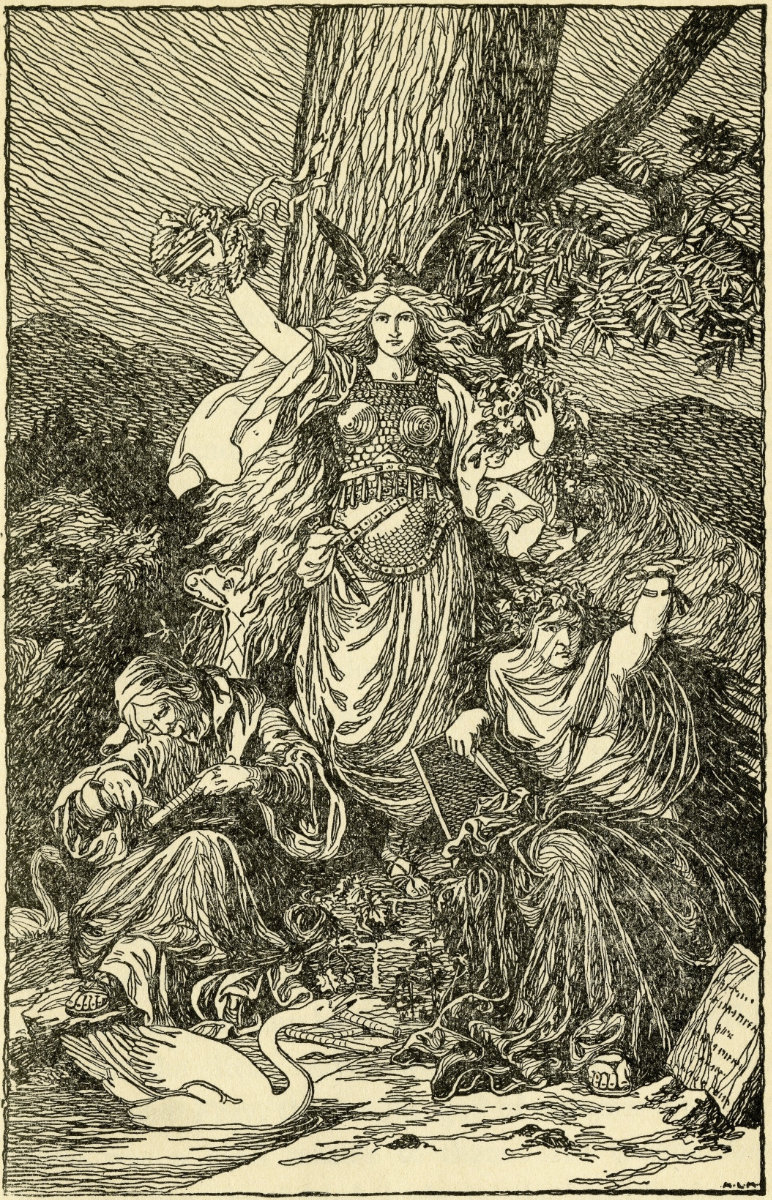
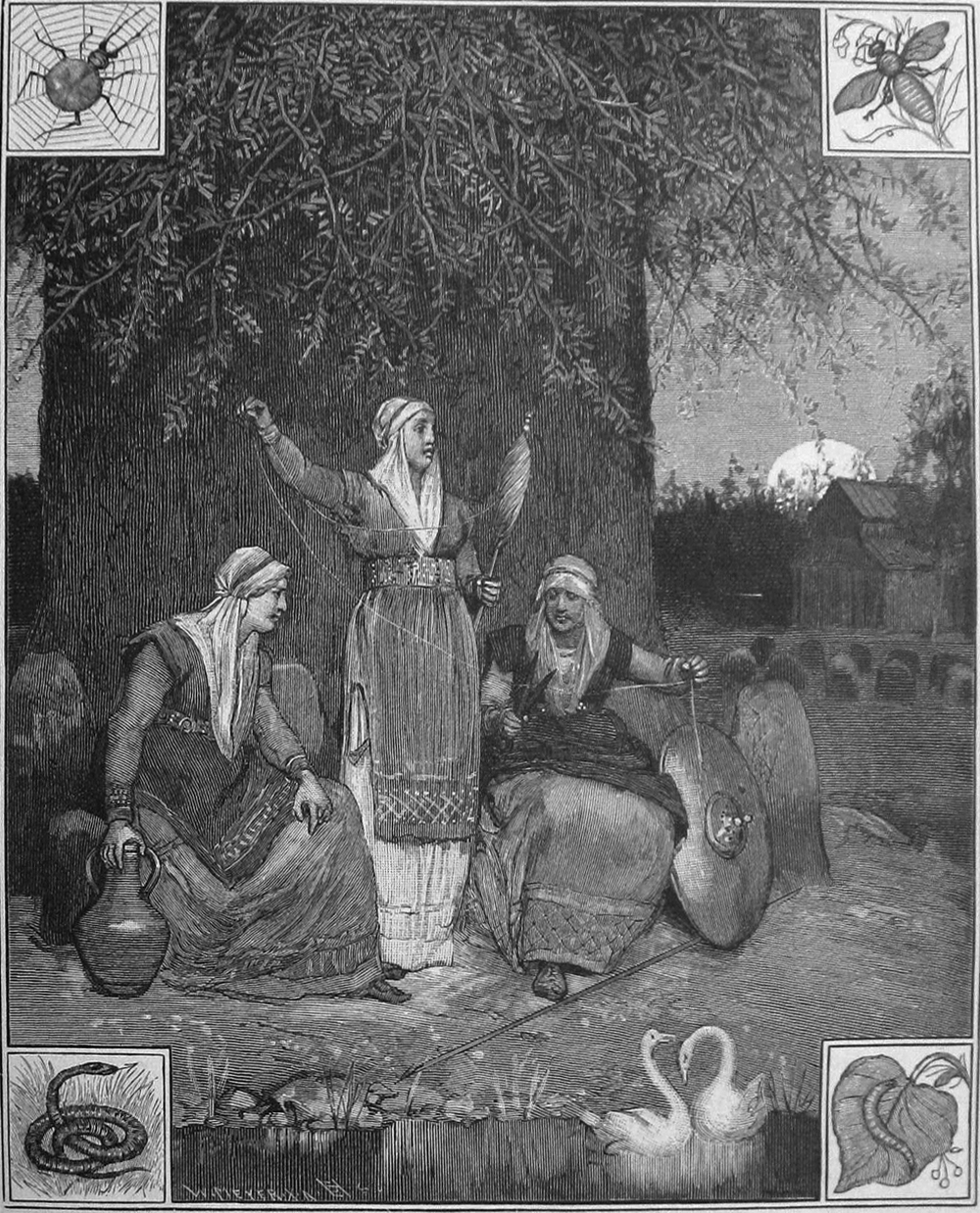
The Norns are deities in Norse mythology responsible for shaping the course of human destinies. In the Völuspá, the three primary Norns Urðr (Wyrd), Verðandi, and Skuld draw water from Urðarbrunnr to nourish Yggdrasill, the tree at the center of the cosmos, and prevent it from rot. These three Norns are described as powerful women whose arrival from Jötunheimr ended the golden age of the gods. The Norns are also described as maidens of Mögþrasir in Vafþrúðnismál. Beside the tending to Yggdrasill, Old Norse sources attest to Norns who visit a newborn child in order to determine the person’s future. These Norns could be malevolent or benevolent, bringing tragic or beneficial events respectively.
Alias The Norns
Real Names/Alt Names Urðr (Wyrd), Verðandi, and Skuld
Appearance List Literary: Prose Edda (c. 1220 CE) by Snorri Sturluson; Poetic Edda (c. 1270 CE); Northern Mythology (1851–1852) by Benjamin Thorpe [Internet Archive]; Asgard Stories: Tales from Norse Mythology (1901) by Mary H. Foster and Mabel H. Cummings [Internet Archive]; In the Days of Giants: A Book of Norse Tales by Abbie Farwell Brown (1902) [Internet Archive]; The Elder or Poetic Edda (1908) [Internet Archive]; The Heroes of Asgard: Tales from Scandinavian Mythology by Keary and Keary (1909) [Internet Archive]; Teutonic Myths and Legends (1912) by Donald A. Mackenzie [Internet Archive]; The Children of Odin (1920) by Padraic Colum [Internet Archive].
Description The Norns are deities in Norse mythology responsible for shaping the course of human destinies. In the Völuspá, the three primary Norns Urðr (Wyrd), Verðandi, and Skuld draw water from Urðarbrunnr to nourish Yggdrasill, the tree at the center of the cosmos, and prevent it from rot. These three Norns are described as powerful women whose arrival from Jötunheimr ended the golden age of the gods. The Norns are also described as maidens of Mögþrasir in Vafþrúðnismál. Beside the tending to Yggdrasill, Old Norse sources attest to Norns who visit a newborn child in order to determine the person’s future. These Norns could be malevolent or benevolent, bringing tragic or beneficial events respectively.
Asgard Stories: Tales from Norse Mythology (1901) by Mary H. Foster and Mabel H. Cummings via MyNDIR (My Norse Digital Image Repository) | Signed ‘H.L.M.’, possibly after original illustration by Carl Emil Doepler