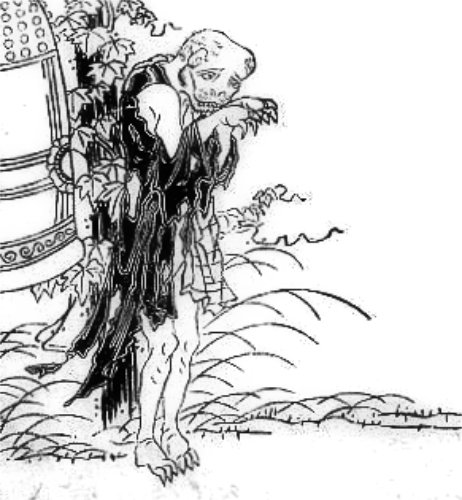
The noderabō is a Japanese yōkai from Toriyama Sekien’s Gazu Hyakki Yagyō and is thought to be a yōkai that appears at abandoned temples. The Gazu Hyakki Yagyō depicts a yōkai that looks like a monk wearing a tattered kasa standing next to a temple bell, but there is no explanation from Sekien about what this is about, so it is not known what characteristics this yōkai was intended to have. Beginning in the Shōwa period, literature about yōkai often explained that they are a yōkai that appear at deserted dilapidated temples or that they are resulting the grudges turned yōkai of a chief priest whose temple became dilapidated from lack of donations from villagers, which would then appear at evenings at the dilapidated temple and ring the bell alone at the deserted temple. As it is not clear what Sekien drew here, starting from the Heisei period, several hypotheses have been put forth, and one of them supposes that this is an original creation from Sekien that was made to satirize the Edo Period monks who broke their precepts.
Appearance List Gazu Hyakki Yagyō (画図百鬼夜行, “The Illustrated Night Parade of a Hundred Demons” or The Illustrated Demon Horde’s Night Parade, 1776) Vol. 2 “Yang”
Sample Read ○
Description The noderabō is a Japanese yōkai from Toriyama Sekien’s Gazu Hyakki Yagyō and is thought to be a yōkai that appears at abandoned temples. The Gazu Hyakki Yagyō depicts a yōkai that looks like a monk wearing a tattered kasa standing next to a temple bell, but there is no explanation from Sekien about what this is about, so it is not known what characteristics this yōkai was intended to have. Beginning in the Shōwa period, literature about yōkai often explained that they are a yōkai that appear at deserted dilapidated temples or that they are resulting the grudges turned yōkai of a chief priest whose temple became dilapidated from lack of donations from villagers, which would then appear at evenings at the dilapidated temple and ring the bell alone at the deserted temple. As it is not clear what Sekien drew here, starting from the Heisei period, several hypotheses have been put forth, and one of them supposes that this is an original creation from Sekien that was made to satirize the Edo Period monks who broke their precepts.