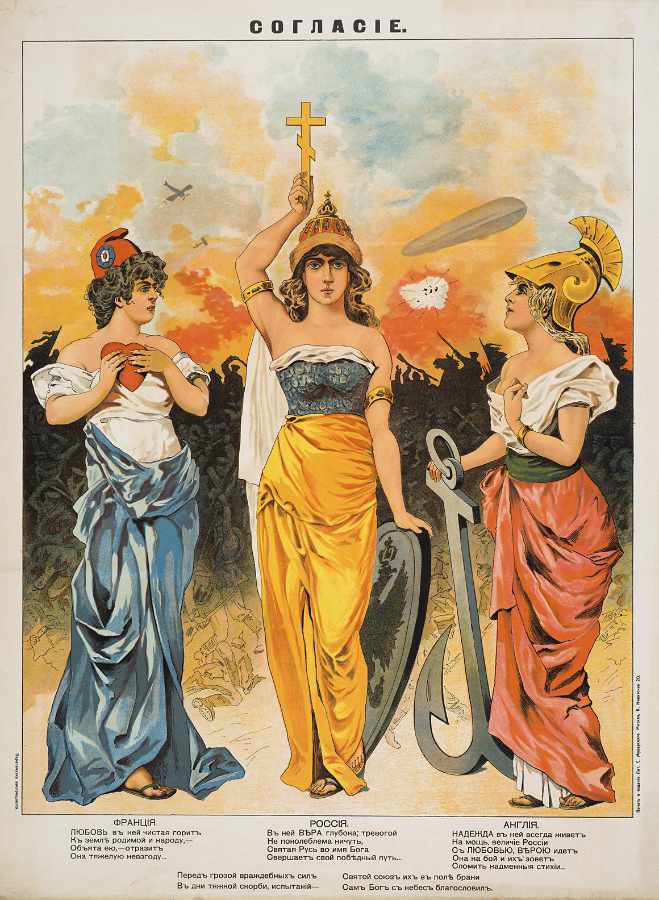
The personification of Russia is traditionally feminine and most commonly maternal since medieval times. Most common terms for national personification of Russia are Mother Russia and Homeland the Mother. In the Russian language, the concept of motherland is rendered by two terms: “родина” (tr. rodina), literally, “place of birth” and “отчизна” (tr. otchizna), literally “fatherland”. A 1914 Russian poster depicts the Triple Entente – Britannia (right) and Marianne (left) in the company of Mother Russia (center). During the October Revolution and the Russian Civil War, the image was in the propaganda of the supporters of the White movement, which interpreted the struggle against the Bolsheviks as a battle with “aliens” who were “oppressors of Mother Russia”. The Bolsheviks also used the image of “Motherland”, including during the fight against Nazi Germany during World War II.
Appearance List Felitsa (1782) by Gavrila Derzhavin — casts Russia in maternal imagery; The Lay of the Ruin of the Russian Land (13th century, first printed 1809, anonymous) — Rus’ as a devastated mother; Mother Russia poster (1914) — WWI propaganda posters with female allegories; The Motherland Calls (Rodina-Mat’ Zovyot!) poster (1941) by Irakli Toidze — iconic WWII poster; The Motherland Calls (Monument, 1967) by Yevgeny Vuchetich — colossal Volgograd statue; Russia as Mother in The Graphic (1877) — during Russo-Turkish War coverage; Mother Russia (1915) by Stephen Graham — Graham’s travel essays in Mother of Cities and other volumes use “Mother Russia” explicitly; The New York Times Magazine (1917) — American press used “Mother Russia” extensively during the Revolution; 1930s–40s political cartoons in Time and Life — often contrasted “Mother Russia” with Uncle Sam/John Bull during WWII.
Sample Read Mother Nature: A History of Mothers, Infants, and Natural Selection (1999) [Internet Archive]
Description The personification of Russia is traditionally feminine and most commonly maternal since medieval times. Most common terms for national personification of Russia are Mother Russia and Homeland the Mother. In the Russian language, the concept of motherland is rendered by two terms: “родина” (tr. rodina), literally, “place of birth” and “отчизна” (tr. otchizna), literally “fatherland”. A 1914 Russian poster depicts the Triple Entente – Britannia (right) and Marianne (left) in the company of Mother Russia (center). During the October Revolution and the Russian Civil War, the image was in the propaganda of the supporters of the White movement, which interpreted the struggle against the Bolsheviks as a battle with “aliens” who were “oppressors of Mother Russia”. The Bolsheviks also used the image of “Motherland”, including during the fight against Nazi Germany during World War II.
Poster for Concord (СОГЛАСIЕ) — depicting the Triple Entente during World War I: the French Marianne (left), Russia (center, holding aloft an Orthodox Cross), and Britannia (right, with anchor referring to Britain’s navy, but also a traditional symbol of hope) (1914, Russia)