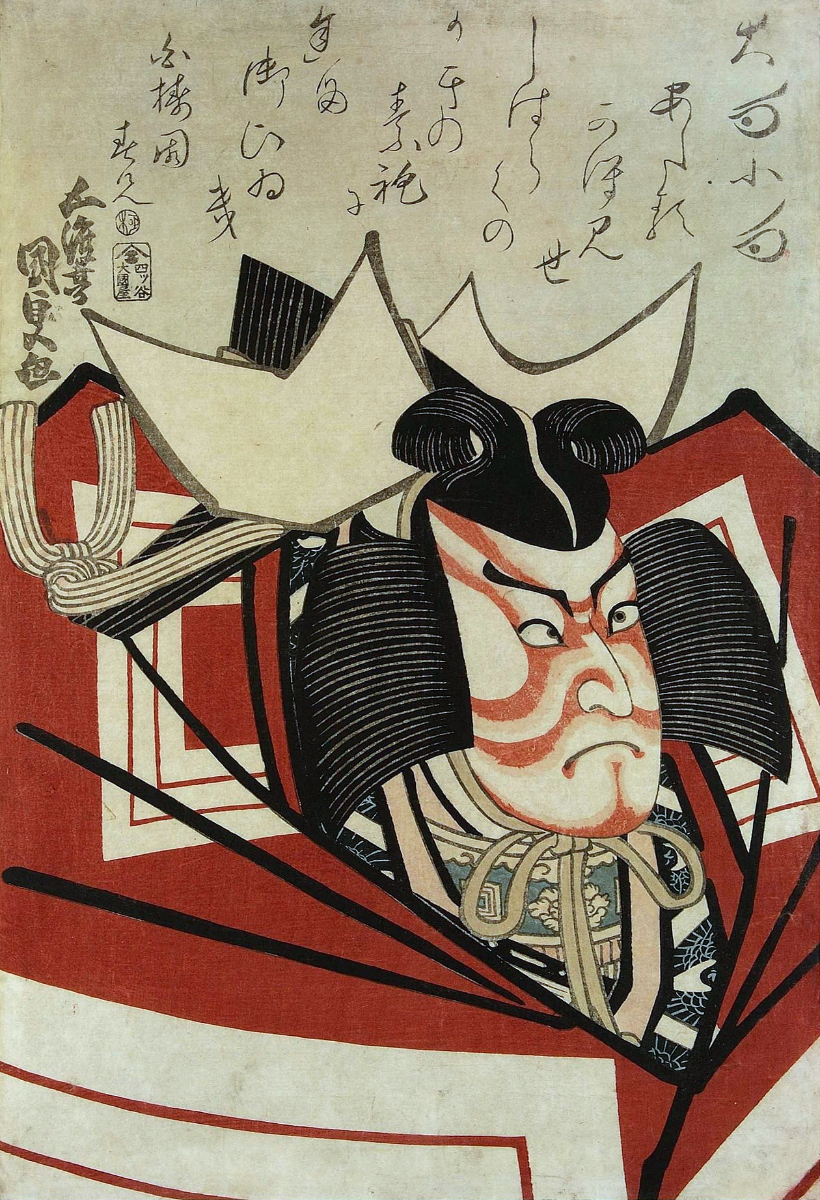
Shibaraku, one of the most widely recognized of all kabuki and one most associated with the form… centers around the figure of Kamakura Gongorō Kagemasa, who has become the stereotypical bombastic hero of the kabuki stage, with red-and-white striped makeup and strong, energetic movements; the historical Kamakura Kagemasa is famous for his bravery for having continued to fight after losing an eye in battle in the Gosannen War (1083–1087). The story is set in front of the Tsuruoka Hachimangu shrine, where an evil aristocrat (his exact identity has changed across the centuries, and in the modern version is the Heian era warlord Kiyohara no Takehira) has usurped power and taken as prisoners several imperial royals, including Prince Kamo Yoshitsuna and the Princess Katsura. One of Takehira’s associates, Lady Teruha, tries to persuade him not to execute the prisoners in front of the shrine, as that might enrage the gods. In response, the evil lord summons, in addition to the four red-faced warriors he already has on his side, an even more powerful and fearless warrior called Narita Gorō. He and the four other warriors perform a haradashi, a dance used to show both the public and the royal prisoners how powerful they are (in a similar fashion to the Haka). Kiyohara orders them to kill the royal family. Just as they are about to draw their swords to cut off their heads, a tremendous shout of “Shibaraku!” (Just a moment!) can be heard loudly from behind a curtain (agemaku). The hero appears and steps out onto the hanamichi (a raised platform extending through the audience seats to the stage) in a magnificent costume (featuring the sanshō, the three-square symbol of the Naritaya, Ichikawa Danjūrō’s acting family) and red striped makeup. Arriving at the stage, he sits on a stool (aibiki) and, in a special kind of monologue called tsurane, tells his story. He claims to possess superhuman strength, and demonstrates this by driving off some of Kiyohara’s henchmen only by “shouting” at them with his eyes. He then walks onto the stage. He accuses the villain of power usurpation and, only by words and without using his strength, he persuades him to return his stolen items, the imperial sword Tomokirimaru and the imperial seal. Lady Teruha, who turns out to be a relative of Gongorō, returns both items to the prince. Showing the illegitimacy of the evil lord’s actions, he manages, again only with words, to allow the royal family and their retainers to escape with Teruha. Gorō orders Takehira’s soldiers to attack him one final time. Surrounded, Gongorō draws his giant sword and cuts their heads off with a single blow, and then performs a stunning Mie pose in an intentionally exaggerated scene which shows his superhuman strength. Takehira is definitively defeated and, as the hero leaves the stage and walks through the hanamichi, he can be seen alongside his five warriors raising his hands in a sign of mutual respect for such an incredible warrior. Now, with the curtain fallen, Gongorō performs a roppō (“flying in six directions”, a technique which calls the actor to leave the hanamichi by exaggerating his movements), and leaves the stage, not as the Warrior, but as the actor.
Alias Kamakura Gongorō Kagemasa (鎌倉権五郎景政)
Real Names/Alt Names Kamakura Gongorō Kagemasa (鎌倉権五郎景政)
First Appearance Historical figure (b. 1069 – d. 1126)
First Publisher ○
Appearance List Gosannen Kassen (後三年合戦, “Later Three Years’ War Tales,” late 12th–early 13th century) — earliest chronicle of the war in which Kagemasa distinguished himself including arrow episode, Azuma Kagami (吾妻鏡, compiled late 13th century) — Kamakura shogunate’s official chronicle, Taiheiki (太平記, c. 14th century), Shibaraku (暫, kabuki play, 1697; codified by Ichikawa Danjūrō I) — introduces “Kamakura Gongorō Kagemasa” as archetypal hero in bold red-and-white kumadori makeup, Yakusha-e prints of Shibaraku (Edo period, esp. 18th–19th centuries) — Utagawa Kunisada, Utagawa Kuniyoshi, et al.
Sample Read A History of Japan to 1334 by G.B. Sansom [Internet Archive]
Description Shibaraku, one of the most widely recognized of all kabuki and one most associated with the form… centers around the figure of Kamakura Gongorō Kagemasa, who has become the stereotypical bombastic hero of the kabuki stage, with red-and-white striped makeup and strong, energetic movements; the historical Kamakura Kagemasa is famous for his bravery for having continued to fight after losing an eye in battle in the Gosannen War (1083–1087). The story is set in front of the Tsuruoka Hachimangu shrine, where an evil aristocrat (his exact identity has changed across the centuries, and in the modern version is the Heian era warlord Kiyohara no Takehira) has usurped power and taken as prisoners several imperial royals, including Prince Kamo Yoshitsuna and the Princess Katsura. One of Takehira’s associates, Lady Teruha, tries to persuade him not to execute the prisoners in front of the shrine, as that might enrage the gods. In response, the evil lord summons, in addition to the four red-faced warriors he already has on his side, an even more powerful and fearless warrior called Narita Gorō. He and the four other warriors perform a haradashi, a dance used to show both the public and the royal prisoners how powerful they are (in a similar fashion to the Haka). Kiyohara orders them to kill the royal family. Just as they are about to draw their swords to cut off their heads, a tremendous shout of “Shibaraku!” (Just a moment!) can be heard loudly from behind a curtain (agemaku). The hero appears and steps out onto the hanamichi (a raised platform extending through the audience seats to the stage) in a magnificent costume (featuring the sanshō, the three-square symbol of the Naritaya, Ichikawa Danjūrō’s acting family) and red striped makeup. Arriving at the stage, he sits on a stool (aibiki) and, in a special kind of monologue called tsurane, tells his story. He claims to possess superhuman strength, and demonstrates this by driving off some of Kiyohara’s henchmen only by “shouting” at them with his eyes. He then walks onto the stage. He accuses the villain of power usurpation and, only by words and without using his strength, he persuades him to return his stolen items, the imperial sword Tomokirimaru and the imperial seal. Lady Teruha, who turns out to be a relative of Gongorō, returns both items to the prince. Showing the illegitimacy of the evil lord’s actions, he manages, again only with words, to allow the royal family and their retainers to escape with Teruha. Gorō orders Takehira’s soldiers to attack him one final time. Surrounded, Gongorō draws his giant sword and cuts their heads off with a single blow, and then performs a stunning Mie pose in an intentionally exaggerated scene which shows his superhuman strength. Takehira is definitively defeated and, as the hero leaves the stage and walks through the hanamichi, he can be seen alongside his five warriors raising his hands in a sign of mutual respect for such an incredible warrior. Now, with the curtain fallen, Gongorō performs a roppō (“flying in six directions”, a technique which calls the actor to leave the hanamichi by exaggerating his movements), and leaves the stage, not as the Warrior, but as the actor.