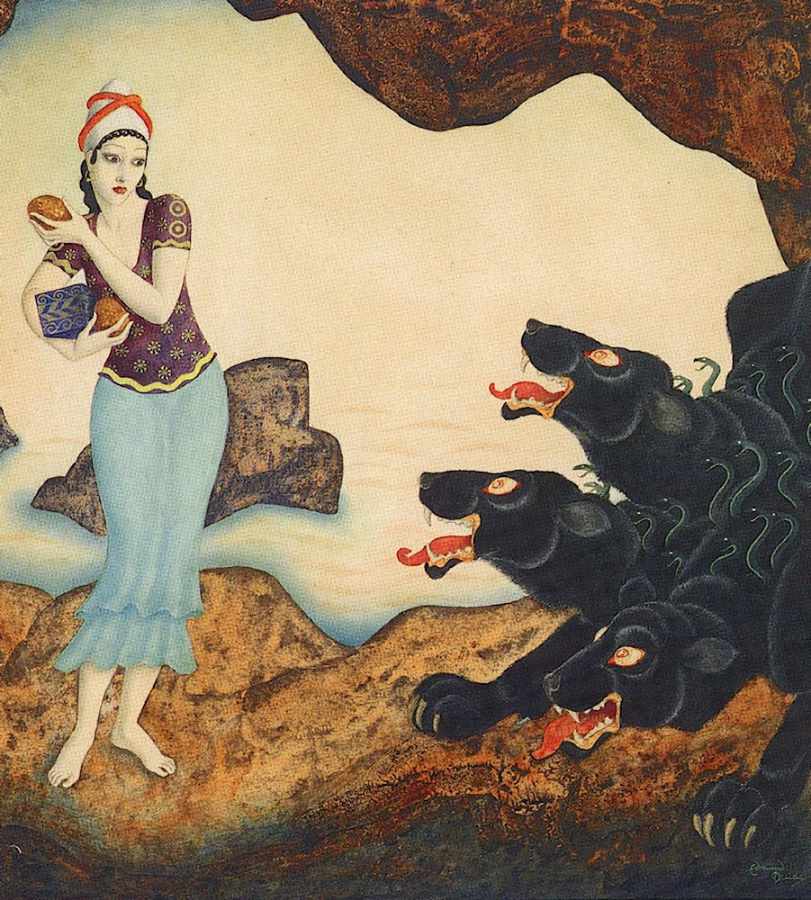
A hellhound is a mythological hound that embodies a guardian or a servant of hell, the devil, or the underworld. Hellhounds occur in mythologies around the world, with the best known examples being Cerberus from Greek mythology, Garmr from Norse mythology, the black dogs of English folklore, and the fairy hounds of Celtic mythology. Physical characteristics vary, but they are commonly black, anomalously overgrown, supernaturally strong, and often have red eyes or accompanied by flames. Oude Rode Ogen (“Old Red Eyes”) or the “Beast of Flanders” was a demon reported in Flanders, Belgium in the 18th century who would take the form of a large black hound with fiery red eyes. In Greek mythology, Cerberus, often referred to as the hound of Hades, is a multi-headed dog that guards the gates of the Underworld to prevent the dead from leaving. He was the offspring of the monsters Echidna and Typhon and was usually described as having three heads, a serpent for a tail, and snakes protruding from multiple parts of his body. In Norse mythology, Garmr or Garm (Old Norse for “rag”) is a wolf or dog associated with both the Goddess Hel and Ragnarök and described as a blood-stained guardian of Hel’s gate. The black dog of English folklore is a supernatural, spectral, or demonic entity. It is usually unnaturally large with glowing red or yellow eyes, is often connected with the Devil (as an English incarnation of the Hellhound), and is sometimes an omen of death. It is sometimes associated with electrical storms (such as Black Shuck’s appearance at Bungay, Suffolk), and also with crossroads, barrows (as a type of fairy hound), places of execution and ancient pathways. Black dogs are generally regarded as sinister or malevolent, and a few (such as the Barghest and Shuck) are said to be directly harmful. Some black dogs, however, such as the Gurt Dog in Somerset, are said to behave benevolently as guardian black dogs, guiding travellers at night onto the right path or protecting them from danger. The earliest written record of the “hellhound” is in the 11th and 12th Century Peterborough version of the Anglo-Saxon Chronicle, which speaks of a “wild hunt” through the forest between Peterborough and Stamford. The legend of a hellhound has persisted in Meriden, Connecticut since the 19th century. The dog is said to haunt the Hanging Hills: a series of rock ridges and gorges that serve as a popular recreation area and can also be known as a protector of the supernatural.
Appearance List Literature (small sample): Homer’s Iliad and Odyssey, Hesiod’s Theogony, Virgil’s Aeneid (1st century BC), Ovid (43 BC – AD 17/18), The Mad Pranks and Merry Jests of Robin Goodfellow (1841), Brewer’s Dictionary of Phrase and Fable (1870), Traditions, Superstitions and Folklore (1872), Goblin Tales of Lancashire by James Bowker (1887), Superstitions of the Highlands and Islands of Scotland Campbell by John Gregorson (1900), The Jataka Volume IV (1901), The Hound of the Baskervilles (1901), The Fairy Faith in Celtic Countries (1911), Doctor Faustus by Thomas Mann (1947).
Sample Read 5 Horrifying Hellhound Encounters in History [YT]
Description A hellhound is a mythological hound that embodies a guardian or a servant of hell, the devil, or the underworld. Hellhounds occur in mythologies around the world, with the best known examples being Cerberus from Greek mythology, Garmr from Norse mythology, the black dogs of English folklore, and the fairy hounds of Celtic mythology. Physical characteristics vary, but they are commonly black, anomalously overgrown, supernaturally strong, and often have red eyes or accompanied by flames. Oude Rode Ogen (“Old Red Eyes”) or the “Beast of Flanders” was a demon reported in Flanders, Belgium in the 18th century who would take the form of a large black hound with fiery red eyes. In Greek mythology, Cerberus, often referred to as the hound of Hades, is a multi-headed dog that guards the gates of the Underworld to prevent the dead from leaving. He was the offspring of the monsters Echidna and Typhon and was usually described as having three heads, a serpent for a tail, and snakes protruding from multiple parts of his body. In Norse mythology, Garmr or Garm (Old Norse for “rag”) is a wolf or dog associated with both the Goddess Hel and Ragnarök and described as a blood-stained guardian of Hel’s gate. The black dog of English folklore is a supernatural, spectral, or demonic entity. It is usually unnaturally large with glowing red or yellow eyes, is often connected with the Devil (as an English incarnation of the Hellhound), and is sometimes an omen of death. It is sometimes associated with electrical storms (such as Black Shuck’s appearance at Bungay, Suffolk), and also with crossroads, barrows (as a type of fairy hound), places of execution and ancient pathways. Black dogs are generally regarded as sinister or malevolent, and a few (such as the Barghest and Shuck) are said to be directly harmful. Some black dogs, however, such as the Gurt Dog in Somerset, are said to behave benevolently as guardian black dogs, guiding travellers at night onto the right path or protecting them from danger. The earliest written record of the “hellhound” is in the 11th and 12th Century Peterborough version of the Anglo-Saxon Chronicle, which speaks of a “wild hunt” through the forest between Peterborough and Stamford. The legend of a hellhound has persisted in Meriden, Connecticut since the 19th century. The dog is said to haunt the Hanging Hills: a series of rock ridges and gorges that serve as a popular recreation area and can also be known as a protector of the supernatural.