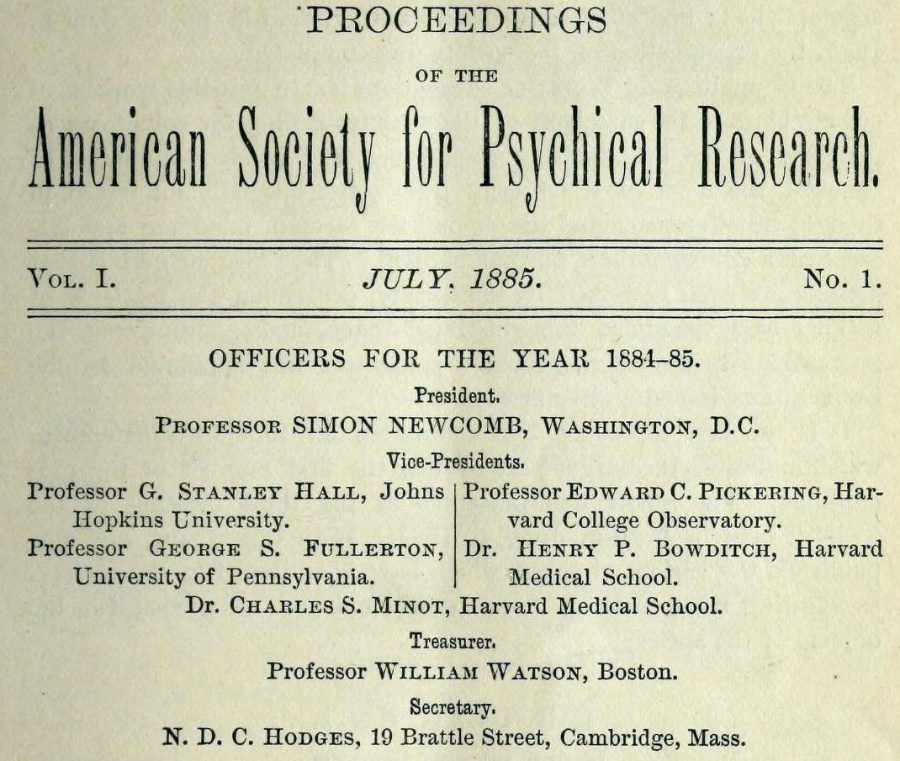
The American Society for Psychical Research (ASPR) is the oldest psychical research organization in the United States. For more than a century, it’s mission has been to explore extraordinary or as yet unexplained phenomena that have been called psychic or paranormal, and their implications for our understanding of consciousness, the universe and the nature of existence. How is mind related to matter, energy, space and time? In what unexplained ways do we interconnect with the universe and each other? The ASPR addresses these profoundly important and far-reaching questions with scientific research and related educational activities including lectures, conferences and other information services. The ASPR was founded in 1885 by a distinguished group of scholars and scientists who shared the courage and vision to explore the uncharted realms of human consciousness, among them renowned Harvard psychologist and Professor of Philosophy, William James. Many of the early participants were pioneers in psychology, psychiatry, physics and astronomy. Freud and Jung were honorary members. Luminaries from a wide range of disciplines have been drawn to the Society throughout its history, including Chester Carlson, the inventor of Xerox; quantum physicist, David Bohm; psychologist Gardner Murphy; and dream researcher Montague Ullman, M.D. From its inception, the Society has investigated the prevalence and meaning of extraordinary human experience from creativity, hypnosis, dreams and states of consciousness to telepathy, clairvoyance, precognition, psychokineses, healing, and the question of survival after death. These topics of study continue to be vitally relevant today. In the ASPR laboratory, Ganzfeld research has examined ESP functioning in an altered state of consciousness with a focus on discovering relevant variables that may affect success or failure. The ASPR continues to collect case reports of personal ESP experiences, including reports bearing on the survival hypothesis from a survey of near-death experiences, apparitions, awareness of death at a distance, and unusual experiences in the presence of the dying. Recent talks given at the Society have discussed precognition, and laboratory ESP with unknown targets. A talk discussed and contrasted hundreds of spontaneous 9/11 premonitions sent to the Society with observations of spontaneous ESP, including precognition, within the Dream Telepathy Group that Dr. Montague Ullman hosted for many years at the ASPR. A talk discussed how ESP can be detected in the stream of consciousness during the altered state of a Ganzfeld laboratory experiment with unknown targets, and that observing the ways ESP may manifest in both free-response experiments and in real life may reveal insights and surprises and suggest new questions.
Appearance List The Journal of the American Society for Psychical Research (1907 to Present), pub. monthly until volume 25, then quarterly from volume 26. Between 1923 and 1930, the magazine published 7 letters written by Arthur Conan Doyle. Podcasts: Astonishing Legends: Episode 107 EVP’s at the KPW, Astonishing Legends: Episode 226-227 Boundless Remote Viewing with Lori Williams.
Sample Read Astonishing Legends: Episode 107 EVP’s at the KPW [YT]
Description The American Society for Psychical Research (ASPR) is the oldest psychical research organization in the United States. For more than a century, it’s mission has been to explore extraordinary or as yet unexplained phenomena that have been called psychic or paranormal, and their implications for our understanding of consciousness, the universe and the nature of existence. How is mind related to matter, energy, space and time? In what unexplained ways do we interconnect with the universe and each other? The ASPR addresses these profoundly important and far-reaching questions with scientific research and related educational activities including lectures, conferences and other information services. The ASPR was founded in 1885 by a distinguished group of scholars and scientists who shared the courage and vision to explore the uncharted realms of human consciousness, among them renowned Harvard psychologist and Professor of Philosophy, William James. Many of the early participants were pioneers in psychology, psychiatry, physics and astronomy. Freud and Jung were honorary members. Luminaries from a wide range of disciplines have been drawn to the Society throughout its history, including Chester Carlson, the inventor of Xerox; quantum physicist, David Bohm; psychologist Gardner Murphy; and dream researcher Montague Ullman, M.D. From its inception, the Society has investigated the prevalence and meaning of extraordinary human experience from creativity, hypnosis, dreams and states of consciousness to telepathy, clairvoyance, precognition, psychokineses, healing, and the question of survival after death. These topics of study continue to be vitally relevant today. In the ASPR laboratory, Ganzfeld research has examined ESP functioning in an altered state of consciousness with a focus on discovering relevant variables that may affect success or failure. The ASPR continues to collect case reports of personal ESP experiences, including reports bearing on the survival hypothesis from a survey of near-death experiences, apparitions, awareness of death at a distance, and unusual experiences in the presence of the dying. Recent talks given at the Society have discussed precognition, and laboratory ESP with unknown targets. A talk discussed and contrasted hundreds of spontaneous 9/11 premonitions sent to the Society with observations of spontaneous ESP, including precognition, within the Dream Telepathy Group that Dr. Montague Ullman hosted for many years at the ASPR. A talk discussed how ESP can be detected in the stream of consciousness during the altered state of a Ganzfeld laboratory experiment with unknown targets, and that observing the ways ESP may manifest in both free-response experiments and in real life may reveal insights and surprises and suggest new questions.