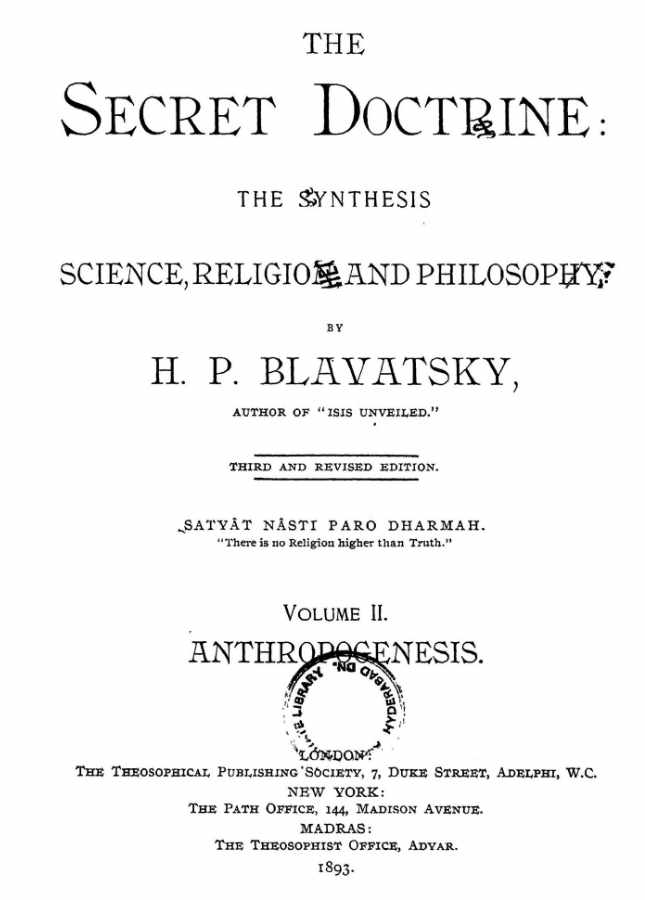
In the religion of theosophy and the philosophical school called anthroposophy, the Akashic records are a compendium of all universal events, thoughts, words, emotions and intent ever to have occurred in the past, present, or future in terms of all entities and life forms, not just human. They are believed by theosophists to be encoded in a non-physical plane of existence known as the mental plane. There are anecdotal accounts but no scientific evidence for the existence of the Akashic records. Akasha (ākāśa आकाश) is the Sanskrit word for “aether”, “sky”, or “atmosphere”. The Sanskrit term akasha was introduced to the language of theosophy through H. P. Blavatsky (1831–1891), who characterized it as a sort of life force; she also referred to “indestructible tablets of the astral light” recording both the past and future of human thought and action, but she did not use the term “akashic”. The notion of an akashic record was further disseminated by Alfred Percy Sinnett in his book Esoteric Buddhism (1883) when he cites Henry Steel Olcott’s A Buddhist Catechism (1881). Olcott wrote that “Buddha taught two things are eternal, viz, ‘Akasa’ and ‘Nirvana’: everything has come out of Akasa in obedience to a law of motion inherent in it, and, passes away. No thing ever comes out of nothing.” By C. W. Leadbeater’s Clairvoyance (1899) the association of the term with the idea was complete, and he identified the akashic records by name as something a clairvoyant could read. In his 1913 Man: Whence, How and Whither, Leadbeater claims to record the history of Atlantis and other civilizations as well as the future society of Earth in the 28th century. Alice A. Bailey wrote in her book Light of the Soul on The Yoga Sutras of Patanjali – Book 3 – Union achieved and its Results (1927): “The akashic record is like an immense photographic film, registering all the desires and earth experiences of our planet. Those who perceive it will see pictured thereon: The life experiences of every human being since time began, the reactions to experience of the entire animal kingdom, the aggregation of the thought-forms of a karmic nature (based on desire) of every human unit throughout time. Only a trained occultist can distinguish between actual experience and those astral pictures created by imagination and keen desire.”
Appearance List Helena Blavatsky’s Isis Unveiled (1877) and The Secret Doctrine (1888), A Buddhist Catechism (1881), Esoteric Buddhism (1884), Clairvoyance (1899), The Submerged Continents of Atlantis and Lemuria, Their History and Civilization, Being Chapters from The Âkâshic Records (1911), Man: How, Whence, and Whither? (1913), Light of the Soul on The Yoga Sutras of Patanjali – Book 3 – Union achieved and its Results (1927), The Fifth Gospel – Investigation of the Akasha Chronicle – Five lectures given in Christiania, 1913 (1950), Cosmic Memory (1959)
Sample Read Isis Unveiled A Master Key To The Mysteries Of Ancient And Modern Science And Theology Vol II Theology [Internet Archive]
Description In the religion of theosophy and the philosophical school called anthroposophy, the Akashic records are a compendium of all universal events, thoughts, words, emotions and intent ever to have occurred in the past, present, or future in terms of all entities and life forms, not just human. They are believed by theosophists to be encoded in a non-physical plane of existence known as the mental plane. There are anecdotal accounts but no scientific evidence for the existence of the Akashic records. Akasha (ākāśa आकाश) is the Sanskrit word for “aether”, “sky”, or “atmosphere”. The Sanskrit term akasha was introduced to the language of theosophy through H. P. Blavatsky (1831–1891), who characterized it as a sort of life force; she also referred to “indestructible tablets of the astral light” recording both the past and future of human thought and action, but she did not use the term “akashic”. The notion of an akashic record was further disseminated by Alfred Percy Sinnett in his book Esoteric Buddhism (1883) when he cites Henry Steel Olcott’s A Buddhist Catechism (1881). Olcott wrote that “Buddha taught two things are eternal, viz, ‘Akasa’ and ‘Nirvana’: everything has come out of Akasa in obedience to a law of motion inherent in it, and, passes away. No thing ever comes out of nothing.” By C. W. Leadbeater’s Clairvoyance (1899) the association of the term with the idea was complete, and he identified the akashic records by name as something a clairvoyant could read. In his 1913 Man: Whence, How and Whither, Leadbeater claims to record the history of Atlantis and other civilizations as well as the future society of Earth in the 28th century. Alice A. Bailey wrote in her book Light of the Soul on The Yoga Sutras of Patanjali – Book 3 – Union achieved and its Results (1927): “The akashic record is like an immense photographic film, registering all the desires and earth experiences of our planet. Those who perceive it will see pictured thereon: The life experiences of every human being since time began, the reactions to experience of the entire animal kingdom, the aggregation of the thought-forms of a karmic nature (based on desire) of every human unit throughout time. Only a trained occultist can distinguish between actual experience and those astral pictures created by imagination and keen desire.”